Results by title
372 books match the query 'Language' and 5 start with b
Banking on Words
The Failure of Language in the Age of Derivative FinanceArjun Appadurai
University of Chicago Press, 2015
Appadurai moves in four steps through his analysis. In the first, he highlights the importance of derivatives in contemporary finance, isolating them as the core technical innovation that markets have produced. In the second, he shows that derivatives are essentially written contracts about the future prices of assets—they are, crucially, a promise. Drawing on Mauss’s The Gift and Austin’s theories on linguistic performatives, Appadurai, in his third step, shows how the derivative exploits the linguistic power of the promise through the special form that money takes in finance as the most abstract form of commodity value. Finally, he pinpoints one crucial feature of derivatives (as seen in the housing market especially): that they can make promises that other promises will be broken. He then details how this feature spread contagiously through the market, snowballing into the systemic liquidity crisis that we are all too familiar with now.
With his characteristic clarity, Appadurai explains one of the most complicated—and yet absolutely central—aspects of our modern economy. He makes the critical link we have long needed to make: between the numerical force of money and the linguistic force of what we say we will do with it.

Battle in the Mind Fields
John A. Goldsmith and Bernard Laks
University of Chicago Press, 2019
Taking note of this phenomenon, John Goldsmith and Bernard Laks embark on a uniquely interdisciplinary history of the genesis of linguistics, from nineteenth-century currents of thought in the mind sciences through to the origins of structuralism and the ruptures, both political and intellectual, in the years leading up to World War II. Seeking to explain where contemporary ideas in linguistics come from and how they have been justified, Battle in the Mind Fields investigates the porous interplay of concepts between psychology, philosophy, mathematical logic, and linguistics. Goldsmith and Laks trace theories of thought, self-consciousness, and language from the machine age obsession with mind and matter to the development of analytic philosophy, behaviorism, Gestalt psychology, positivism, and structural linguistics, emphasizing throughout the synthesis and continuity that has brought about progress in our understanding of the human mind. Arguing that it is impossible to understand the history of any of these fields in isolation, Goldsmith and Laks suggest that the ruptures between them arose chiefly from social and institutional circumstances rather than a fundamental disparity of ideas.
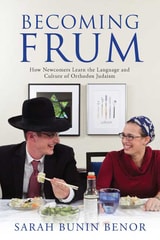
Becoming Frum
How Newcomers Learn the Language and Culture of Orthodox JudaismSarah Bunin Benor
Rutgers University Press, 2012
Winner, 2013 Sami Rohr Choice Award for Jewish Literature
When non-Orthodox Jews become frum (religious), they encounter much more than dietary laws and Sabbath prohibitions. They find themselves in the midst of a whole new culture, involving matchmakers, homemade gefilte fish, and Yiddish-influenced grammar. Becoming Frum explains how these newcomers learn Orthodox language and culture through their interactions with community veterans and other newcomers. Some take on as much as they can as quickly as they can, going beyond the norms of those raised in the community. Others maintain aspects of their pre-Orthodox selves, yielding unique combinations, like Matisyahu’s reggae music or Hebrew words and sing-song intonation used with American slang, as in “mamish (really) keepin’ it real.”
Sarah Bunin Benor brings insight into the phenomenon of adopting a new identity based on ethnographic and sociolinguistic research among men and women in an American Orthodox community. Her analysis is applicable to other situations of adult language socialization, such as students learning medical jargon or Canadians moving to Australia. Becoming Frum offers a scholarly and accessible look at the linguistic and cultural process of “becoming.”
Becoming a Bilingual Family
Help Your Kids Learn Spanish (and Learn Spanish Yourself in the Process)By Stephen Marks and Jeffrey Marks
University of Texas Press, 2013
Would you like your children to grow up bilingual, even if you aren’t yet? Then speak to your kids in Spanish as you learn the language along with them. Becoming a Bilingual Family gives English-speaking parents the tools to start speaking Spanish with their kids in their earliest years, when children are most receptive to learning languages. It teaches the vocabulary and idioms for speaking to children in Spanish and offers practical, proven ways to create a language-learning environment at home.
The first part of the book introduces parents to many resources—books, audio books, music, television, computer programs, childcare workers, school, and friends—that can help you establish a home environment conducive to the acquisition of Spanish. The second part is a Spanish phrasebook that takes you through all the typical activities that parents and children share, from getting up in the morning to going to bed at night. Few, if any, other Spanish study aids provide this much vocabulary and guidance for talking to small children about common daily activities. The authors also include a quick course in Spanish pronunciation and enough grammar to get a parent started. Spanish-language resources, kids’ names in Spanish, and an easy-to-use index and glossary complete the book.
Take the Markses’ advice and start talking to your kids in Spanish, even if it’s not perfect. You’ll learn the language together and share the excitement of discovering the peoples and cultures that make up the Spanish-speaking world.
Beyond Grammar
An Experience-Based Theory of LanguageRens Bod
CSLI, 1998