Results by title
71 books match the query 'Language and culture' and 2 start with b
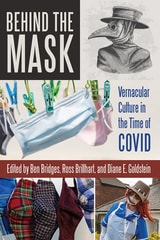
Behind the Mask
Vernacular Culture in the Time of COVIDBen Bridges
Utah State University Press, 2023
Vernacular responses have been crucial for communities seeking creative ways to cope with the coronavirus pandemic. With most people locked down and separated from the normal ebb and flow of life for an extended period of time, COVID-19 inspired community and creativity, adaptation and flexibility, traditional knowledge, resistance, and dynamism. Removing people from assumed norms and daily lives, the pandemic provided a moment of insight into the nature of vernacular culture as it was used, abused, celebrated, critiqued, and discarded. In Behind the Mask, contributors from the USA, the UK, and Scandinavia emphasize the choices that individual people and communities made during the COVID pandemic, prioritizing the everyday lives of people enduring this health crisis.
Despite vernacular’s potential nod to dominant or external culture, it is the strong connection to the local that grounds the vernacular within the experiential context that it occupies. Exploring the nature and shape of vernacular responses to the ongoing public health crisis, Behind the Mask documents processes that are otherwise likely to be forgotten. Including different ethnographic presents, contributors capture moments during the pandemic rather than upon reflection, making the work important to students and scholars of folklore and ethnology, as well as general readers interested in the COVID pandemic.
Despite vernacular’s potential nod to dominant or external culture, it is the strong connection to the local that grounds the vernacular within the experiential context that it occupies. Exploring the nature and shape of vernacular responses to the ongoing public health crisis, Behind the Mask documents processes that are otherwise likely to be forgotten. Including different ethnographic presents, contributors capture moments during the pandemic rather than upon reflection, making the work important to students and scholars of folklore and ethnology, as well as general readers interested in the COVID pandemic.
[more]
Bodies of Knowledge
Embodied Rhetorics in Theory and PracticeA. Abby Knoblauch
Utah State University Press, 2021
Bodies of Knowledge challenges homogenizing (mis)understandings of knowledge construction and provides a complex discussion of what happens when we do not attend to embodied rhetorical theories and practices. Because language is always a reflection of culture, to attempt to erase language and knowledge practices that reflect minoritized and historically excluded cultural experiences obscures the legitimacy of such experiences both within and outside the academy.
The pieces in Bodies of Knowledge draw explicit attention to the impact of the body on text, the impact of the body in text, the impact of the body as text, and the impact of the body upon textual production. The contributors investigate embodied rhetorics through the lenses of race and ethnicity, gender and sexuality, disability and pain, technologies and ecologies, clothing and performance, and scent, silence, and touch. In doing so, they challenge the (false) notion that academic knowledge—that is, “real” knowledge—is disembodied and therefore presumed white, middle class, cis-het, able-bodied, and male. This collection lays bare how myriad bodies invent, construct, deliver, and experience the processes of knowledge building.
Experts in the field of writing studies provide the necessary theoretical frameworks to better understand productive (and unproductive) uses of embodied rhetorics within the academy and in the larger social realm. To help meet the theoretical and pedagogical needs of the discipline, Bodies of Knowledge addresses embodied rhetorics and embodied writing more broadly though a rich, varied, and intersectional approach. These authors address larger questions around embodiment while considering the various impacts of the body on theories and practices of rhetoric and composition.
Contributors: Scot Barnett, Margaret Booker, Katherine Bridgman, Sara DiCaglio, Kristie S. Fleckenstein, Vyshali Manivannan, Temptaous Mckoy, Julie Myatt, Julie Nelson, Ruth Osorio, Kate Pantelides, Caleb Pendygraft, Nadya Pittendrigh, Kellie Sharp-Hoskins, Anthony Stagliano, Megan Strom
[more]