Results by title
172 books match the query 'Legislative Branch' and 5 start with b
Beyond Ideology
Politics, Principles, and Partisanship in the U. S. SenateFrances E. Lee
University of Chicago Press, 2009
The congressional agenda, Frances Lee contends, includes many issues about which liberals and conservatives generally agree. Even over these matters, though, Democratic and Republican senators tend to fight with each other. What explains this discord? Beyond Ideology argues that many partisan battles are rooted in competition for power rather than disagreement over the rightful role of government.
The first book to systematically distinguish Senate disputes centering on ideological questions from the large proportion of them that do not, this volume foregrounds the role of power struggle in partisan conflict. Presidential leadership, for example, inherently polarizes legislators who can influence public opinion of the president and his party by how they handle his agenda. Senators also exploit good government measures and floor debate to embarrass opponents and burnish their own party’s image—even when the issues involved are broadly supported or low-stakes. Moreover, Lee contends, the congressional agenda itself amplifies conflict by increasingly focusing on issues that reliably differentiate the parties. With the new president pledging to stem the tide of partisan polarization, Beyond Ideology provides a timely taxonomy of exactly what stands in his way.
Big Money Unleashed
The Campaign to Deregulate Election SpendingAnn Southworth
University of Chicago Press, 2023
The story of how the First Amendment became an obstacle to campaign finance regulation—a history that began much earlier than most imagine.
Americans across party lines believe that public policy is rigged in favor of those who wield big money in elections. Yet, legislators are restricted in addressing these concerns by a series of Supreme Court decisions finding that campaign finance regulations violate the First Amendment.
Big Money Unleashed argues that our current impasse is the result of a long-term process involving many players. Naturally, the justices played critical roles—but so did the attorneys who hatched the theories necessary to support the legal doctrine, the legal advocacy groups that advanced those arguments, the wealthy patrons who financed these efforts, and the networks through which they coordinated strategy and held the Court accountable.
Drawing from interviews, public records, and archival materials, Big Money Unleashed chronicles how these players borrowed a litigation strategy pioneered by the NAACP to dismantle racial segregation and used it to advance a very different type of cause.
Bridging the Information Gap
Legislative Member Organizations as Social Networks in the United States and the European UnionNils Ringe and Jennifer Nicoll Victor with Christopher J. Carman
University of Michigan Press, 2013
Legislative member organizations (LMOs)—such as caucuses in the U.S. Congress and intergroups in the European Parliament—exist in lawmaking bodies around the world. Unlike parties and committees, LMOs play no obvious, predefined role in the legislative process. They provide legislators with opportunities to establish social networks with colleagues who share common interests. In turn, such networks offer valuable opportunities for the efficient exchange of policy-relevant—and sometimes otherwise unattainable—information between legislative offices. Building on classic insights from the study of social networks, the authors provide a comparative overview of LMOs across advanced, liberal democracies. In two nuanced case studies of LMOs in the European Parliament and the U.S. Congress, the authors rely on a mix of social network analysis, sophisticated statistical methods, and careful qualitative analysis of a large number of in-depth interviews.
Broken Record
The Origins and Evolution of Recorded Voting in the U.S. CongressMichael S. Lynch & Anthony J. Madonna
University of Michigan Press, 2025
Consistent with the Founders’ skepticism of the impact of recorded voting in Congress, Broken Record shows that the contemporary roll call voting record includes far more meaningless position-taking and procedural roll call votes than it did during earlier congresses. The book argues that the removal of practical barriers to roll calls, internal changes to legislative procedures, and increased electoral competitiveness have led to more roll call votes on proposals sponsored by more extreme members. In addition to policy making being more difficult, increased roll call voting has played a substantial role in artificially increasing observed levels of polarization. This book argues that solving polarization requires a more nuanced set of solutions than simply replacing legislators; it will require increased public education about how Congress operates and specific procedural reforms.
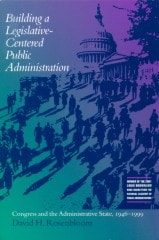
Building a Legislative-Centered Public Administration
Congress and the Administrative State, 1946-1999David Rosenbloom
University of Alabama Press, 2002
2001 Louis Brownlow Award from the National Academy of Public Administration
Reimagining public administration through the lens of constitutional governance and legislative intent.
Before 1946 the congressional role in public administration had been limited to authorization, funding, and review of federal administrative operations, which had grown rapidly as a result of the New Deal and the Second World War. But in passing the Administrative Procedure Act and the Legislative Reorganization Act that pivotal year, Congress self-consciously created for itself a comprehensive role in public administration. Reluctant to delegate legislative authority to federal agencies, Congress decided to treat the agencies as extensions of itself and established a framework for comprehensive regulation of the agencies' procedures. Additionally, Congress reorganized itself so it could provide continuous supervision of federal agencies.
Rosenbloom shows how these 1946 changes in the congressional role in public administration laid the groundwork for future major legislative acts, including the Freedom of Information Act (1966), Privacy Act (1974), Government in the Sunshine Act (1976), Paperwork Reduction Acts (1980, 1995), Chief Financial Officers Act (1990), and Small Business Regulatory Fairness Enforcement Act (1996). Each of these acts, and many others, has contributed to the legislative-centered public administration that Congress has formed over the past 50 years.
This first book-length study of the subject provides a comprehensive explanation of the institutional interests, values, and logic behind the contemporary role of Congress in federal administration and attempts to move the public administration field beyond condemning legislative "micromanagement" to understanding why Congress values it.