Results by title
154 books match the query 'Lesbian Studies' and 6 start with b
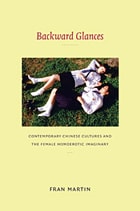
Backward Glances
Contemporary Chinese Cultures and the Female Homoerotic ImaginaryFran Martin
Duke University Press, 2010
As Martin explains, memorial schoolgirl love stories are popular throughout contemporary Chinese cultures. The same-sex attracted young woman appears in both openly homophobic and proudly queer-affirmative narratives, as well as in stories whose ideological valence is less immediately clear. Martin demonstrates that the stories, television programs, and films she analyzes are not idiosyncratic depictions of marginal figures, but manifestations of a broader, mainstream cultural preoccupation. Her investigation of representations of same-sex love between women sheds new light on contemporary Chinese understandings of sex, love, gender, marriage, and the cultural ordering of human life.

Barbie's Queer Accessories
Erica Rand
Duke University Press, 1995
Rand begins by focusing on the production and marketing of Barbie, starting in 1959, including Mattel’s numerous tie-ins and spin-offs. These variations, which include the much-promoted multiethnic Barbies and the controversial Earring Magic Ken, helped make the doll one of the most profitable toys on the market. In lively chapters based on extensive interviews, the author discusses adult testimony from both Barbie "survivors" and enthusiasts and explores how memories of the doll fit into women’s lives. Finally, Rand looks at cultural reappropriations of Barbie by artists, collectors, and especially lesbians and gay men, and considers resistance to Barbie as a form of social and political activism.
Illustrated with photographs of various interpretations and alterations of Barbie, this book encompasses both Barbie glorification and abjection as it testifies to the irrefutably compelling qualities of this bestselling toy. Anyone who has played with Barbie—or, more importantly, thought or worried about playing with Barbie—will find this book fascinating.
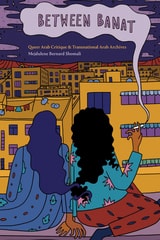
Between Banat
Queer Arab Critique and Transnational Arab ArchivesMejdulene Bernard Shomali
Duke University Press, 2023
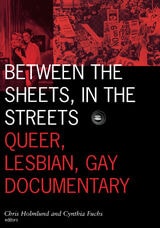
Between the Sheets, in the Streets
Queer, Lesbian, Gay DocumentaryChris Holmlund
University of Minnesota Press, 1997
The first book to focus on the connections between sexuality, activism, and documentary film.
From film festivals to university campuses, from private homes to first-run theaters, people everywhere are viewing and discussing gay, lesbian, queer, bisexual, and transgender films and videos. Between the Sheets, In the Streets considers these videos and films, testifying to the unavoidable connections between sexuality (the sheets) and activism (the streets) for all who identify as gay, lesbian, or queer in the 1990s.
This first collection of essays to focus exclusively on queer, lesbian, and gay documentary argues that documentary films and videos speak with a sense of political and social urgency, acting as testaments to the importance of reclaiming history and asserting the importance of these points of view. Among the topics discussed are representations of young queers on such shows as MTV’s The Real World; pre-Stonewall films; portrayals of lesbians and aging; video activism in Oregon and the South; and the works of Derek Jarman, Su Friedrich, Cheryl Dunye, and Sadie Benning. A range of films and videos is examined, including Strangers in Good Company, Paris Is Burning, Juggling Gender, Silverlake Life, and Without You I’m Nothing.Tracing an exhilarating range of perspectives and subject positions, Between the Sheets, In the Streets is an essential guide to current developments in queer, lesbian, and gay documentary. Contributors: Chris Cagle, Brown U; Linda Dittmar, U of Massachusetts, Boston; Lynda Goldstein, Pennsylvania State U, Wilkes-Barre Campus; Ronald Gregg, Drake U; Janet Jakobsen, U of Arizona; Lynda McAfee, New York Public Library; Kathleen McHugh, U of California, Riverside; Beverly Seckinger, U of Arizona; Marc Siegel, UCLA; Chris Straayer, Tisch School of the Arts; Erika Suderburg, U of California, Riverside; Thomas Waugh, Concordia U, Montreal; Justin Wyatt, U of North Texas.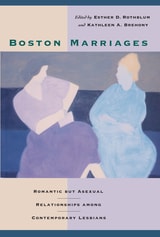
Boston Marriages
Romantic but Asexual Relationships among Contemporary LesbiansEdited by Esther D. Rothblum and Kathleen A. Brehony
University of Massachusetts Press, 1993
For decades the term “Boston marriage” was used to describe single women who lived together and shared their lives. The presumption then was that these partnerships were nonsexual. In recent years, however, the opposite assumption has prevailed, causing some women involved in such relationships to hide the asexual nature of their attachments in the lesbian community.
Convinced that Boston marriages are both legitimate and important, Esther D. Rothblum and Kathleen A. Brehony argue that in a society that defines intimacy by the occurrence of sexual activity, we have no word for—and thus no understanding of—the intensely romantic but asexual relationships that some lesbians form. By bringing these relationships “out of the closet” and discussing them openly, the editors and other contributors to this volume challenge our views about lesbianism and address larger questions concerning the construction of sexuality and sexual identity. How, for example, do we define a lesbian relationship? What constitutes a romantic involvement? If a couple does not engage in sex, are they still considered lovers?
This book includes ten personal accounts by women involved in Boston marriages as well as theoretical essays by Lillian Faderman, Marnie Hall, JoAnn Loulan, Suzanna Rose, Debra Zand, Marie Cini, and Laura Brown.
Bulldaggers, Pansies, and Chocolate Babies
Performance, Race, and Sexuality in the Harlem RenaissanceJames F. Wilson
University of Michigan Press, 2011
—David Krasner, author of A Beautiful Pageant: African American Theatre, Drama, and Performance in the Harlem Renaissance, 1910-1927