Results by title
151 books match the query 'Liberalism' and 5 start with b
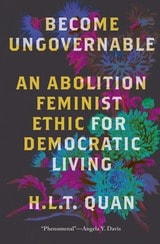
Become Ungovernable
An Abolition Feminist Ethic for Democratic LivingH.L.T. Quan
Pluto Press, 2004
'Phenomenal ... Offers us possibilities for rescuing the concept of democracy from its fatal entanglement with racial, heteropatriarchal capitalism' -- Angela Y. Davis
'Embraces the unruliness of collective struggle, and recognizes freedom not as a destination but practice—an abolitionist, feminist, anticapitalist, antiracist, radically inclusive practice' -- Robin D.G. Kelley, author of Freedom Dreams
'A compelling and inspiring book that belongs in our movements and our classrooms' -- Chandra Talpade Mohanty, author of Feminism Without Borders
'An elegantly written masterpiece' -- Barbara Ransby, author of Making All Black Lives Matter
Become Ungovernable is a provocative new work of political thought setting out to reclaim “freedom”, “justice”, and “democracy”, revolutionary ideas that are all too often warped in the interests of capital and the state. Revealing the mirage of mainstream democratic thought and the false promises of liberal political ideologies, H.L.T. Quan offers an alternative approach: an abolition feminism drawing on a kaleidoscope of refusal praxes, and on a deep engagement with the Black Radical Tradition and queer analytics.
With each chapter anchored by episodes from the long history of resistance and rebellions against tyranny, Quan calls for us to take up a feminist ethic of living rooted in the principles of radical inclusion, mutuality and friendship as part of the larger toolkit for confronting fascism, white supremacy, and the neoliberal labor regime.
H.L.T. Quan is a political theorist, award-winning filmmaker and Associate Professor of Justice and Social Inquiry in the School of Social Transformation at Arizona State University. Quan is the author of Growth Against Democracy and editor of Cedric J. Robinson.
Between Gaia and Ground
Four Axioms of Existence and the Ancestral Catastrophe of Late LiberalismElizabeth A. Povinelli
Duke University Press, 2021
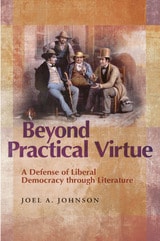
Beyond Practical Virtue
A Defense of Liberal Democracy through LiteratureJoel A. Johnson
University of Missouri Press, 2007
Why hasn’t democracy been embraced worldwide as the best form of government?
Aesthetic critics of democracy such as Carlyle and Nietzsche have argued that modern democracy, by removing the hierarchical institutions that once elevated society’s character, turns citizens into bland, mediocre souls. Joel A. Johnson now offers a rebuttal to these critics, drawing surprising inspiration from American literary classics.
Addressing the question from a new perspective, Johnson takes a fresh look at the worth of liberal democracy in these uncertain times and tackles head-on the thorny question of cultural development. Examining the novels of James Fenimore Cooper, Mark Twain, and William Dean Howells, he shows that through their fiction we can gain a better appreciation of the rich detail of everyday life, making the debate relevant to contemporary discussions of liberal democracy.
Johnson focuses on an issue that liberals have inadequately addressed: whether people tend to develop fully as individuals under liberal democracy when such a regime does little formally to encourage their development. He argues that, though the liberal fear of state-guided culture is well founded, it should not prevent us from evaluating liberalism’s effect on individual flourishing. By extending the debate over the worthiness of liberal democracy to include democracy’s effect on individual development, he contends that the democratic experience is much fuller than the aristocratic one and thus expands the faculties of its citizens.
Critics of American democracy such as John Rawls have sought to transform it into a social or egalitarian democracy in the European style. Johnson shows that neither the debate between Rawls and his communitarian critics nor the ongoing discussion of the globalization of American values adequately addresses the fundamental critique of democratic culture advanced by the aesthetic critics. Johnson’s cogent analysis reaches out to those readers who are ready for a more comprehensive evaluation of liberal democracy, offering new insight into the relationship between the state and the individual while blazing new trails in the intersection of politics and literature.
Bleak Liberalism
Amanda Anderson
University of Chicago Press, 2016
Amanda Anderson examines canonical works of high realism, political novels from England and the United States, and modernist works to argue that liberalism has engaged sober and even stark views of historical development, political dynamics, and human and social psychology. From Charles Dickens’s Bleak House and Hard Times to E. M. Forster’s Howards End to Doris Lessing’s The Golden Notebook, this literature demonstrates that liberalism has inventive ways of balancing sociological critique and moral aspiration. A deft blend of intellectual history and literary analysis, Bleak Liberalism reveals a richer understanding of one of the most important political ideologies of the modern era.
Bridging Liberalism and Multiculturalism in American Education
Rob Reich
University of Chicago Press, 2002
Linking political theory with educational history and policy, Rob Reich offers provocative new answers to these questions. He develops a liberal theory of multicultural education in which the leading goal is the cultivation of individual autonomy in children. Reich draws out the policy implications of his theory through one of the first sustained considerations of homeschooling in American education. He also evaluates three of the most prominent trends in contemporary school reform—vouchers, charter schools, and the small school movement—and provides pedagogical recommendations that sharply challenge the reigning wisdom of many multicultural educators.
Written in clear and accessible language, this book will be of interest to political theorists, philosophers, educators, educational policymakers, and teachers.