Results by title
97 books match the query 'Louisiana' and 9 start with b
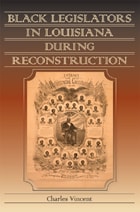
Black Legislators in Louisiana during Reconstruction
Charles Vincent
Southern Illinois University Press, 2011
Now updated with a new preface, this volume endures as an important work that illustrates the strength of minorities in state government during Reconstruction. It focuses on the achievements of the black representatives and senators in the Louisiana legislature who, through tireless fighting, were able to push forward many progressive reforms, such as universal public education, and social programs for the less fortunate.
Black New Orleans, 1860-1880
John W. Blassingame
University of Chicago Press, 1976
“Blending historical and sociological perspectives, and drawing with skill and imagination upon a variety of sources, [Blassingame] offers fresh insights into an oft-studied period of Southern history. . . . In both time and place the author has chosen an extraordinarily revealing vantage point from which to view his subject. ”—Neil R. McMillen, American Historical Review

Black, White, and Catholic
New Orleans Interracialism, 1947-1956R. Bentley Anderson
Vanderbilt University Press, 2005
Anderson leads readers through the tumultuous years just after World War II when the Roman Catholic Church in the American South struggled to reconcile its commitment to social justice with the legal and social heritage of Jim Crow society. Though these early efforts at reform, by and large, failed, they did serve to galvanize Catholic supporters and opponents of the Civil Rights Movement and provided a model for more successful efforts at desegregation in the '60s.
As a Jesuit himself, Anderson has access to archives that remain off-limits to other scholars. His deep knowledge of the history of the Catholic Church also allows him to draw connections between this historical period and the present. In the resistance to desegregation, Anderson finds expression of a distinctly American form of Catholicism, in which lay people expect Church authorities to ratify their ideas and beliefs in an almost democratic fashion. The conflict he describes is as much between popular and hierarchical models of the Church as between segregation and integration.
This book has been made possible through a grant from the Louisiana Endowment for the Humanities, a state affiliate of the National Endowment for the Humanities.

Blues in the Blood
Julien Delmaire
Seagull Books, 2023
Blues in the Blood is an ode to the spring of 1932 in the Mississippi delta, when stifling heat crushed the countryside and threatened the harvest, pervasive injustice ruled the day, and ghostly riders of the Ku Klux Klan spread terror. A panoramic historical and musical portrait, Blues in the Blood follows a poor young Black couple who believe their love for each other will save them from this devastation. Julien Delmaire introduces us to a gallery of figures: Blacks, Whites, Native Americans, mulattos, landowners, itinerant bluesmen, preachers, witches, corrupt politicians, prisoners, bootleggers, and Legba, the voodoo god, “master of crossroads,” who, like an otherworldly detective, watches over people’s destinies. As the story unfolds, a world is reborn: the delta, the birthplace of the blues, in which oppressed women and men rediscover the voices and rhythms of their humanity.
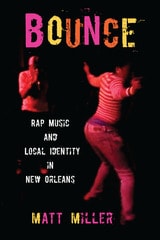
Bounce
Rap Music and Local Identity in New OrleansMatt Miller
University of Massachusetts Press, 2012
Over the course of the twentieth century, African Americans in New Orleans helped define the genres of jazz, rhythm and blues, soul, and funk. In recent decades, younger generations of New Orleanians have created a rich and dynamic local rap scene, which has revolved around a dance-oriented style called “bounce.”
Hip-hop has been the latest conduit for a “New Orleans sound” that lies at the heart of many of the city's best-known contributions to earlier popular music genres. Bounce, while globally connected and constantly evolving, reflects an enduring cultural continuity that reaches back and builds on the city's rich musical and cultural traditions.
In this book, the popular music scholar and filmmaker Matt Miller explores the ways in which participants in New Orleans's hip-hop scene have collectively established, contested, and revised a distinctive style of rap that exists at the intersection of deeply rooted vernacular music traditions and the modern, globalized economy of commercial popular music. Like other forms of grassroots expressive culture in the city, New Orleans rap is a site of intense aesthetic and economic competition that reflects the creativity and resilience of the city's poor and working-class African Americans.

Bounded Lives, Bounded Places
Free Black Society in Colonial New Orleans, 1769–1803Kimberly S. Hanger
Duke University Press, 1997
Drawing on rare archives in Louisiana and Spain, Hanger reconstructs the world of late-eighteenth-century New Orleans from the perspective of its free black residents, and documents the common experiences and enterprises that helped solidify libres’ sense of group identity. Over the course of three and a half decades of Spanish rule, free people of African descent in New Orleans made their greatest advances in terms of legal rights and privileges, demographic expansion, vocational responsibilities, and social standing. Although not all blacks in Spanish New Orleans yearned for expanded opportunity, Hanger shows that those who did were more likely to succeed under Spain’s dominion than under the governance of France, Great Britain, or the United States.
The advent of U.S. rule brought restrictions to both manumission and free black activities in New Orleans. Nonetheless, the colonial libre population became the foundation for the city’s prosperous and much acclaimed Creoles of Color during the antebellum era.
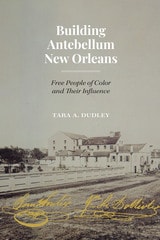
Building Antebellum New Orleans
Free People of Color and Their InfluenceBy Tara A. Dudley
University of Texas Press, 2021
2024 Spiro Kostof Book Award, Society of Architectural Historians
2022 PROSE Award in Architecture and Urban Planning
2022 Summerlee Book Prize in Nonfiction, Center for History and Culture of Southeast Texas and the Upper Gulf Coast
2022 Best Book Prize, Southeast Chapter of the Society of Architectural Historians
2022 On the Brinck Book Award, University of New Mexico School of Architecture + Planning
A significant and deeply researched examination of the free nineteenth-century Black developers who transformed the cultural and architectural legacy of New Orleans.
The Creole architecture of New Orleans is one of the city’s most-recognized features, but studies of it largely have focused on architectural typology. In Building Antebellum New Orleans, Tara A. Dudley examines the architectural activities and influence of gens de couleur libres—free people of color—in a city where the mixed-race descendants of whites and other free Blacks could own property.
Between 1820 and 1850 New Orleans became an urban metropolis and industrialized shipping center with a growing population. Amidst dramatic economic and cultural change in the mid-antebellum period, the gens de couleur libres thrived as property owners, developers, building artisans, and patrons. Dudley writes an intimate microhistory of two prominent families of Black developers, the Dollioles and Souliés, to explore how gens de couleur libres used ownership, engagement, and entrepreneurship to construct individual and group identity and stability. With deep archival research, Dudley re-creates in fine detail the material culture, business and social history, and politics of the built environment for free people of color and adds new, revelatory information to the canon on New Orleans architecture.
Building the Devil's Empire
French Colonial New OrleansShannon Lee Dawdy
University of Chicago Press, 2008
Building the Devil’s Empire is the first comprehensive history of New Orleans’s early years, tracing the town’s development from its origins in 1718 to its revolt against Spanish rule in 1768. Shannon Lee Dawdy’s picaresque account of New Orleans’s wild youth features a cast of strong-willed captives, thin-skinned nobles, sharp-tongued women, and carousing travelers. But she also widens her lens to reveal the port city’s global significance, examining its role in the French Empire and the Caribbean, and she concludes that by exemplifying a kind of rogue colonialism—where governments, outlaws, and capitalism become entwined—New Orleans should prompt us to reconsider our notions of how colonialism works.
"[A] penetrating study of the colony's founding."—Nation
“A brilliant and spirited reinterpretation of the emergence of French New Orleans. Dawdy leads us deep into the daily life of the city, and along the many paths that connected it to France, the North American interior, and the Greater Caribbean. A major contribution to our understanding of the history of the Americas and of the French Atlantic, the work is also a model of interdisciplinary research and analysis, skillfully bringing together archival research, archaeology, and literary analysis.”—Laurent Dubois, Duke University

Business Of Jews In Louisiana, 1840–1875
Elliot Ashkenazi
University of Alabama Press, 1988
Goes beyond institutional history to concentrate on commercial and social matters
The author’s findings imply that Jewish immigrants to the South in the first half of the 19th century came from particular locales with similar social, economic, and religious backgrounds, and they chose to live in the South because of those traditions. The experience of Jews with commercial capitalism, rather than landowning, in agricultural societies, gave the Jews of Louisiana a comparable niche in America, and they participated in the commercial aspects of a regional economy based on agricultural production. Commercial and family connections with other Jewish groups facilitated their development into a settled community. In growth and decline, Jewish communities in Louisiana and elsewhere became permanent features of the landscape and influenced, and were influenced, by the areas in which they lived.