Results by title
268 books match the query 'Mass media' and 9 start with b

Bangladesh’s Changing Mediascape
From State Control to Market ForcesEdited by Brian Shoesmith, Jude William Genilo, and Md Asiuzzaman
Intellect Books, 2013
With contributions from a diverse group of media and communications scholars from around the globe, Bangladesh’s Changing Mediascape presents a pioneering study of the trends, patterns, and prospects shaping the contemporary Bangladeshi media. Among the many topics discussed here are the difference among specific media formats, including television, newspapers, radio, film, and photography; policy issues; and the challenge that new media poses to governance in a developing nation faced with innumerable economic, social, and political problems. Eschewing the currently dominant development communication model, the editors argue that market forces rather than planned state interventions will contribute to a more equitable communication environment.
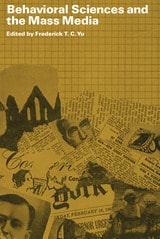
Behavioral Sciences and the Mass Media
Frederick T. C. Yu
Russell Sage Foundation, 1968

Belo
From Newspapers to New MediaBy Judith Garrett Segura
University of Texas Press, 2008
Founded in Galveston in 1842 with the launch of the Daily News, the Belo Corporation entered the twenty-first century as a powerhouse conglomerate, owning four daily newspapers (including the Dallas Morning News), twenty-six television and cable stations, and over thirty interactive Web sites. The first comprehensive work to bring to life this remarkable success story, Belo blends biography with a history of corporate strategies.
Drawing on company archives and private papers of key figures, including A. H. Belo and G. B. Dealey, former company archivist Judith Garrett Segura brings to life important chapters in the cultural life of Texas, from Galveston's days as the largest and most vibrant town in the Republic of Texas, through the wars that followed statehood, periods of economic hardship, and the effects of sweeping social change. Turning points in the company's history, such as the sale of its Galveston paper when company revenues were dramatically affected by candid reporting of Ku Klux Klan activities in the 1920s, highlight crucial elements of the press's role in the life of a community. Segura also charts technological advances, from the telegraph and the typographers' union to the dawn of the Information Age. Finally, she includes the most complete portrait of the Dallas Times Herald Company to date, documenting the rise and fall of Belo's chief rival.
This is a story of frontier survival and futuristic thinking, marketing genius and historic reporting, nurtured by a family of mavericks.
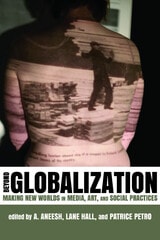
Beyond Globalization
Making New Worlds in Media, Art, and Social PracticesAneesh, A.
Rutgers University Press, 2011
Does living in a globally networked society mean that we are moving toward a single, homogenous world culture? Or, are we headed for clashes between center and periphery, imperial and subaltern, Western and non-Western, First and Third World? The interdisciplinary essays in Beyond Globalization present us with another possibility—that new media will lead to new kinds of “worldmaking.”
This provocative volume brings together the best new work of scholars within such diverse fields as history, sociology, anthropology, film, media studies, and art. Whether examining the inauguration of a virtual community on the website Second Life or investigating the appropriation of biotechnology for transgenic art, this collection highlights how mediated practices have become integral to global culture; how social practices have emerged out of computer-related industries; how contemporary apocalyptic narratives reflect the anxieties of a U.S. culture facing global challenges; and how design, play, and technology help us understand the histories and ideals
behind the digital architectures that mediate our everyday actions.

Blaming the Victim
How Global Journalism Fails Those in PovertyJairo Lugo-Ocando
Pluto Press, 2014
The books asks many biting questions. When - and how - does poverty become newsworthy? How does ideology come into play when determining the ways in which 'poverty' is constructed in newsrooms - and how do the resulting narratives frame the issue? And why do so many journalists and news editors tend to obscure the structural causes of poverty?
In analysing the processes of news production and presentation around the world, Lugo-Ocando reveals that the news-makers' agendas are often as problematic as the geopolitics they seek to represent. This groundbreaking study reframes the ways in which we can think and write about the enduring global injustice of poverty.
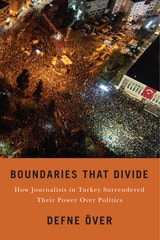
Boundaries That Divide
How Journalists in Turkey Surrendered Their Power over PoliticsDefne Över
Rutgers University Press, 2026
Turkey presents a striking example of the most recent wave of global authoritarian turns. The two-decade-long transition in the country’s political system also transformed its media environment. As mainstream journalists gradually yielded their places to sycophants, much more willing to praise the government in their news, the mainstream media that once oversaw—however imperfectly—political decisions started devoting its full service to cheerleading the government. Simultaneously, a new sphere of critical journalism began to emerge, with mainstream media journalists joining their fellows in the peripheries of the media. Considering the transformation of Turkey’s news media as the decay of a democratic institution, this book asks, How does the media break down under the rule of an elected government?
Drawing on fieldwork and in-depth interviews, the book traces the ruling AKP’s manipulation of social divides to consolidate power and journalists’ navigation of the resulting climate of fear, hope, doubt, and anger. The book shows how Turkey’s news media surrendered its power over politics as some journalists embraced disinformation as a path to heightened status, others turned to self-censorship for protection, and still others resisted capture through continuous but fragmented efforts.
The book portrays journalists as central actors in media decay, while also revealing that resilience to decay emerges where rising demand for “news” meets the contentious mobilization of journalists. Although focused on Turkey, the book’s insights extend far beyond, offering urgent lessons about the future of journalism in an age of populism, polarization, and institutional erosion.

Boxed In
The Culture of TVMark Crispin Miller
Northwestern University Press, 1988

Broadcasting Birth Control
Mass Media and Family PlanningParry, Manon
Rutgers University Press, 2013
Mass media, Manon Parry contends, was critical to the birth control movement’s attempts to build support and later to publicize the idea of fertility control and the availability of contraceptive services in the United States and around the world. Though these public efforts in advertising and education were undertaken initially by leading advocates, including Margaret Sanger, increasingly a growing class of public communications experts took on the role, mimicking the efforts of commercial advertisers to promote health and contraception in short plays, cartoons, films, and soap operas. In this way, they made a private subject—fertility control—appropriate for public discussion.
Parry examines these trends to shed light on the contested nature of the motivations of birth control advocates. Acknowledging that supporters of contraception were not always motivated by the best interests of individual women, Parry concludes that family planning advocates were nonetheless convinced of women’s desire for contraception and highly aware of the ethical issues involved in the use of the media to inform and persuade.
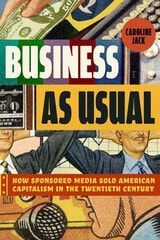
Business as Usual
How Sponsored Media Sold American Capitalism in the Twentieth CenturyCaroline Jack
University of Chicago Press, 2024
Business as Usual reveals how American capitalism has been promoted in the most ephemeral of materials: public service announcements, pamphlets, educational films, and games—what Caroline Jack calls “sponsored economic education media.” These items, which were funded by corporations and trade groups who aimed to “sell America to Americans,” found their way into communities, classrooms, and workplaces, and onto the airwaves, where they promoted ideals of “free enterprise” under the cloaks of public service and civic education. They offered an idealized vision of US industrial development as a source of patriotic optimism, framed business management imperatives as economic principles, and conflated the privileges granted to corporations by the law with foundational political rights held by individuals. This rhetoric remains dominant—a harbinger of the power of disinformation that so besets us today. Jack reveals the funding, production, and distribution that together entrenched a particular vision of corporate responsibility—and, in the process, shut out other hierarchies of value and common care.