Results by title
178 books match the query 'Media' and 3 start with b
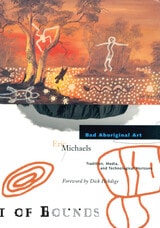
Bad Aboriginal Art
Tradition, Media, and Technological HorizonsEric Michaels
University of Minnesota Press, 1994
Bad Aboriginal Art is the extraordinary account of Eric Michaels’ period of residence and work with the Warlpiri Aborigines of western Central Australia, where he studied the impact of television on remote Aboriginal communities.
Sharp, exact, and unrelentingly honest, Michaels records with an extraordinary combination of distance and immersion the intervention of technology into a remote Aboriginal community and that community’s forays into the technology of broadcasting. Michaels’s analyses in Bad Aboriginal Art will disrupt and redirect current debates surrounding the theory and practice of anthropology, ethnography, film and video making, communications policy, and media studies - no less than his work has already disrupted and redirected the cultural technologies of both the Warlpiri and Australian technocrats.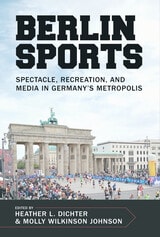
Berlin Sports
Spectacle, Recreation, and Media in Germany’s MetropolisHeather L. Dichter
University of Arkansas Press, 2024
This book begins with a long-distance equestrian race in the 1890s and continues with the role of media in spectacle, celebrity, urban life, and gender from the 1890s to the 1920s.It then turns to grassroots sport participation and spectatorship as well as sport diplomacy at the elite international level during the postwar period and the years of German division. Next, it explores recreational sport associations within the context of immigration and youth counterculture. It concludes with the 2015 European Maccabi Games, an international Jewish sports festival through which Berlin sought to grapple with the infamous 1936 Olympics and showcase Berlin as a cosmopolitan and multicultural city. Taken together, the book’s scholarly essays on all of these sporting endeavors reveal the rich and varied sporting culture in Berlin and yield fresh insights into spectacle, recreation, and media in the city.
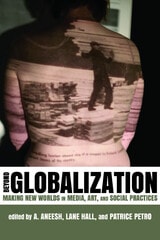
Beyond Globalization
Making New Worlds in Media, Art, and Social PracticesAneesh, A.
Rutgers University Press, 2011
Does living in a globally networked society mean that we are moving toward a single, homogenous world culture? Or, are we headed for clashes between center and periphery, imperial and subaltern, Western and non-Western, First and Third World? The interdisciplinary essays in Beyond Globalization present us with another possibility—that new media will lead to new kinds of “worldmaking.”
This provocative volume brings together the best new work of scholars within such diverse fields as history, sociology, anthropology, film, media studies, and art. Whether examining the inauguration of a virtual community on the website Second Life or investigating the appropriation of biotechnology for transgenic art, this collection highlights how mediated practices have become integral to global culture; how social practices have emerged out of computer-related industries; how contemporary apocalyptic narratives reflect the anxieties of a U.S. culture facing global challenges; and how design, play, and technology help us understand the histories and ideals
behind the digital architectures that mediate our everyday actions.