Results by title
273 books match the query 'Memoir' and 19 start with b
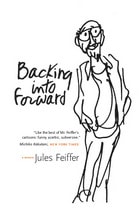
Backing into Forward
A MemoirJules Feiffer
University of Chicago Press, 2012
Subversive, funny, and effortlessly droll, Jules Feiffer’s cartoons were all over New York in the 1960s and ’70s—featured in the Village Voice, but also cut out and pinned to bulletin boards in offices and on refrigerators at home. Feiffer describes himself as “lucking into the zeitgeist,” and there’s some truth to the sentiment; Feiffer’s brand of satire reflected Americans’ ambivalence about the Vietnam War, changing social mores, and much more.
Feiffer’s memoir, Backing into Forward, like his cartoons, is sharply perceptive with a distinctive bite of mordant humor. Beginning with his childhood in Brooklyn, Feiffer paints a picture of a troubled kid with an overbearing mother and a host of crippling anxieties. From there, he discusses his apprenticeship with his hero, Will Eisner, and his time serving in the military during the Korean War, which saw him both feigning a breakdown and penning a cartoon narrative called “Munro” that solidified his distinctive aesthetic as an artist. While Feiffer’s voice grounds the book, the sheer scope of his artistic accomplishment, from his cartoons turning up in the New Yorker, Playboy, and the Nation to his plays and film scripts, is remarkable and keeps the narrative bouncing along at a speedy clip. A compelling combination of a natural sense of humor and a ruthless dedication to authenticity, Backing into Forward is full of wit and verve, often moving but never sentimental.
“Jules Feiffer’s original and neurotic voice. . . . reinvented comics in the 1950s and made possible what’s now called the ‘graphic novel.’ His engaging new memoir is told in that same witty and perceptive New York cadence, mellowed and laced with wisdom. He’s an inspiration.”—Art Spiegelman
Because We Must
A MemoirTracy Youngblom
University of Massachusetts Press, 2025
A breathtaking memoir navigating caregiving, motherhood, and letting go after a tragic accident
On March 16th, 2015, Tracy Youngblom was rushing to finish last-minute preparations for a class she would teach the next day when there was an unexpected knock at her door. Grudgingly, she answered it to find a uniformed officer standing on her front porch. Youngblom realized then that her youngest son Elias should have been arriving home from a trip to Fargo where he was visiting friends at North Dakota State University. The officer told her that Elias had been in an accident and was in the hospital. Later, she learned that his car had been struck nearly head on by a drunk driver going 70 miles per hour. Denial and shock took over as she made the long drive from their home in Coon Rapids, Minnesota. When she saw Elias in the ICU—swollen beyond recognition, covered in stitches, with a myriad of tubes attached to him—the full gravity of the situation descended.
On the day of the crash, Elias had been driving back to Coon Rapids to celebrate National Ice Cream Day with friends. An avid lover of music, he’d been working as a conductor while wrapping up his degree, moving toward his dream of becoming a marching band director. After the accident, Elias begins his long journey of recovery, which is set back when doctors announce that his optic nerves are dead. Despite it all, Elias never wavers, approaching each challenge with resilience, grace, and humor.
Alongside Elias, Youngblom faces her own challenges, staying by his side in the ICU for weeks, coordinating with other family members and friends, and never flagging in her care of her severely injured son, yet all the while coping with her own emotions, fears, and trauma. She struggles to support Elias, heal her self, and let him go on with his life. In this riveting memoir, Youngblom traverses her family’s lives before and after the accident, capturing the complications of grief, recovery, and the strength it takes to move forward—because we must.

Between Jaffa and Tel Aviv, 1870–1930
A MemoirYosef Eliyahu Chelouche
Brandeis University Press, 2025
Born in Jaffa in 1870, Yosef Eliyahu Chelouche grew up within a notable Sephardi family in the local Jewish community. He went on to become a prominent entrepreneur; a founder of Tel Aviv; and a fierce critic of the Ashkenazi Zionist leadership, Arab nationalism, and British colonial sectarianism; before emerging, in the last decade of his life, as an anguished public figure struggling to repair Arab-Jewish relations.
His memoir paints an intimate portrait of life in Palestine at the turn of the twentieth century, told from the perspective of a Middle Eastern Jew deeply embedded in local society. By centering on the world and experiences of a native Jew who was an eyewitness to and participant in the unfolding conflict in Palestine, this book shows how the course of Zionist politics and Jewish-Arab relations in pre-state Palestine might have taken alternative pathways. A comprehensive introduction sets the scene in late nineteenth- and early twentieth-century Jaffa and thoughtful annotations contextualize Chelouche’s story within the modern history of Palestine and Israel. Between Jaffa and Tel Aviv, 1870–1930 tells the fascinating story of a civic leader—and offers a complex view of the various cultural, social, and political forces that forged multilayered Jewish identities in the Middle East. The book includes a family tree and is illustrated with photographs of the family and scenes of Jaffa and early Tel Aviv.
Beyond Market Value
A Memoir of Book Collecting and the World of Venture CapitalBy Annette Campbell-White
University of Texas Press, 2019
Beyond Market Value chronicles Annette Campbell-White’s remarkable life, from a childhood spent in remote mining camps throughout the British Commonwealth, where books created an imaginary home; to her early adulthood in London, where she first discovered a vocation as a book collector; to Silicon Valley, where she built a pioneering career as a formidable venture capitalist. She recalls the impulsive purchase of the first book in her collection, T. S. Eliot’s A Song for Simeon, and her pursuit of rare editions of all one hundred titles listed in Cyril Connolly’s The Modern Movement. Campbell-White’s collecting and career peaked in 2005, when she acquired the last of the Connolly titles and was first named to Forbes’ Midas List, the annual ranking of the most successful dealmakers in venture capital.
In 2007, out of concern for their preservation, Campbell-White rashly sold the Connolly titles she had spent more than twenty years assembling, leading to a new appreciation of what remained of her collection and, going forward, a broader focus on collecting modernist letters, manuscripts, and ephemera. Beyond Market Value is both a loving tribute to literary collecting and a telling account of the challenges of being a woman in the male-dominated world of finance.
Beyond The Whiteness of Whiteness
Memoir of a White Mother of Black SonsJane Lazarre
Duke University Press, 1997
Lazarre has spent over twenty-five years living in a Black American family, married to an African American man, birthing and raising two sons. A teacher of African American literature, she has been influenced by an autobiographical tradition that is characterized by a speaking out against racism and a grounding of that expression in one’s own experience—an overlapping of the stories of one’s own life and the world. Like the stories of that tradition, Lazarre’s is a recovery of memories that come together in this book with a new sense of meaning. From a crucial moment in which consciousness is transformed, to recalling and accepting the nature and realities of whiteness, each step describes an aspect of her internal and intellectual journey. Recalling events that opened her eyes to her sons’ and husband’s experience as Black Americans—an operation, turned into a horrific nightmare by a doctor’s unconscious racism or the jarring truths brought home by a visit to an exhibit on slavery at the Richmond Museum of the Confederacy—or her own revealing missteps, Lazarre describes a movement from silence to voice, to a commitment to action, and to an appreciation of the value of a fluid, even ambiguous, identity. It is a coming of age that permits a final retelling of family history and family reunion.
With her skill as a novelist and her experience as a teacher, Jane Lazarre has crafted a narrative as compelling as it is telling. It eloquently describes the author’s delight at being accepted into her husband’s family and attests to the power of motherhood. And as personal as this story is, it is a remarkably incisive account of how perceptions of racial difference lie at the heart of the history and culture of America.
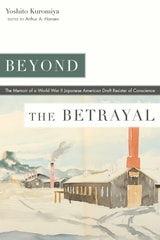
Beyond the Betrayal
The Memoir of a World War II Japanese American Draft Resister of Conscienceby Yoshito Kuromiya edited by ArthurA.Hansen
University Press of Colorado, 2022
Of the 300 Japanese Americans who resisted the military draft on the grounds that the US government had deprived them of their fundamental rights as US citizens, Kuromiya alone has produced an autobiographical volume that explores the short- and long-term causes and consequences of this fateful wartime decision. In his exquisitely written and powerfully documented testament he speaks truth to power, making evident why he is eminently qualified to convey the plight of the Nisei draft resisters. He perceptively reframes the wartime and postwar experiences of the larger Japanese American community, commonly said to have suffered in the spirit of shikata ga nai—enduring that which cannot be changed—and emerged with dignity.
Beyond the Betrayal makes abundantly clear that the unjustly imprisoned Nisei could and did exercise their patriotism even when they refused to serve in the military in the name of civil liberties and social justice. Kuromiya’s account, initially privately circulated only to family and friends, is an invaluable and insightful addition to the Nikkei historical record.
Beyond the Whiteness of Whiteness
Memoir of a White Mother of Black SonsJane Lazarre
Duke University Press, 1996
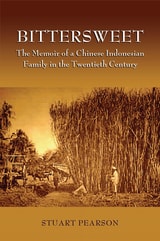
BitterSweet
The Memoir of a Chinese Indonesian Family in the Twentieth CenturyStuart Pearson
National University of Singapore Press, 2013
BitterSweet
The Memoir of a Chinese-Indonesian Family in the Twentieth CenturyStuart Pearson
Ohio University Press, 2008
BitterSweet is the account of one Chinese-Indonesian family whose story stretches over the generations as their fortunes waxed and waned through revolution, riots, war, depression, occupation, and finally emigration to yet another country—Australia.
BitterSweet offers a unique insight into a world rarely seen before. An Sudibjo’s memoir, written from a woman’s perspective, is a valuable resource for anyone studying Indonesian history or the Chinese Diaspora.

Bleeder
A MemoirShelby Smoak
Michigan State University Press, 2013
Blue Daughter of the Red Sea
A MemoirMeti Birabiro
University of Wisconsin Press, 2004
Born into a life of constant financial, physical, and moral threat, Meti Birabiro takes refuge in literature and the fantastic. Blue Daughter of the Red Sea is Birabiro’s poetic account of the harsh reality of her young life spread across three continents. Her voice is a fresh mélange of child and adult perspectives, at once brutally honest and wise beyond her years. Through her journey from Ethiopia to Italy and finally to the United States, we encounter Birabiro’s relatives, friends, and enemies—relationships so intense that these people become her vampires, devils, angels, and saints. These characterizations always lead her back to the truth, helping her to decipher what is fair and good, to understand what she must cherish and what she must rage against.
Bluegrass Bluesman
A MemoirJosh Graves; Edited by Fred Bartenstein; Foreword by Neil Rosenberg
University of Illinois Press, 2012
Bluegrass Generation
A MemoirNeil V Rosenberg
University of Illinois Press, 2018
Rosenberg's memoir shines a light on the changing bluegrass scene of the early 1960s. Already a fan and aspiring musician, his appetite for banjo music quickly put him on the Jamboree stage. Rosenberg eventually played with Monroe and spent four months managing the Jamboree. Those heights gave him an eyewitness view of nothing less than bluegrass's emergence from the shadow of country music into its own distinct art form. As the likes of Bill Keith and Del McCoury played, Rosenberg watched Monroe begin to share a personal link to the music that tied audiences to its history and his life--and helped turn him into bluegrass's foundational figure.
An intimate look at a transformative time, Bluegrass Generation tells the inside story of how an American musical tradition came to be.
Body, Remember
A MemoirKenny Fries
University of Wisconsin Press, 2003
In this poetic, introspective memoir, Kenny Fries illustrates his intersecting identities as gay, Jewish, and disabled. While learning about the history of his body through medical records and his physical scars, Fries discovers just how deeply the memories and psychic scars run. As he reflects on his relationships with his family, his compassionate doctor, the brother who resented his disability, and the men who taught him to love, he confronts the challenges of his life. Body, Remember is a story about connection, a redemptive and passionate testimony to one man’s search for the sources of identity and difference.

Botanical Companions
A Memoir of Plants and PlaceFrieda Knobloch
University of Iowa Press, 2005
Bread
A Memoir of HungerLisa Knopp
University of Missouri Press, 2025
When she was 54, Lisa Knopp’s weight dropped to a number on the scale that she hadn’t seen since seventh grade. The severe food restricting that left her thin and sick when she was 15 and 25 had returned. This time, she was determined to understand the causes of her malady and how she could heal from a condition that is caused by a tangle of genetic, biological, familial, psychological, cultural, and spiritual factors. This compelling memoir, at once a food and illness narrative, explores the forces that cause eating disorders and disordered eating, including the link between those conditions in women, middle-aged and older, and the fear of aging and ageism.
Winner of the 2017 Nebraska Book Award for Memoir
2017 Choice Outstanding Academic Title
Broadcasting the Civil War in El Salvador
A Memoir of Guerrilla RadioBy Carlos Henriquez Consalvi ("Santiago")
University of Texas Press, 2010
During the 1980s war in El Salvador, Radio Venceremos was the main news outlet for the Frente Farabundo Martí para la Liberación Nacional (FMLN), the guerrilla organization that challenged the government. The broadcast provided a vital link between combatants in the mountains and the outside world, as well as an alternative to mainstream media reporting. In this first-person account, "Santiago," the legend behind Radio Venceremos, tells the story of the early years of that conflict, a rebellion of poor peasants against the Salvadoran government and its benefactor, the United States.
Originally published as La Terquedad del Izote, this memoir also addresses the broader story of a nationwide rebellion and its international context, particularly the intensifying Cold War and heavy U.S. involvement in it under President Reagan. By the war's end in 1992, more than 75,000 were dead and 350,000 wounded—in a country the size of Massachusetts. Although outnumbered and outfinanced, the rebels fought the Salvadoran Army to a draw and brought enough bargaining power to the negotiating table to achieve some of their key objectives, including democratic reforms and an overhaul of the security forces.
Broadcasting the Civil War in El Salvador is a riveting account from the rebels' point of view that lends immediacy to the Salvadoran conflict. It should appeal to all who are interested in historic memory and human rights, U.S. policy toward Central America, and the role the media can play in wartime.
Broken Contract
A Memoir of Harvard Law SchoolRichard D. Kahlenberg
University of Massachusetts Press, 1999
In 1986, 70 percent of the first-year class of Harvard Law School wanted to pursue careers in public-interest law. Ten years later, the same percentage of this class was pursuing careers in private corporate firms. How is it that these students began their careers interested in using law as a vehicle for social change, but ended up in those very law firms most resistant to change? How are law students able to reconcile liberal politics with careers in corporate law?
Richard D. Kahlenberg's Broken Contract serves to warn prospective law students on the transformation that happens during the second and third years. His memoir explores the intense competitiveness and insidious pressure leading to jobs that are lucrative, prestigious, and challenging, but ultimately unsatisfying.
Though Broken Contract doesn't seek to convince every law student to go into public service, Kahlenberg means to challenge and restructure our social institutions to make it easier to follow our impulses toward good instead of toward the goods.
Brothers
A Memoir of Love, Loss, and RaceNico Slate
Temple University Press, 2023
Brothers is Nico Slate’s poignant memoir about Peter Slate, aka XL, a Black rapper and screenwriter whose life was tragically cut short. Nico and Peter shared the same White American mother but had different fathers. Nico’s was White; Peter’s was Black. Growing up in California in the 1980s and 1990s, Nico often forgot about their racial differences until one night in March 1994 when Peter was attacked by a White man in a nightclub in Los Angeles.
Nico began writing Brothers with the hope that investigating the attack would bring him closer to Peter. He could not understand that night, however, without grappling with the many ways race had long separated him from his brother.
This is a memoir of loss—the loss of a life and the loss at the heart of our racial divide—but it is also a memoir of love. The love between Nico and Peter permeates every page of Brothers. This achingly beautiful memoir presents one family’s resilience on the fault lines of race in contemporary America.