Results by title
55 books match the query 'Memories' and 3 start with b

Bear Tracks
Memories of a Ho-Chunk ElderSherman Funmaker
Wisconsin Historical Society Press, 2026
Poems, essays, and photos reveal the life, art, and inspirations of a Ho-Chunk elder.
“For me, writing is a form of therapy. I write thoughts down and send them out to the universe. I miss the ones I loved, and when I write about them it feels good to put these stories onto paper. It allows me to visit them when I need to.”
Sherman Funmaker—poet and musician, designer and teacher, son and brother—shares his life story in his intensely personal debut, Bear Tracks: Memories of a Ho-Chunk Elder. In this collection of poems and short essays, Funmaker explores themes of childhood and familial ties, finding and leaving home, coming of age, experiencing love and loss, creating art, and seeking belonging.
A Ho-Chunk Nation Bear Clan elder and grandson of renowned Ho-Chunk storyteller Xéhachiwinga (Mountain Wolf Woman), Funmaker illuminates how his Ho-Chunk culture has had a lasting impact on his life, self-expression, and point of view. With emotional depth and clarity, Bear Tracks confronts hard topics, such as poverty, racism, and personal loss, leavening them with optimism and a wry sense of humor.
Family photos from across generations accompany Funmaker’s reflections on the people and places that have shaped his life and art. Bear Tracks concludes with a reader’s guide offering additional topics for discussion and reflection.
With a voice both distinct and entirely relatable, Funmaker creates space for readers to find resilience and hope for the future while reckoning with the struggles of their past.
[more]
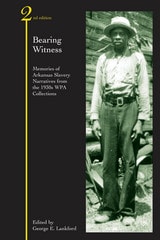
Bearing Witness
Memories of Arkansas SlaveryGeorge E. Lankford
University of Arkansas Press, 2006
The first edition of Bearing Witness brought together for the first time 176 slave narratives from the state of Arkansas. Now, this new edition adds ten previously undiscovered accounts. No one knew the truths of slavery better than the slaves themselves, but no one consulted them until the 1930s. Then, recognizing that this generation of unique witnesses would soon be lost to history, the Works Progress Administration's Federal Writers' Project acted to interview as many former slaves as possible. In a continuation of the project's interest in the life histories of ordinary people, writers interviewed over two thousand former slaves, more than a third of them in Arkansas. These oral histories were first published in the 1970s in a thirty-nine-volume series organized by state, and they transformed America's understanding of slavery. They have offered crucial evidence on a variety of other topics as well: the Civil War, Reconstruction, agricultural practices, everyday life, and oral history itself. But some former Arkansas slaves were interviewed in Texas, Oklahoma, and other states, so their narratives were published in those other collections. And more than half of the testimonies in the Arkansas volume were interviews with people who had moved to Arkansas after freedom. Folklorist George Lankford combed all of the state collections for the testimonies properly belonging to Arkansas and deleted from this state's collection the testimony of later migrants
[more]
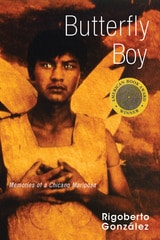
Butterfly Boy
Memories of a Chicano MariposaRigoberto Gonzalez
University of Wisconsin Press, 2011
Winner of the American Book Award
[more]