Results by title
179 books match the query 'Middle West' and 6 start with b
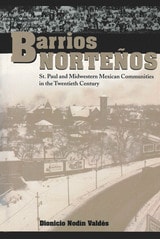
Barrios Norteños
St. Paul and Midwestern Mexican Communities in the Twentieth CenturyBy Dionicio Nodín Valdés
University of Texas Press, 2000
Mexican communities in the Midwestern United States have a history that extends back to the turn of the twentieth century, when a demand for workers in several mass industries brought Mexican agricultural laborers to jobs and homes in the cities. This book offers a comprehensive social, labor, and cultural history of these workers and their descendants, using the Mexican barrio of "San Pablo" (St. Paul) Minnesota as a window on the region.
Through extensive archival research and numerous interviews, Dennis Valdés explores how Mexicans created ethnic spaces in Midwestern cities and how their lives and communities have changed over the course of the twentieth century. He examines the process of community building before World War II, the assimilation of Mexicans into the industrial working class after the war, the Chicano Movement of the 1960s and 1970s, and more recent changes resulting from industrial restructuring and unprecedented migration and population growth. Throughout, Valdés pays particular attention to Midwestern Mexicans' experiences of inequality and struggles against domination and compares them to Mexicans' experiences in other regions of the U.S.
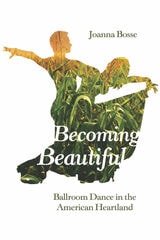
Becoming Beautiful
Ballroom Dance in the American HeartlandJoanna Bosse
University of Illinois Press, 2015
Bosse uses sensitive fieldwork as well as her own immersion in ballroom culture to lead readers into a community that springs up around ballroom dance. The result is a portrait of the real people who connect with others, change themselves, and join a world that foxtrots to its own rules, conventions, and rewards. Bosse's eye for revealing, humorous detail adds warmth and depth to discussions around critical perspectives on the experiences the dance hall provides, the nature of partnership and connection, and the notion of how dancing allows anyone to become beautiful.
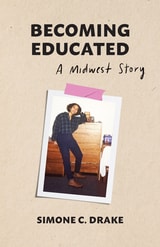
Becoming Educated
A Midwest StorySimone C. Drake
The Ohio State University Press, 2026
Becoming Educated is Simone C. Drake’s engaging and bold memoir about race, class, gender, and the meaning of education in the urban Midwest. Drake, a scholar of literature, culture, and law, uses her own story as a Black girl attending recently desegregated Columbus public schools in the 1980s and 1990s to explore the United States’ most entrenched social problems and how local systems have tried to combat them. From starting kindergarten the year after an Ohio court decision called for busing to end school segregation, to climbing the ranks of academia, to her decision to send her sons to highly rated but largely white suburban schools, Drake weaves a lively and erudite accounting of her identity formation as an “integration guinea pig.” She punctuates her story with rich evocations of the music, TV, and film that shaped her generation, powerful reflections on relevant works by Black writers and artists from Dawoud Bey to Jay-Z, and images of her own artwork. This prismatic book is a must-read for Gen Xers, Midwesterners, and Americans of any race wanting to think more deeply about how our nation’s educational systems—and by extension, all of us—must reckon with inequalities past and present.
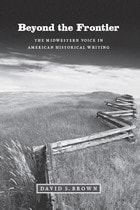
Beyond the Frontier
The Midwestern Voice in American Historical WritingDavid S. Brown
University of Chicago Press, 2009
As the world went to war in 1941, Time magazine founder Henry Luce coined a term for what was rapidly becoming the establishment view of America’s role in the world: the twentieth century, he argued, was the American Century. Many of the nation’s most eminent historians—nearly all of them from the East Coast—agreed with this vision and its endorsement of the vigorous use of power and persuasion to direct world affairs. But an important concentration of midwestern historians actively dissented. With Beyond the Frontier, David S. Brown tells their little-known story of opposition.
Raised in a cultural landscape that combined agrarian provincialism with reform-minded progressivism, these historians—among them Charles Beard, William Appleman Williams, and Christopher Lasch—argued strenuously against the imperial presidencies, interventionist foreign policies, and Keynesian capitalism that swiftly shaped cold war America. Casting a skeptical eye on the burgeoning military-industrial complex and its domestic counterpart, the welfare state, they warned that both components of the liberal internationalist vision jeopardized the individualistic, republican ethos that had long lain at the heart of American democracy.
Drawing on interviews, personal papers, and correspondence of the imoprtant players in the debate, Brown has written a fascinating follow-up to his critically acclaimed biography of Richard Hofstadter. Illuminating key ideas that link midwestern writers from Frederick Jackson Turner all the way to William Cronon and Thomas Frank, Beyond the Frontier is intellectual history at its best: grounded in real lives and focused on issues that remain salient—and unresolved—even today.

Birdscaping in the Midwest
A Guide to Gardening with Native Plants to Attract BirdsMariette Nowak; Foreword by Peter H. Raven
University of Wisconsin Press, 2012

Building Sustainable Worlds
Latinx Placemaking in the MidwestEdited by Theresa Delgadillo, Ramon H. Rivera-Servera, Geraldo L. Cadava, and Claire F. Fox
University of Illinois Press, 2022
A rare and crucial perspective on Latina/o/x people in the Midwest, Building Sustainable Worlds reveals how expressive culture contributes to, and sustains, a sense of place in an uncertain era.