Results by title
100 books match the query 'Missions' and 5 start with b

Battle for the Soul
Mètis Children Encounter Evangelical Protestants at Mackinaw Mission, 1823-1837Keith R. Widder
Michigan State University Press, 1999
In 1823 William and Amanda Ferry opened a boarding school for Métis children on Mackinac Island, Michigan Territory, setting in motion an intense spiritual battle to win the souls and change the lives of the children, their parents, and all others living at Mackinac. Battle for the Soul demonstrates how a group of enthusiastic missionaries, empowered by an uncompromising religious motivation, served as agents of Americanization. The Ferrys' high hopes crumbled, however, as they watched their work bring about a revival of Catholicism and their students refuse to abandon the fur trade as a way of life. The story of the Mackinaw Mission is that of people who held differing world views negotiating to create a "middle-ground," a society with room for all.
Widder's study is a welcome addition to the literature on American frontier missions. Using Richard White's "middle ground" paradigm, it focuses on the cultural interaction between French, British, American, and various native groups at the Mackinac mission in Michigan during the early 19th century. The author draws on materials from the American Board of Commissioners for Foreign Missions archives, as well as other manuscript sources, to trace not only the missionaries' efforts to Christianize and Americanize the native peoples, but the religious, social, and cultural conflicts between Protestant missionaries and Catholic priests in the region. Much attention has been given to the missionaries to the Indians in other areas of the US, but little to this region.
Biocultural Histories in La Florida
A Bioarchaeological PerspectiveChristopher Stojanowski
University of Alabama Press, 2005
Examines the effects of the Spanish mission system on population structure and genetic variability in indigenous communities in northern Florida and southern Georgia during the 16th and 17th centuries
This book examines the effects of the Spanish mission system on population structure and genetic variability in indigenous communities living in northern Florida and southern Georgia during the 16th and 17th centuries. Data on tooth size were collected from 26 archaeological samples representing three time periods: Late Precontact (~1200-1500), Early Mission (~1600-1650), and Late Mission (~1650-1700) and were subjected to a series of statistical tests evaluating genetic variability. Predicted changes in phenotypic population variability are related to models of group interaction, population demo-graphy, and genetic admixture as suggested by ethnohistoric and archaeological data.
Results suggest considerable differences in diachronic responses to the mission environment for each cultural province. The Apalachee demonstrate a marked increase in variability while the Guale demonstrate a decline in variability. Demographic models of population collapse are therefore inconsistent with predicted changes based on population geneticsl, and the determinants of population structure seem largely local in nature. This book highlights the specificity with which indigenous communities responded to European contact and the resulting transformations in their social worlds.
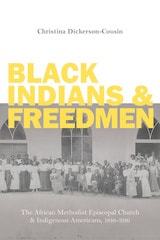
Black Indians and Freedmen
The African Methodist Episcopal Church and Indigenous Americans, 1816-1916Christina Dickerson-Cousin
University of Illinois Press, 2021
Insightful and richly detailed, Black Indians and Freedmen illuminates how faith and empathy encouraged the unique interactions between two peoples.

Bread, Wine, and Money
The Windows of the Trades at Chartres CathedralJane Welch Williams
University of Chicago Press, 1993
Williams weaves a tight net of historical circumstances, iconographic traditions, exegetical implications, political motivations, and liturgical functions to explain the imagery in the windows of the trades. Her account of changing social relationships in thirteenth-century Chartres focuses on the bakers, tavern keepers, and money changers whose bread, wine, and money were used as means of exchange, tithing, and offering throughout medieval society. Drawing on a wide variety of original documents and scholarly work, this book makes important new contributions to our knowledge of one of the great monuments of Western culture.

Bright Lights in the Desert
The Latter-day Saints of Las VegasFred E Woods
University of Nevada Press, 2023
Bright Lights in the Desert explores the history of how members of the Church of Jesus Christ of Latter-day Saints in Las Vegas have improved the regions’ neighborhoods, inspired educational institutions, brought integrity to the marketplace, and provided wholesome entertainment and cultural refinement. The LDS influence has helped shape the metropolitan city because of its members’ focus on family values and community service.
Woods discusses how, through their beliefs and work ethics, they have impacted the growth of the area from the time of their first efforts to establish a mission in 1855 through the present day. Bright Lights in the Desert reveals Las Vegas as more than just a tourist destination and shows the LDS community’s commitment to making it a place of deep religious faith and devotion to family.