Results by title
73 books match the query 'Modern (late 19th Century to 1945)' and 4 start with b
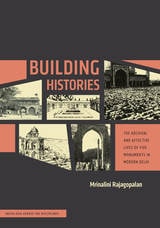
Building Histories
The Archival and Affective Lives of Five Monuments in Modern DelhiMrinalini Rajagopalan
University of Chicago Press, 2016
Building Histories offers innovative accounts of five medieval monuments in Delhi—the Red Fort, Rasul Numa Dargah, Jama Masjid, Purana Qila, and the Qutb complex—tracing their modern lives from the nineteenth century into the twentieth.
Mrinalini Rajagopalan argues that the modern construction of the history of these monuments entailed the careful selection, manipulation, and regulation of the past by both the colonial and later postcolonial states. Although framed as objective “archival” truths, these histories were meant to erase or marginalize the powerful and persistent affective appropriations of the monuments by groups who often existed outside the center of power. By analyzing these archival and affective histories together, Rajagopalan works to redefine the historic monument—far from a symbol of a specific past, the monument is shown in Building Histories to be a culturally mutable object with multiple stories to tell.
Mrinalini Rajagopalan argues that the modern construction of the history of these monuments entailed the careful selection, manipulation, and regulation of the past by both the colonial and later postcolonial states. Although framed as objective “archival” truths, these histories were meant to erase or marginalize the powerful and persistent affective appropriations of the monuments by groups who often existed outside the center of power. By analyzing these archival and affective histories together, Rajagopalan works to redefine the historic monument—far from a symbol of a specific past, the monument is shown in Building Histories to be a culturally mutable object with multiple stories to tell.
[more]
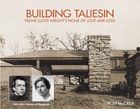
Building Taliesin
Frank Lloyd Wright’s Home of Love and LossRon McCrea
Wisconsin Historical Society Press, 2012
Through letters, memoirs, contemporary documents, and a stunning assemblage of photographs - many of which have never before been published - author Ron McCrea tells the fascinating story of the building of Frank Lloyd Wright's Taliesin, which would be the architect's principal residence for the rest of his life. Photos taken by Wright's associates show rare views of Taliesin under construction and illustrate Wright's own recollections of the first summer there and the craftsmen who worked on the site.
The book also brings to life Wright’s "kindred spirit," "she for whom Taliesin had first taken form," Mamah Borthwick. Wright and Borthwick had each abandoned their families to be together, causing a scandal that reverberated far beyond Wright's beloved Wisconsin valley. The shocking murder and fire that took place at Taliesin in August 1914 brought this first phase of life at Taliesin to a tragic end.
[more]
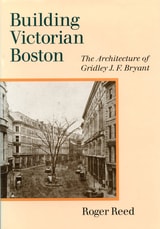
Building Victorian Boston
The Architecture of Gridley J.F. BryantRoger G. Reed
University of Massachusetts Press, 2007
Much of Boston's rich heritage of Victorian buildings dates from the mid-nineteenth century when Gridley James Fox Bryant (1816–1899) dominated the profession of architecture in the city. At that time, Boston was undergoing a transformation from a quaint post-colonial town to a rapidly expanding Victorian metropolis. Bryant led this transformation, providing an important link between the earlier architecture of Charles Bulfinch and Alexander Parris and the later work of such practitioners as H. H. Richardson and Peabody & Stearns.
In Building Victorian Boston, Roger Reed focuses on representative projects by Bryant, presenting them in a chronological narrative that both illuminates the trajectory of his career and creates a portrait of the profession of architecture during a defining period of New England history. Bryant designed more major buildings in Boston from 1840 to 1880 than any other architect. He also undertook commissions throughout New
England, especially in towns linked to Boston by newly constructed railroad lines. In many ways, his practice presaged aspects of modern architectural firms. His ability to work with a variety of designers, his expertise in construction management, and his exceptional talent for self-promotion all contributed to his success. Although by the time of his death his work was no longer fashionable, newspaper accounts noted the passing of the "Famed Bostonian" and "Great Builder" whose career had had such a dramatic impact on the face of the city.
For this volume, Reed has tracked down hundreds of Bryant's drawings as well as specifications, letters, newspaper articles, published renderings, and historical photographs. These materials are amply represented in this book, the definitive study of a quintessential Victorian architect.
[more]
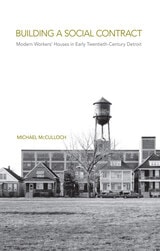
Building a Social Contract
Modern Workers' Houses in Early-Twentieth Century DetroitMcCulloch, Michael
Temple University Press, 2023
The dream of the modern worker’s house emerged in early twentieth-century America as wage earners gained access to new, larger, and better-equipped dwellings. Building a Social Contract is a cogent history of the houses those workers dreamed of and labored for. Michael McCulloch chronicles the efforts of employers, government agencies, and the building industry who, along with workers themselves, produced an unprecedented boom in housing construction that peaked in the mid-1920s.
Through oral histories, letters, photographs, and period fiction, McCulloch traces wage earners’ agency in negotiating a new implicit social contract, one that rewarded hard work with upward mobility in modern houses. This promise reflected workers’ increased bargaining power but, at the same time, left them increasingly vulnerable to layoffs.
Building a Social Contract focuses on Detroit, the quintessential city of the era, where migrant workers came and were Americanized, and real estate agents and the speculative housebuilding industry thrived. The Motor City epitomized the struggle of Black workers in this period, who sought better lives through industrial labor but struggled to translate their wages into housing security amid racist segregation and violence. When Depression-era unemployment created an eviction crisis, the social contract unraveled, and workers rose up—at the polls and in the streets—to create a labor movement that reshaped American capitalism for decades.
Today, the lessons McCulloch provides from early twentieth-century Detroit are a necessary reminder that wages are not enough, and only working-class political power can secure affordable housing.
[more]