Results by title
225 books match the query 'Modernism' and 5 start with b
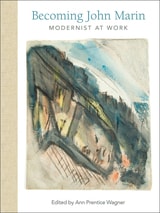
Becoming John Marin
Modernist at WorkAnn Prentice Wagner
University of Arkansas Press, 2018
John Marin was a major figure among the cutting-edge circle of American modernist artists who showed his work in Alfred Stieglitz’s New York galleries from 1909 until 1950. A new collection of the artist’s work at the Arkansas Arts Center, given by Marin’s daughter-in-law, forms the basis of this first book of essays and images to concentrate on Marin’s drawings in the context of Marin’s life, his watercolors, and his etchings.
We follow Marin to his most famous subject matter: New York City and the coast of Maine. Foundational drawings and an unfinished watercolor of the towering Woolworth Building, still under construction when they were made in 1912, begin the story of a renowned group of watercolors first exhibited in 1913 at Alfred Stieglitz’s 291 Gallery and then at the ground-breaking 1913 Armory Show. Other images take us to lesser-known locales, such as the Ramapo Mountains in New York and New Jersey where Marin often painted when he couldn’t get to Maine. More obscure aspects of the artist’s career explored in this collection include portraits of friends and family, charming drawings of animals, and circus scenes.
Becoming John Marin invites readers to look over this important artist’s shoulder as he created and honed the sketches he would interpret into completed watercolors and etchings, illustrating the evolution of his style and methods as he transformed from intuitive draftsman to innovative modernist watercolorist and etcher.
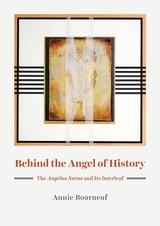
Behind the Angel of History
The "Angelus Novus" and Its InterleafAnnie Bourneuf
University of Chicago Press, 2022
This book begins with artist R. H. Quaytman uncovering something startling about a picture by Paul Klee. Pasted beneath Klee’s 1920 Angelus Novus—famous for its role in the writings of its first owner, Walter Benjamin—Quaytman found that Klee had interleaved a nineteenth-century engraving of Martin Luther, leaving just enough visible to provoke questions.
Behind the Angel of History reveals why this hidden face matters, delving into the intertwined artistic, political, and theological issues consuming Germany in the wake of the Great War. With the Angelus Novus, Klee responded to a growing call for a new religious art. For Benjamin, Klee’s Angelus became bound up with the prospect of meaningful dialogue among religions in Germany.
Reflecting on Klee’s, Benjamin’s, and Quaytman’s strategies of superimposing conflicting images, Annie Bourneuf reveals new dimensions of complexity in this iconic work and the writing it inspired.
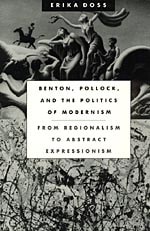
Benton, Pollock, and the Politics of Modernism
From Regionalism to Abstract ExpressionismErika Doss
University of Chicago Press, 1991
"A welcome addition to the growing body of literature that deals with the art and culture of the depression and cold war eras. It is a pioneering work that makes a valuable contribution to our understanding of a puzzling conundrum of American art—the shift from regionalism to abstract expressionism."—M. Sue Kendall, Winterthur Portfolio
"An important scholarly contribution. . . . This book will stand as a step along the way to a better understanding of the most amazing transition in the art of our tumultuous century."—James G. Rogers, Jr., Art Journal
"A valuable and interesting book that restores continuity and political context to the decades of depression and war."—Marlene Park, American Historical Review
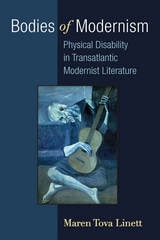
Bodies of Modernism
Physical Disability in Transatlantic Modernist LiteratureMaren Tova Linett
University of Michigan Press, 2016
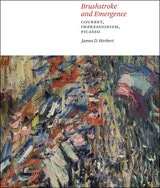
Brushstroke and Emergence
Courbet, Impressionism, PicassoJames D. Herbert
University of Chicago Press, 2015
Yet the question of how much we can credit to the individual brushstroke is complicated—and in Brushstroke and Emergence, James D. Herbert uses that question as a starting point for an extended essay that draws on philosophy of mind, the science of emergence, and art history. Brushstrokes, he reminds us, are as much creatures of habit and embodied experience as they are of intent. When they gather in great numbers they take on a life of their own, out of which emerge complexity and meaning. Analyzing ten paintings by Courbet, Manet, Cézanne, Monet, Seurat, and Picasso, Herbert exposes vital relationships between intention and habit, the singular and the complex. In doing so, he uncovers a space worthy of historical and aesthetic analysis between the brushstroke and the self.