Results by title
121 books match the query 'Motion picture industry' and 8 start with b
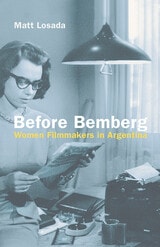
Before Bemberg
Women Filmmakers in ArgentinaMatt Losada
Rutgers University Press, 2020
Watch some of the films discussed in the book with English subtitles (https://www.youtube.com/channel/UCF_6F4am5024rklIWwExUVA?view_as=subscriber).
Below the Stars
How the Labor of Working Actors and Extras Shapes Media ProductionBy Kate Fortmueller
University of Texas Press, 2021
Longlisted for the 2022 Kraszna-Krausz Book Award, Moving Image Category
Despite their considerable presence in Hollywood, extras and working actors have received scant attention within film and media studies as significant contributors to the history of the industry. Looking not to the stars but to these supporting players in film, television, and, recently, streaming programming, Below the Stars highlights such actors as precarious laborers whose work as freelancers has critically shaped the entertainment industry throughout the twentieth and twenty-first centuries. By addressing ordinary actors as a labor force, Kate Fortmueller proposes a media industry history that positions underrepresented and quotidian experiences as the structural elements of the culture and business of Hollywood.
Resisting a top-down assessment, Fortmueller explores the wrangling of labor unions and guilds that advocated for collective action for everyday actors and helped shape professional norms. She pulls from archival research, in-person interviews, and firsthand observation to examine a history that cuts across industry boundaries and situates actors as a labor group at the center of industrial and technological upheavals, with lasting implications for race, gender, and labor relations in Hollywood.
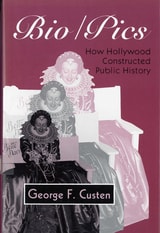
Bio/Pics
How Hollywood Constructed Public HistoryGeorge Custen
Rutgers University Press, 1992
Bio/Pics is the first comprehensive study of a once important film genre, the biographical film. Using previously unavailable archival materials from Twentieth Century-Fox, Warner Bros., MGM, and RKO studios, as well as censorship files from the Production Code Administration, George Custen argues that, through these films, Hollywood manufactured a nearly monochromatic view of history that was systematically distorted in regard to race, gender, nationality, and profession.Utilizing a carefully selected sample of over 100 films produced during the Studio Era (1927-1960), Custen maintains that the biopic constructed a Hollywood code of history out of a tightly controlled reference system, glamorizing the producers' own personal visions of what constituted a great life. Custen's examination of production practices reveals that the machinery of public history operating through these films was fueled by difference sources. His analysis of the roles played by star personae, legal considerations, censorship practices, and the producers' own ideologies brings the world of biopic alive, even into the age of the made-for-TV movie.
Black Women Directors
Christina N. Baker
Rutgers University Press, 2022
Black women have long recognized the power of film for storytelling. For far too long, however, the cultural and historical narratives about film have not accounted for the contributions of Black women directors. This book remedies this omission by highlighting the trajectory of the culturally significant work of Black women directors in the United States, from the under-examined pioneers of the silent era, to the documentarians who sought to highlight the voices and struggles of Black women, and the contemporary Black women directors in Hollywood. Applying a Black feminist perspective, this book examines the ways that Black women filmmakers have made a way for themselves and their work by resisting the dominant cultural expectations for Black women and for the medium of film, as a whole.
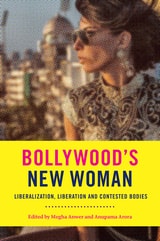
Bollywood’s New Woman
Liberalization, Liberation, and Contested BodiesMegha Anwer
Rutgers University Press, 2021
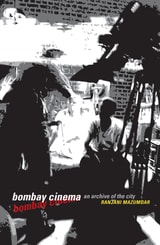
Bombay Cinema
An Archive of the CityRanjani Mazumdar
University of Minnesota Press, 2007
In this analysis of the cinematic city, Mazumdar reveals a complex postnationalist world, convulsed by the social crisis of the 1970s and transformed by the experience of globalization in the 1990s. She argues that the upheaval of postcolonial nationalism led to Bombay cinema’s articulation of urban life in entirely new terms. Specifically, the place of the village in the imaginary constitution of anticolonial nationalism gave way to a greater acknowledgment, even centrality, of urban space. Bombay Cinema takes the reader on an inventive journey through a cinematic city of mass crowds, violence, fashion, architectural fantasies, and subcultural identities. Moving through the world of gangsters and vamps, families and drifters, and heroes and villains, Bombay Cinema explores an urban landscape marked by industrial decline, civic crisis, working-class disenchantment, and diverse street life.Combining the anecdotal with the theoretical, the philosophical with the political, and the textual with the historical, Bombay Cinema leads the reader into the heart of the urban labyrinth in India, revising and deepening our understanding of both the city and the cinema.
"A landmark study—carefully researched, well organized and offering refreshingly uncondescending and strikingly insightful discussions of mainstream films—that deserves to be read by anyone interested in India's popular cinema or its contemporary urban life." —Journal of Asian Studies
"Bombay Cinema is an exciting and important contribution to a field that has, to date, been under researched and under theorized. Lively, provocative and richly suggestive, it will also serve as a surefire incentive to watch those films all over again." —Screen
"Here, at last, is a book length study on Cinema in India that does not get locked into a dance of hermetic closure between what transpires on screen and a set of stock off screen textual and cultural references, but more importantly, walks the streets where the films are set, looks at shop windows, publicity material, costumes, fashion, architecture, telecommunications and the concrete materiality that surrounds the film object." —Seminar
"Bombay Cinema is lucid, provocative, stylish and substantial. It is an illuminating scholarly study that spares no effort to bring Bombay cinema out of the academic closet." —The Book Review India
"Departing from the obsession that Film Studies in India has displayed with the idea of cinema as a national allegory, the book convincingly argues for the need to examine the city's hidden archive as one that cannot be subsumed within the sign of the national." —Biblio
"Mazumdar has a great capacity to discuss Indian cinema, with a brilliant grasp of its political, historical, and aesthetic developments, but equally she is well attuned to the interests and ruptures in the academic discourse of film and cinema studies."—Film International
"Mazumdar's experience as a filmmaker allowed her to offer significant readings of not just the narratives and character development in the films, but of the cinematography, mise-en-scene, and other technical and performance aspects of production." —Journal of Popular Culture
"At once about Hindi films, spatial practices, urban modernity and globalization . . . the strength of Bombay Cinema lies in bringing all of them together in a productive conversation.” —Economic and Political Weekly
"Bombay Cinema is methodologically challenging in its deployment of moments rather than discursiveformations of film as text. The book also refuses to read film alone, but interprets the medium alongside the detailed insights of people involved in making them, and with the recent history of Bombay, within which the film industry is located. In Mazumdar's evocative reading of the films she engages with, the cinematic city becomes the space of critique of the nation, the site of the ruin of the modern nationalist project." —Contemporary South Asia
Broadcasting Hollywood
The Struggle over Feature Films on Early TVJennifer Porst
Rutgers University Press, 2021
Business Plans for Filmmakers
John W. Cones
Southern Illinois University Press, 2010
The practical and legal aspects of writing a business plan for a film venture can be daunting to navigate without a firm grasp of know-how. With this in mind, John W. Cones's Business Plans for Filmmakers arms independent movie-makers and students with everything they need to successfully tackle the confusing intersection of law, business, and art when creating a business plan for a movie. This pragmatic volume offers plenty of examples and strategies for success, sharing straightforward insight into some of the toughest challenges independent filmmakers face when encountering these documents.
With simple yet thorough detail and clarity, Cones outlines the legal requirements affecting movie proposals, including ways to evaluate the necessity for a business plan or a securities disclosure document, as well as the legal definition of "an active investor." Also addressed are the numerous subjects filmmakers and students must consider before a film offering, including the efficacy of a business plan to fund the development, production, and distribution phases of a film; common elements of fraud of which fledgling filmmakers should beware; the intricacies of revenue sharing; and how to render financial projections. Cones also imparts useful distinctions between such industry terms as "company financing" versus "project financing," along with many others.
This bookalso includes in-depth guidance through the murky paths of investor analysis and key strategies to find and attract parties interested in financing film. Drawing upon his many years as a securities and entertainment attorney, and his experiences advising independent film producers, Cones offers the tools necessary not only to understand investors' motivations but also to use that knowledge to the filmmaker's advantage. Also provided are perceptive studies of the investment vehicles commonly used in business plans seeking investors, with analysis of each method's pros and cons. Throughout the volume, Cones uses sample plans to offer a real-world grasp of the intricacies of the business.
In the business of this art, knowledge is power. Business Plans for Filmmakers dispels the myths and misinformation circulating among filmmakers to provide accurate and useful advice.