Results by title
184 books match the query 'Murder' and 10 start with b
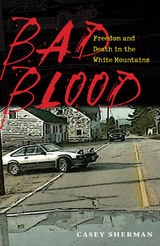
Bad Blood
Freedom and Death in the White MountainsCasey Sherman
University Press of New England, 2012
In the shadow of the fallen Old Man of the Mountain, on a lonely stretch of mountain road, two men lay dead. A spasm of violence that took only a few minutes to play out leaves a community divided and searching for answers. From the author of newly released Boston Strong: A City’s Triumph Over Tragedy, about the 2013 Boston Marathon bombings, Bad Blood is the riveting account of the long-standing feud between Franconia, New Hampshire, police officer Bruce McKay, 48, and Liko Kenney, 24. In May 2007, Kenney shot and killed Officer McKay, following a dramatic chase that began with a routine traffic stop. Kenney, cousin of ski legend Bode Miller, was then shot and killed by a shadowy passerby. Almost immediately, the tragic incident revealed deep tensions within this otherwise quiet community in the White Mountains with charges that Kenney was a hell-raiser and mentally unstable and counter-charges that Officer McKay was a rogue cop who dispensed justice as a way to settle personal scores. Striving to get at the truth of the story, the author uncovers a complicated mix of personalities and motivations. Local and statewide interests clash while regional and national media— and even YouTube viewers— supply ready stereotypes to fit their agendas. Amid larger questions of the meaning of individual freedom we are, ultimately, helpless witnesses to an inevitable clash of characters.
[more]
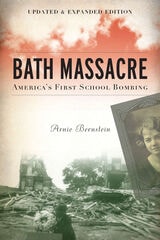
Bath Massacre, New Edition
America's First School BombingArnie Bernstein
University of Michigan Press, 2022
The new edition of this Michigan Notable Book includes a new introduction and stories from interviews with two additional survivors, Myrna (Gates) Coulter and Ralph Witchell, which took place after the first edition was published in 2009.
On May 18, 1927, the small town of Bath, Michigan, was forever changed when Andrew Kehoe set off a cache of explosives concealed in the basement of the local school. Thirty-eight children and six adults were dead, among them Kehoe, who had literally blown himself to bits by setting off a dynamite charge in his car. The next day, on Kehoe's farm, what was left of his wife—burned beyond recognition after Kehoe set his property and buildings ablaze—was found tied to a handcart, her skull crushed. With seemingly endless stories of school violence and suicide bombers filling today's headlines, Bath Massacre serves as a reminder that terrorism and large-scale murder are nothing new.
On May 18, 1927, the small town of Bath, Michigan, was forever changed when Andrew Kehoe set off a cache of explosives concealed in the basement of the local school. Thirty-eight children and six adults were dead, among them Kehoe, who had literally blown himself to bits by setting off a dynamite charge in his car. The next day, on Kehoe's farm, what was left of his wife—burned beyond recognition after Kehoe set his property and buildings ablaze—was found tied to a handcart, her skull crushed. With seemingly endless stories of school violence and suicide bombers filling today's headlines, Bath Massacre serves as a reminder that terrorism and large-scale murder are nothing new.
[more]
Bath Massacre
America's First School BombingArnie Bernstein
University of Michigan Press, 2009
"With the meticulous attention to detail of a historian and a storyteller's eye for human drama, Bernstein shines a beam of truth on a forgotten American tragedy. Heartbreaking and riveting."
---Gregg Olsen, New York Times best-selling author of Starvation Heights
"A chilling and historic character study of the unfathomable suffering that desperation and fury, once unleashed inside a twisted mind, can wreak on a small town. Contemporary mass murderers Timothy McVeigh, Columbine's Dylan Klebold, and Virginia Tech's Seung-Hui Cho can each trace their horrific genealogy of terror to one man: Bath school bomber Andrew Kehoe."
---Mardi Link, author of When Evil Came to Good Hart
On May 18, 1927, the small town of Bath, Michigan, was forever changed when Andrew Kehoe set off a cache of explosives concealed in the basement of the local school. Thirty-eight children and six adults were dead, among them Kehoe, who had literally blown himself to bits by setting off a dynamite charge in his car. The next day, on Kehoe's farm, what was left of his wife---burned beyond recognition after Kehoe set his property and buildings ablaze---was found tied to a handcart, her skull crushed. With seemingly endless stories of school violence and suicide bombers filling today's headlines, Bath Massacre serves as a reminder that terrorism and large-scale murder are nothing new.
[more]
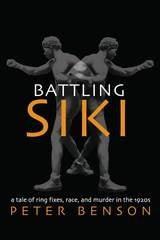
Battling Siki
A Tale of Ring Fixes, Race, and Murder in the 1920sPeter Benson
University of Arkansas Press, 2008
Battling Siki (1887–1925) was once one of the four or five most recognizable black men in the world, and was written about in detail by such figures as Ring Lardner and his son John, Damon Runyon, and Westbrook Pegler. One can find his legacy in the name of a popular rock group, one of Che Guevara’s lieutenants, a character on Xena, Warrior Princess, and the Battling Siki Hotel in the fighter’s homeland, Senegal. Peter Benson’s biography of the first African to win a world championshipin boxing delves into the complex world of sports, race, colonialism, and the cult of personality in the early twentieth century. Born Amadu Fall, Siki was taken from Senegal to France by an actress and assumed the name Louis M’barick Fall. After an inauspicious beginning as a boxer, he served in World War I with distinction then returned to boxing and compiled a most impressive record (forty-three wins in forty-six bouts). Then, on September 24, 1922, at Paris’s Buffalo Velodrome, before forty thousand stunned spectators (including a young Ernest Hemingway, who wrote about the fight), Battling Siki, employing his trademark “windmill” punch, fought and defeated the reigning world and European light heavyweight champion, Georges Carpentier. The colorful Siki spent a fortune partying and carousing, was arrested for firing a pistol in the air, and was frequently seen on the streets of Paris, dressed in flashy clothes, walking his pet lion cubs on a leash. But he also provoked a scandal by exposing the corruption of the fight game in France, spoke out boldly against racisim, and was arrected for deliberately defying the code of racial segregation in the American South. Siki’s flamboyant image was largely created by newsmen. In fact, the real Siki, while he did certainly like to party, was also an intelligent and socially conscious person, who detested the media’s image of him as a simple-minded drunken savage. Offers rushed in for him to fight in the United States, maybe even against Jack Dempsey. But in a move many have called one of the strangest a fighter ever made, he fought Irishman Mike McTigue in Dublin on St. Patrick’s Day—and lost. After losing his European title he came to the United States and fought without much success. He continued to drink and get into street brawls. On the evening of December 15, 1925, at the age of twenty-eight, he was shot and killed in Hell’s Kitchen in what some claimed was a gangland execution. Peter Benson’s biography beautifully captures Battling Siki’s amazing boxing career and sheds new light on the scandal surrounding his marriages and public behavior, his alleged participation in ring fixes, and the mystery surrounding his death.
[more]
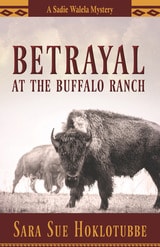
Betrayal at the Buffalo Ranch
Sara Sue Hoklotubbe
University of Arizona Press, 2018
When Sadie Walela learns that her new neighbor in Cherokee Country, Angus Clyborn’s Buffalo Ranch, offers rich customers a chance to kill buffalo for fun, she is horrified. No good can surely come from this. It doesn’t, and murder soon follows.
Even though Deputy Sheriff Lance Smith, Sadie’s love interest, suspects a link to the Buffalo Ranch, he can find little evidence to make an arrest. And when a rare white buffalo calf is born on the ranch and immediately disappears, Sadie’s instincts tell her something is wrong—and she sets out to prove it. Her suspicions—and fears of more violence—escalate when a former schoolmate returns to Oklahoma to visit her ailing father and finds employment at the ranch. Will she be the next victim?
Drawn deeper and deeper into danger, Sadie uncovers an unparalleled web of greed and corruption. It will take all of her investigative skill to set things straight—assuming she and her wolfdog can stay alive long enough to succeed.
[more]
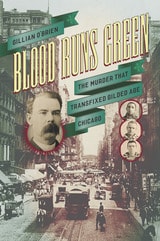
Blood Runs Green
The Murder That Transfixed Gilded Age ChicagoGillian O'Brien
University of Chicago Press, 2015
The dramatic story of a Gilded Age murder that shocked people from Chicago to Ireland
It was the biggest funeral Chicago had seen since Lincoln’s. On May 26, 1889, four thousand mourners proceeded down Michigan Avenue, followed by a crowd forty thousand strong, in a howl of protest at what commentators called one of the ghastliest and most curious crimes in civilized history. The dead man, Dr. P. H. Cronin, was a respected Irish physician, but his brutal murder uncovered a web of intrigue, secrecy, and corruption that stretched across the United States and far beyond.
Blood Runs Green tells the story of Cronin’s murder from the police investigation to the trial. It is a story of hotheaded journalists in pursuit of sensational crimes, of a bungling police force riddled with informers and spies, and of a secret revolutionary society determined to free Ireland but succeeding only in tearing itself apart. It is also the story of a booming immigrant population clamoring for power at a time of unprecedented change.
From backrooms to courtrooms, historian Gillian O’Brien deftly navigates the complexities of Irish Chicago, bringing to life a rich cast of characters and tracing the spectacular rise and fall of the secret Irish American society Clan na Gael. She draws on real-life accounts and sources from the United States, Ireland, and Britain to cast new light on Clan na Gael and reveal how Irish republicanism swept across the United States. Destined to be a true crime classic, Blood Runs Green is an enthralling tale of a murder that captivated the world and reverberated through society long after the coffin closed.
[more]

Blood Ties
Sex, Scandal, and Serial Murder at the Turn of the Twentieth CenturyHarold Schechter
University of Iowa Press, 2027
[more]
Brother Bullet
PoemsCasandra López
University of Arizona Press, 2019
Speaking to both a personal and collective loss, in Brother Bullet Casandra López confronts her relationships with violence, grief, guilt, and ultimately, endurance. Revisiting the memory and lasting consequences of her brother’s murder, López traces the course of the bullet—its trajectory, impact, wreckage—in lyrical narrative poems that are haunting and raw with emotion, yet tender and alive in revelations of light.
Drawing on migratory experiences, López transports the reader to the Inland Empire, Baja California, New Mexico, and Arizona to create a frame for memory, filled with imagery, through the cyclical but changing essence of sorrow. This is paralleled with surrounding environments, our sense of belonging—on her family’s porch, or in her grandfather’s orange grove, or in the darkest desert. López’s landscapes are geographical markers and borders, connecting shared experiences and memories.
Brother Bullet tugs and pulls, drawing us into a consciousness—a story—we all bear.
[more]
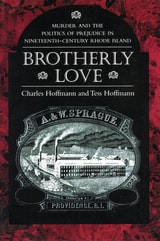
Brotherly Love
Murder and the Politics of Prejudice in Nineteenth-Century Rhode IslandCharles Hoffmann
University of Massachusetts Press, 1993
On New Year's Eve in 1843, Rhode Island textile manufacturer Amasa Sprague was shot and beaten to death. Within two days, three Irish immigrant brothers were arrested, charged with murder, and eventually brought to trial.
Brotherly Love is a graphic reconstruction of the crime, its social and economic background, and the subsequent trials. The story reveals the antagonism between native-born Yankees, who commanded great power, and the growing number of Irish Catholic immigrants, most of whom worked in the textile mills. Indeed, the economic, political, and religious dimensions of the conflict are all evident in the trials.
The authors argue persuasively that the Gordons were victims of bigotry and circumstantial evidence, serving as convenient scapegoats to appease a community outraged over the murder of its wealthiest citizen. In telling the story of this notorious case, Brotherly Love reveals the politics of prejudice in nineteenth-century New England as played out in community and courtroom.
[more]
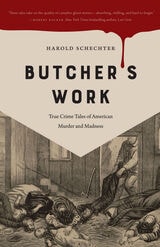
Butcher's Work
True Crime Tales of American Murder and MadnessHarold Schechter
University of Iowa Press, 2022
A Civil War veteran who perpetrated one of the most ghastly mass slaughters in the annals of U.S. crime. A nineteenth-century female serial killer whose victims included three husbands and six of her own children. A Gilded Age “Bluebeard” who did away with as many as fifty wives throughout the country. A decorated World War I hero who orchestrated a murder that stunned Jazz Age America. While other infamous homicides from the same eras—the Lizzie Borden slayings, for example, or the “thrill killing” committed by Leopold and Loeb—have entered into our cultural mythology, these four equally sensational crimes have largely faded from public memory. A quartet of gripping historical true-crime narratives, Butcher’s Work restores these once-notorious cases to vivid, dramatic life.
[more]