Results by title
111 books match the query 'Museum Studies' and 4 start with b
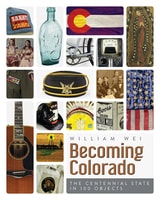
Becoming Colorado
The Centennial State in 100 ObjectsWilliam Wei
University Press of Colorado, 2021
In Becoming Colorado, historian William Wei paints a vivid portrait of Colorado history using 100 of the most compelling artifacts from Colorado’s history. These objects reveal how Colorado has evolved over time, allowing readers to draw multiple connections among periods, places, and people. Collectively, the essays offer a treasure trove of historical insight and unforgettable detail.
Beginning with Indigenous people and ending in the early years of the twenty-first century, Wei traces Colorado’s story by taking a close look at unique artifacts that bring to life the cultures and experiences of its people. For each object, a short essay accompanies a full-color photograph. These accessible accounts tell the human stories behind the artifacts, illuminating each object’s importance to the people who used it and its role in forming Colorado’s culture. Together, they show how Colorado was shaped and how Coloradans became the people they are. Theirs is a story of survival, perseverance, enterprise, and luck.
Providing a fresh lens through which to view Colorado’s past, Becoming Colorado tells an inclusive story of the Indigenous and the immigrant, the famous and the unknown, the vocal and the voiceless—for they are all Coloradans.
Biennial Boom
Making Contemporary Art GlobalPaloma Checa-Gismero
Duke University Press, 2024
Black Curators Matter
Conversations on Art and ChangeKellie Jones
J. Paul Getty Trust, The, 2026
Selected as one of Hyperallergic’s 15 Art Books We’re Excited to Read in 2026
This book chronicles the transformative impact of Black curators on American art museums since the 1970s as told by visionaries at the forefront of the change.
The relationship between Black Americans and U.S. art museums has historically been fraught and hard-won. In the late 1960s, the Black Emergency Cultural Coalition and other groups organized protests at major art museums, calling for the inclusion of Black artists and curators. Such advocacy led to acquisitions and exhibitions by Black artists at important institutions and spurred the establishment of museums and cultural organizations promoting Black art and culture. Today, Black curators hold significant positions at institutions nationwide. Black Curators Matter illuminates this critical history by spotlighting figures who have transformed the art world since the 1970s.
This book presents illuminating conversations between six pioneering curators—Lowery Stokes Sims, Deborah Willis, Richard J. Powell, Kellie Jones, Thelma Golden, and Franklin Sirmans—and a new generation of professionals, including Ashley James, Kalia Brooks, Aaron Bryant, Thomas Jean Lax, Rujeko Hockley, and LeRonn P. Brooks. Capturing the voices and experiences of Black curators, these discussions highlight their achievements and provide guidance for future generations aiming to diversify and enrich the cultural landscape. This volume reexamines the curatorial field to reveal the transformative strategies, critical interventions, and boundary-breaking exhibitions that reshaped American art museums toward greater inclusivity and experimentation.
Building a Nation
Chickasaw Museums and the Construction of History and HeritageJoshua M. Gorman
University of Alabama Press, 2011
A groundbreaking study of Indigenous museums and cultural self-representation.
The Chickasaw Nation, an American Indian nation headquartered in southeastern Oklahoma, entered into a period of substantial growth in the late 1980s. Following its successful reorganization and expansion, which was enabled by federal policies for tribal self-determination, the Nation pursued gaming and other industries to affect economic growth. From 1987 to 2009 the Nation’s budget increased exponentially as tribal investments produced increasingly large revenues for a growing Chickasaw population. Coincident to this growth, the Chickasaw Nation began acquiring and creating museums and heritage properties to interpret their own history, heritage, and culture through diverse exhibitionary representations. By 2009, the Chickasaw Nation directed representation of itself at five museum and heritage properties throughout its historic boundaries.
Josh Gorman examines the history of these sites and argues that the Chickasaw Nation is using museums and heritage sites as places to define itself as a coherent and legitimate contemporary Indian nation. In doing so, they are necessarily engaging with the shifting historiographical paradigms as well as changing articulations of how museums function and what they represent. The roles of the Chickasaw Nation’s museums and heritage sites in defining and creating discursive representations of sovereignty are examined within their historicized local contexts. The work describes the museum exhibitions’ dialogue with the historiography of the Chickasaw Nation, the literature of new museum studies, and the indigenous exhibitionary grammars emerging from indigenous museums throughout the United States and the world.