99 books match the query 'Muslims' and 6 start with b
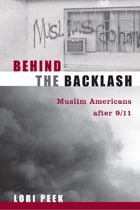
cover of Behind the Backlash: Muslim Americans After 9/11

Behind the Backlash

Muslim Americans After 9/11

Lori Peek

Temple University Press, 2010

As the nation tried to absorb the shock of the 9/11 attacks, Muslim Americans were caught up in an unprecedented wave of backlash violence. Public discussion revealed that widespread misunderstanding and misrepresentation of Islam persisted, despite the striking diversity of the Muslim community.

Letting the voices of 140 ordinary Muslim American men and women describe their experiences, Lori Peek's path-breaking book, Behind the Backlash presents moving accounts of prejudice and exclusion. Muslims speak of being subjected to harassment before the attacks, and recount the discrimination they encountered afterwards. Peek also explains the struggles of young Muslim adults to solidify their community and define their identity during a time of national crisis.

Behind the Backlash seeks to explain why blame and scapegoating occur after a catastrophe. Peek sets the twenty-first century experience of Muslim Americans, who were vilified and victimized, in the context of larger sociological and psychological processes. Peek’s book will be of interest to those in disaster research studies, sociology of religion, and race and ethnic relations.
[more]
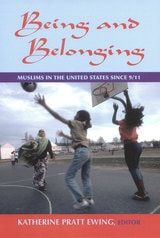
cover of Being and Belonging: Muslims in the United States since 9/11

Being and Belonging

Muslims in the United States since 9/11

Katherine Pratt Ewing

Russell Sage Foundation, 2008
The terrorist attacks of September 11, 2001, instantly transformed many ordinary Muslim and Arab Americans into suspected terrorists. In the weeks and months following the attacks, Muslims in the United States faced a frighteningly altered social climate consisting of heightened surveillance, interrogation, and harassment. In the long run, however, the backlash has been more complicated. In Being and Belonging, Katherine Pratt Ewing leads a group of anthropologists, sociologists, and cultural studies experts in exploring how the events of September 11th have affected the quest for belonging and identity among Muslims in America—for better and for worse. From Chicago to Detroit to San Francisco, Being and Belonging takes readers on an extensive tour of Muslim America—inside mosques, through high school hallways, and along inner city streets.  Jen'nan Ghazal Read compares the experiences of Arab Muslims and Arab Christians in Houston and finds that the events of 9/11 created a "cultural wedge" dividing Arab Americans along religious lines. While Arab Christians highlighted their religious affiliation as a means of distancing themselves from the perceived terrorist sympathies of Islam, Muslims quickly found that their religious affiliation served as a barrier, rather than a bridge, to social and political integration. Katherine Pratt Ewing and Marguerite Hoyler document the way South Asian Muslim youth in Raleigh, North Carolina, actively contested the prevailing notion that one cannot be both Muslim and American by asserting their religious identities more powerfully than they might have before the terrorist acts, while still identifying themselves as fully American. Sally Howell and Amaney Jamal distinguish between national and local responses to terrorism. In striking contrast to the erosion of civil rights, ethnic profiling, and surveillance set into motion by the federal government, well-established Muslim community leaders in Detroit used their influence in law enforcement, media, and social services to empower the community and protect civil rights. Craig Joseph and Barnaby Riedel analyze how an Islamic private school in Chicago responded to both September 11 and the increasing ethnic diversity of its student body by adopting a secular character education program to instruct children in universal values rather than religious doctrine. In a series of poignant interviews, the school's students articulate a clear understanding that while 9/11 left deep wounds on their community, it also created a valuable opportunity to teach the nation about Islam. The rich ethnographies in this volume link 9/11 and its effects to the experiences of a group that was struggling to be included in the American mainstream long before that fateful day. Many Muslim communities never had a chance to tell their stories after September 11. In Being and Belonging, they get that chance.
[more]
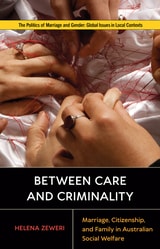
cover of Between Care and Criminality: Marriage, Citizenship, and Family in Australian Social Welfare

Between Care and Criminality

Marriage, Citizenship, and Family in Australian Social Welfare

Helena Zeweri

Rutgers University Press, 2024
Between Care and Criminality examines social welfare’s encounter with migration and marriage in a period of intensified border control in Melbourne, Australia. It offers an in-depth ethnographic account of the effort to prevent forced marriage in the aftermath of a 2013 law that criminalized the practice. Disproportionately targeted toward Muslim migrant communities, prevention efforts were tasked with making the family relations and marital practices of migrants objects of policy knowledge in the name of care and community empowerment. Through tracing the everyday ways that direct service providers, police, and advocates learned to identify imminent marriages and at-risk individuals, this book reveals how the domain of social welfare becomes the new frontier where the settler colonial state judges good citizenship. In doing so, it invites social welfare to reflect on how migrant conceptions of familial care, personhood, and mutual obligation become structured by the violence of displacement, borders, and conditional citizenship.
[more]
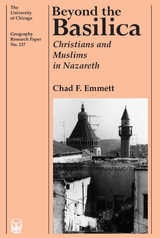
cover of Beyond the Basilica: Christians and Muslims in Nazareth

Beyond the Basilica

Christians and Muslims in Nazareth

Chad F. Emmett

University of Chicago Press, 1994

Nazareth, the largest Arab city in Israel, is a surprising example of ethnic harmony in a region dominated by conflict. A recent trend toward integration of its historical Greek Orthodox, Roman Catholic, and Muslim quarters however, has disrupted the harmony. In Beyond the Basilica: Christians and Muslims in Nazareth, Chad F. Emmett provides penetrating analysis of the complex relationship between the structure of Nazareth’s quarters and the relations between its ethnic communities.

Emmett describes both the positive and negative effects of Nazareth’s residential patterns. He shows that the addition of new and ethnically mixed quarters has promoted mixed schools, joint holiday celebrations, a common political culture, and social networks that cross ethnic boundaries. But he also finds that tensions exist among Christian groups and between Muslims and Christians in regard to intersectarian marriages, religious conversion, attempts to establish a joint Christian cemetery, and the emergence of a local Islamic party.

Extensive interviews with leaders of religious groups, political parties, and residents reveal the way in which members of each ethnic community perceive one another. A survey of 300 families gives a wealth of details about the make-up of Nazareth’s population, including residential histories, religion, level of religious conviction, friendship and shopping patterns, and much more. Fourteen maps trace changes in the distribution of religious groups and political affiliation in Nazareth from the mid-nineteenth century to the present.

Beyond the Basilica will interest cultural geographers, historians, demographers, political scientists, and anyone who would like to learn more about an ethnically divided community in the residents cooperate more than they fight.
[more]
cover of Black Nationalism: The Search for an Identity

Black Nationalism

The Search for an Identity

E. U. Essien-Udom

University of Chicago Press, 1995

One of the first studies of the organization, life and meaning of the Nation of Islam and, by extension, all Black Nationalist movements, this classic work dispels the still common conception that the movement functioned primarily for political purposes. By observing the daily life of its members, Essien-Udom demonstrates that the Nation of Islam served primarily as a means for poor urban blacks to attain a national identity, a sense of ethnic consciousness, and empowerment in a society that denied them these privileges. Black Nationalism continues to hold profound implications for our understanding of the appeal of Black Nationalism as an ideology and a political force.

"An excellent standard treatment of black nationalist belief and practice in the 50's."—Michael Eric Dyson, New York Times Book Review

"This is an absorbing exercise in first class reporting. . . . In the light of his scrupulous fairness, the book is another illustration of how the press prejudges a story. And most provocatively, Essien-Udom has emphasized that even after the current campaigns for wide-scale integration are won, there will be an even wider chasm between the 'liberated' Negro middle class and the rootless Negro poor."—Nat Hentoff,Commonweal
[more]
cover of Black Star, Crescent Moon: The Muslim International and Black Freedom beyond America

Black Star, Crescent Moon

The Muslim International and Black Freedom beyond America

Sohail Daulatzai

University of Minnesota Press, 2012

“The same rebellion, the same impatience, the same anger that exists in the hearts of the dark people in Africa and Asia,” Malcolm X declared in a 1962 speech, “is existing in the hearts and minds of 20 million black people in this country who have been just as thoroughly colonized as the people in Africa and Asia.” Four decades later, the hip-hop artist Talib Kweli gave voice to a similar Pan-African sentiment in the song “K.O.S. (Determination)”: “The African diaspora represents strength in numbers, a giant can't slumber forever.”

Linking discontent and unrest in Harlem and Los Angeles to anticolonial revolution in Algeria, Egypt, and elsewhere, Black leaders in the United States have frequently looked to the anti-imperialist movements and antiracist rhetoric of the Muslim Third World for inspiration. In Black Star, Crescent Moon, Sohail Daulatzai maps the rich, shared history between Black Muslims, Black radicals, and the Muslim Third World, showing how Black artists and activists imagined themselves not as national minorities but as part of a global majority, connected to larger communities of resistance. Daulatzai traces these interactions and alliances from the Civil Rights movement and the Black Power era to the “War on Terror,” placing them within a broader framework of American imperialism, Black identity, and the global nature of white oppression.

From Malcolm X and Muhammad Ali to contemporary artists and activists like Rakim and Mos Def, Black Star, Crescent Moon reveals how Muslim resistance to imperialism came to occupy a central position within the Black radical imagination, offering a new perspective on the political and cultural history of Black internationalism from the 1950s to the present.

[more]