Results by title
52 books match the query 'Mythology' and 4 start with b
Baby and Child Heroes in Ancient Greece
Corinne Ondine Pache
University of Illinois Press, 2004
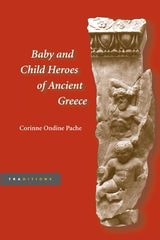
In addition to their famous gods and goddesses, the ancient Greeks also worshiped deceased human beings, including child and baby heroes. Although these heroes played an essential role in Greek religion, Corinne Ondine Pache's Baby and Child Heroes in Ancient Greece is the first systematic study of the considerable number of Greek babies and children who became enduring myths, objects of worship, and the recipients of sacrifice.
Examining literary, pictorial, and numismatic representations, Pache opens up a vast territory once occupied by children such as Charila, Opheltes, Melikertes, and the children of Herakles and Medea. She elegantly argues that the stories, songs, and sanctuaries honoring these heroes express parental fears and guilt about children's death. Pache further demonstrates that while the myths and rituals articulate basic human anxieties, their emphasis is ultimately on the beauty that transcends the gruesomeness of the narrative, turning their dread into poetry. By showing the continuity of child heroes in Greek religion, she is able to throw new light on iconographies that have previously defied explanation.
Examining literary, pictorial, and numismatic representations, Pache opens up a vast territory once occupied by children such as Charila, Opheltes, Melikertes, and the children of Herakles and Medea. She elegantly argues that the stories, songs, and sanctuaries honoring these heroes express parental fears and guilt about children's death. Pache further demonstrates that while the myths and rituals articulate basic human anxieties, their emphasis is ultimately on the beauty that transcends the gruesomeness of the narrative, turning their dread into poetry. By showing the continuity of child heroes in Greek religion, she is able to throw new light on iconographies that have previously defied explanation.
[more]
Birds and Beasts of Ancient Mesoamerica
Animal Symbolism in the Postclassic PeriodSusan Milbrath
University Press of Colorado, 2025
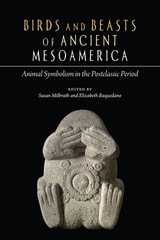
Birds and Beasts of Ancient Mesoamerica links Precolumbian animal imagery with scientific data related to animal morphology and behavior, providing in-depth studies of the symbolic importance of animals and birds in Postclassic period Mesoamerica.
Representations of animal deities in Mesoamerica can be traced back at least to Middle Preclassic Olmec murals, stone carvings, and portable art such as lapidary work and ceramics. Throughout the history of Mesoamerica real animals were merged with fantastical creatures, creating zoological oddities not unlike medieval European bestiaries. According to Spanish chroniclers, the Aztec emperor was known to keep exotic animals in royal aviaries and zoos. The Postclassic period was characterized by an iconography that was shared from central Mexico to the Yucatan peninsula and south to Belize. In addition to highlighting the symbolic importance of nonhuman creatures in general, this volume focuses on the importance of the calendrical and astronomical symbolism associated with animals and birds.
Inspired by and dedicated to the work of Mesoamerican scholar Cecelia Klein and featuring imagery from painted books, monumental sculpture, portable arts, and archaeological evidence from the field of zooarchaeology, Birds and Beasts of Ancient Mesoamerica highlights the significance of the animal world in Postclassic and early colonial Mesoamerica. It will be important to students and scholars studying Mesoamerican art history, archaeology, ethnohistory, and zoology.
[more]
Bloody Bill Longley
The Mythology of a Gunfighter, Second EditionRick Miller
University of North Texas Press, 2011
[more]
Building the East German Myth
Historical Mythology and Youth Propaganda in the German Democratic Republic, 1945-1989Alan L. Nothnagle
University of Michigan Press, 1999
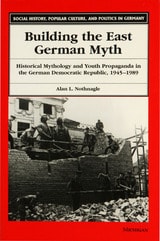
Ten years after the fall of the Berlin Wall, the political and economic structures of the former German Democratic Republic are largely understood, yet many questions remain. What actually motivated the East Germans themselves? What common goals and values kept GDR society going and, until its unexpected collapse in 1989, seemed to make it into a relative success story? Building the East German Myth examines the East German communist party's propagandistic treatment of German high culture, antifascism, "German-Soviet" friendship, and the German nationalist tradition. In this pathbreaking study, Alan Nothnagle argues that the party's mass events and indoctrination campaigns were not mere propaganda, but rather an ingenious program of mythbuilding by which young people were instilled with a dynamic and nearly inescapable mythology. Using a wealth of previously unexplored sources, Nothnagle shows this mythology was as essential to the GDR's existence as the Wall of the Soviet occupation and, as its leaders discovered in 1989, the GDR could not survive without it. Alongside the economic and human costs this book demonstrates, the loss of honesty, subtlety, and a sense of proportion may represent the most devastating legacy of the East German experience. Written to appeal to both specialists and non-specialists, Building the East German Myth will prove essential reading for those interested in German and European history, communism, political propaganda, and Cold War culture.
[more]