Results by title
59 books match the query 'Narratives' and 2 start with b
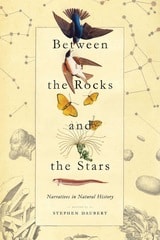
Between the Rocks and the Stars
Narratives in Natural HistoryStephen Daubert
Vanderbilt University Press, 2020
These stories take readers where they cannot go, be it out into space, back in time, deep under the ocean, down to microscopic scales, or out onto the geologic overview.
Squid turn themselves inside-out when disturbed by predators hunting through the darkness with sonar. Beneficial microbes spend their summer living in nectar and being transferred between blooms by the bees, then spend the winter living within those bees. Ecological stories are seen through the eyes of squirrels, birds, fish, ants, butterflies, and beetles.
Between the Rocks and the Stars dives deep into the relationships that shape the natural world. The book presents a collection of vignettes from the wild, each of which describes the natural advantage of a particular organism. These true-to-life accounts are then posed in particular circumstances that illustrate the principles—commensalism, speciation—that shape the place of these organisms in their living environment. Some stories cover topics in geology and cosmology, describing the physical world context in which natural history progresses across the eons.
Underlying themes in the book include the network of connections that link all these organisms together and the adaptations they make to the physical world in which they must find themselves a home.
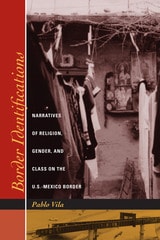
Border Identifications
Narratives of Religion, Gender, and Class on the U.S.-Mexico BorderBy Pablo Vila
University of Texas Press, 2005
From poets to sociologists, many people who write about life on the U.S.-Mexico border use terms such as "border crossing" and "hybridity" which suggest that a unified culture—neither Mexican nor American, but an amalgamation of both—has arisen in the borderlands. But talking to people who actually live on either side of the border reveals no single commonly shared sense of identity, as Pablo Vila demonstrated in his book Crossing Borders, Reinforcing Borders: Social Categories, Metaphors, and Narrative Identities on the U.S.-Mexico Frontier. Instead, people living near the border, like people everywhere, base their sense of identity on a constellation of interacting factors that includes regional identity, but also nationality, ethnicity, and race.
In this book, Vila continues the exploration of identities he began in Crossing Borders, Reinforcing Borders by looking at how religion, gender, and class also affect people's identifications of self and "others" among Mexican nationals, Mexican immigrants, Mexican Americans, Anglos, and African Americans in the Cuidad Juárez-El Paso area. Among the many fascinating issues he raises are how the perception that "all Mexicans are Catholic" affects Mexican Protestants and Pentecostals; how the discourse about proper gender roles may feed the violence against women that has made Juárez the "women's murder capital of the world"; and why class consciousness is paradoxically absent in a region with great disparities of wealth. His research underscores the complexity of the process of social identification and confirms that the idealized notion of "hybridity" is only partially adequate to define people's identity on the U.S.-Mexico border.