Results by title
208 books match the query 'Nation' and 14 start with b

Bad Language, Naked Ladies, and Other Threats to the Nation
A Political History of Comic Books in MexicoAnne Rubenstein
Duke University Press, 1998
Since their first appearance in 1934, comic books enjoyed wide readership, often serving as a practical guide to life in booming new cities. Conservative protest against the so-called immorality of these publications, of mass media generally, and of Mexican modernity itself, however, led the Mexican government to establish a censorship office that, while having little impact on the content of comic books, succeeded in directing conservative ire away from government policies and toward the Mexican media. Bad Language, Naked Ladies, and Other Threats to the Nation examines the complex dynamics of the politics of censorship occasioned by Mexican comic books, including the conservative political campaigns against them, government and industrial responses to such campaigns, and the publishers’ championing of Mexican nationalism and their efforts to preserve their publishing empires through informal influence over government policies. Rubenstein’s analysis suggests a new Mexican history after the revolution, one in which negotiation over cultural questions replaced open conflict and mass-media narrative helped ensure political stability.
This book will engage readers with an interest in Mexican history, Latin American studies, cultural studies, and popular culture.
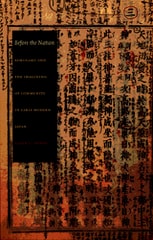
Before the Nation
Kokugaku and the Imagining of Community in Early Modern JapanSusan L. Burns
Duke University Press, 2003
Central to Burns's analysis is Motoori Norinaga’s Kojikiden, arguably the most important intellectual work of Japan's early modern period. Burns situates the Kojikiden as one in a series of attempts to analyze and interpret the mythohistories dating from the early eighth century, the Kojiki and Nihon shoki. Norinaga saw these texts as keys to an original, authentic, and idyllic Japan that existed before being tainted by "flawed" foreign influences, notably Confucianism and Buddhism. Hailed in the nineteenth century as the begetter of a new national consciousness, Norinaga's Kojikiden was later condemned by some as a source of Japan's twentieth-century descent into militarism, war, and defeat. Burns looks in depth at three kokugaku writers—Ueda Akinari, Fujitani Mitsue, and Tachibana Moribe—who contested Norinaga's interpretations and produced competing readings of the mythohistories that offered new theories of community as the basis for Japanese social and cultural identity. Though relegated to the footnotes by a later generation of scholars, these writers were quite influential in their day, and by recovering their arguments, Burns reveals kokugaku as a complex debate—involving history, language, and subjectivity—with repercussions extending well into the modern era.

Believing in Cleveland
Managing Decline in “The Best Location in the Nation”J. Mark Souther
Temple University Press, 2017
Detractors have called it "The Mistake on the Lake." It was once America’s "Comeback City." According to author J. Mark Souther, Cleveland has long sought to defeat its perceived civic malaise. Believing in Cleveland chronicles how city leaders used imagery and rhetoric to combat and, at times, accommodate urban and economic decline.
Souther explores Cleveland's downtown revitalization efforts, its neighborhood renewal and restoration projects, and its fight against deindustrialization. He shows how the city reshaped its image when it was bolstered by sports team victories. But Cleveland was not always on the upswing. Souther places the city's history in the postwar context when the city and metropolitan area were divided by uneven growth. In the 1970s, the city-suburb division was wider than ever.
Believing in Cleveland recounts the long, difficult history of a city that entered the postwar period as America's sixth largest, then lost ground during a period of robust national growth. But rather than tell a tale of decline, Souther provides a fascinating story of resilience for what some folks called "The Best Location in the Nation."
Between Frontiers
Nation and Identity in a Southeast Asian BorderlandNoboru Ishikawa
Ohio University Press, 2010
Noboru Ishikawa grounds his discussion of border zones in materials gathered during two years of archival research and fieldwork relating to the boundary that separates Malaysian from Indonesian territory in western Borneo. His book considers how the state maintains its national space and how people strategically situate themselves by their community, nation, and ethnic group designated as national territory. Examining these issues in the context of concrete circumstances, where a village boundary coincides with a national border, allows him to delineate the dialectical relationship between nation-state and borderland society both as history and as process. Scholars across the humanities and social sciences will learn from this masterful linking of history and ethnography, and of macro and micro perspectives.

Between Woman and Nation
Nationalisms, Transnational Feminisms, and the StateCaren Kaplan, Norma Alarcón, and Minoo Moallem, eds.
Duke University Press, 1999
This interdisciplinarily collection investigates women in diverse locales—ranging from Quebec to Beirut. The contributors consider such subjects as Yucatan feminism, Islamic fundamentalisms, Canadian gender formations, historic Chicana/o struggles, and Israeli/Palestinian conflicts. Divided into three parts, the collection first examines constructions of nationalism and communities whose practices complicate these constructions. The second section discusses regulations of particular nation-states and how they affect the lives of women, while the third presents studies of transnational identity formation, in which contributors critique ideas such as “multicultural nationalism” and “global feminism.” Arguing provocatively that such movements and concepts inadequately represent women’s interests, contributors examine how such beliefs and their attendant organizations may actually bolster the very formations they ought to subvert.
In its demonstration of the critical possibilities of feminist alliances across discrepant and distinct material conditions, Between Woman and Nation will make a unique contribution to women’s studies, feminist theory, studies of globalization and transnationalism, ethnic studies, and cultural studies.
Beyond Mosque, Church, and State
Alternative Narratives of the Nation in the BalkansYana Hashamova
Central European University Press, 2016
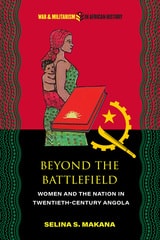
Beyond the Battlefield
Women and the Nation in Twentieth-Century AngolaSelina S. Makana
Ohio University Press, 0
Beyond the Battlefield offers a critical reappraisal of Angola’s nationalist history by centering the experiences and political agency of women during the country’s transition from Portuguese colonial rule to independence. Challenging dominant masculinist narratives that equate anticolonial resistance with armed combat, this study introduces maternalist nationalism as a theoretical framework to illuminate how women engaged in nation building through often-overlooked forms of labor and activism.
While men were largely visible on the battlefield, women fought a parallel struggle on the home front—mobilizing care work, reproductive labor, and political engagement in ways that were essential to the liberation movement and the postindependence state. Drawing on archival sources and women’s testimonies, Makana explores how patriotic motherhood—a concept defined as the fusion of nationalist politics with gendered expectations of women’s roles—enabled women to see themselves as vital contributors to the nation’s future.
This study contributes to scholarship in African history, gender studies, and postcolonial theory by offering a nuanced account of the intersections among militarism, nationalism, and gender. It invites readers to reconsider the frameworks through which political subjectivity and historical memory are constructed. Beyond the Battlefield is an essential resource for scholars and students interested in the gendered dimensions of colonialism, war, and state formation in modern Africa.

Biogenetic Paradoxes of the Nation
Finncattle, Apples, and Other Genetic-Resource PuzzlesSakari Tamminen
Duke University Press, 2019

Birth of a Nation
D.W. Griffith, DirectorRobert Lang
Rutgers University Press, 1993
Robert Lang's introduction to this volume explores in fascinating detail the warped view of history that this great film presents. Griffith, a Southerner, was intent on resurrecting, idealizing, and justifying the South. In The Birth of a Nation, it is racism that unites the white North and South; the protection or abolition of slavery is not the divisive issue. In a powerful synthesis of spectacle and narrative, Griffith seeks to give the Southern cause a sense of glamour and high purpose. Lang considers the film as a historical melodrama, and by examining Griffith's "historiography as ideological practice," he traces the way in which the bloody, traumatic reality of the Civil War and Reconstruction becomes melodramatic myth. This unparalleled guide to The Birth of a Nation offers a shot-by-shot continuity script; a biographical sketch of the director; a sampling of contemporary reviews; a series of essays by distinguished critics including James Chandler, Michael Rogin, Janet Staiger, and Mimi White; and a filmography and bibliography.
Body and Nation
The Global Realm of U.S. Body Politics in the Twentieth CenturyEmily S. Rosenberg and Shanon Fitzpatrick, eds.
Duke University Press, 2014
Contributors. Frank Costigliola, Janet M. Davis, Shanon Fitzpatrick, Paul A. Kramer, Shirley Jennifer Lim, Mary Ting Yi Lui, Natalia Molina, Brenda Gayle Plummer, Emily S. Rosenberg, Kristina Shull, Annessa C. Stagner, Marilyn B. Young

Bolivia
Refounding the NationKepa Artaraz
Pluto Press, 2012
The election of the Movimiento al Socialismo (MAS, movement towards socialism) to power in Bolivia in 2006 marked a historic break from centuries of foreign domination and indigenous marginalisation. Evo Morales, leader of the MAS, became the first indigenous president of Bolivia.
Kepa Artaraz looks at the attempt to 'refound the nation' which the new government has made as its goal. He shows how the mix of Marxism, indigenous liberation politics, anti-imperialism and environmentalism has made Bolivia one of the most interesting and unique political experiments of Latin America's 'red decade'.
As the historic left-turn in Latin America reaches a crossroads, Bolivia: Refounding the Nation guides us through the politics and ideas which have animated this popular movement, drawing out important lessons for progressive politics everywhere.

Broadcasting and National Imagination in Post-Communist Latvia
Defining the Nation, Defining Public TelevisionJanis Juzefovics
Intellect Books, 2017
Building a Nation
Chickasaw Museums and the Construction of History and HeritageJoshua M. Gorman
University of Alabama Press, 2011
A groundbreaking study of Indigenous museums and cultural self-representation.
The Chickasaw Nation, an American Indian nation headquartered in southeastern Oklahoma, entered into a period of substantial growth in the late 1980s. Following its successful reorganization and expansion, which was enabled by federal policies for tribal self-determination, the Nation pursued gaming and other industries to affect economic growth. From 1987 to 2009 the Nation’s budget increased exponentially as tribal investments produced increasingly large revenues for a growing Chickasaw population. Coincident to this growth, the Chickasaw Nation began acquiring and creating museums and heritage properties to interpret their own history, heritage, and culture through diverse exhibitionary representations. By 2009, the Chickasaw Nation directed representation of itself at five museum and heritage properties throughout its historic boundaries.
Josh Gorman examines the history of these sites and argues that the Chickasaw Nation is using museums and heritage sites as places to define itself as a coherent and legitimate contemporary Indian nation. In doing so, they are necessarily engaging with the shifting historiographical paradigms as well as changing articulations of how museums function and what they represent. The roles of the Chickasaw Nation’s museums and heritage sites in defining and creating discursive representations of sovereignty are examined within their historicized local contexts. The work describes the museum exhibitions’ dialogue with the historiography of the Chickasaw Nation, the literature of new museum studies, and the indigenous exhibitionary grammars emerging from indigenous museums throughout the United States and the world.
Byzantium after the Nation
The Problem of Continuity in Balkan HistoriographiesDimitris Stamatopoulos
Central European University Press, 2023
Stamatopoulos undertakes the first systematic comparison of the dominant ethnic historiographic models and divergences elaborated by Greek, Bulgarian, Serbian, Albanian, Romanian, Turkish, and Russian intellectuals with reference to the ambiguous inheritance of Byzantium. The title alludes to the seminal work of Nicolae Iorga in the 1930s, Byzantium after Byzantium, that argued for the continuity between the Byzantine and the Ottoman empires. Rival Balkan nationalisms engaged in a “war of interpretation” as to the nature of Byzantium, assuming different positions of adoption or rejection of its imperial model and leading to various schemes of continuity in each national historiographic canon.
Stamatopoulos discusses what Byzantium represented for nineteenth-, and twentieth-century scholars and how their perceptions related to their treatment of the imperial model: whether a different perception of the medieval Byzantine period prevailed in the Greek national center as opposed to Constantinople; how nineteenth-century Balkan nationalists and Russian scholars used Byzantium to invent their own medieval period (and, by extension, their own antiquity); and finally, whether there exist continuities or discontinuities in these modes of making ideological use of the past.