Results by title
163 books match the query 'Nationalism & Patriotism' and 13 start with b
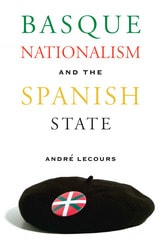
Basque Nationalism and the Spanish State
Andre Lecours
University of Nevada Press, 2016
An examination of Basque nationalism from a historical perspective. Basque nationalism has been extensively examined from the perspectives of Basque culture and internal conditions in the Basque Country, but André Lecours is among the first to demonstrate how Basque nationalism was shaped by the many forms and historical phases of the Spanish state. His discussion employs one of the most debated approaches in the social sciences—historical institutionalism—and it includes an up-to-date examination of the circumstances for, and consequences of, recent events such as ETA's announcement in 2006 of a permanent cease-fire. Lecours also analyzes other aspects of Basque nationalism, including the international relations of the Basque Autonomous Government, as well as the responses of the contemporary Spanish state and how it deploys its own brand of nationalism. Finally, the book offers a comparative discussion of Basque, Catalan, Scottish, Flemish, and Quebecois nationalist movements, suggesting that nationalism in the Basque Country, despite the historical presence of violence, is in many ways similar to nationalism in other industrialized democracies. Basque Nationalism and the Spanish State is an original and provocative discussion that is essential reading for anyone interested in the Basques or in the development of modern nationalist movements.
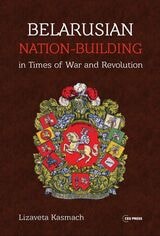
Belarusian Nation-Building in Times of War and Revolution
Lizaveta Kasmach
Central European University Press, 2023
The proclamation of Belarusian independence on March 25, 1918, and the rival establishment of the Soviet Belarusian state on January 1, 1919, created two distinct and mutually exclusive national myths, which continue to define contemporary Belarusian society. This book examines the processes that resulted in this dual resolution in the context of World War I and the subsequent Russian Revolutions.
Based on original archival material, Lizaveta Kasmach scrutinizes the development of competing concepts of Belarusian nationhood in the context of rivaling national aspirations and imperial policies. The analysis convincingly demonstrates the divisions within the nationalist movement, both politically between the moderates and socialists, and geographically between German-occupied territory with Vilna as a center versus Russian-controlled territory around Minsk. Besides the case study of Belarusian nation-building efforts, the book is a contribution to the study of the First World War in East Central Europe, approaching the war and its aftermath as a mobilizational moment in the region.
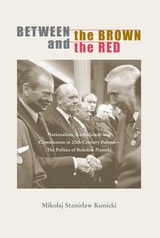
Between the Brown and the Red
Nationalism, Catholicism, and Communism in Twentieth-Century Poland—The Politics of Boleslaw PiaseckiMikolaj Stanislaw Kunicki
Ohio University Press, 2012
Between the Brown and the Red captures the multifaceted nature of church-state relations in communist Poland, relations that oscillated between mutual confrontation, accommodation, and dialogue. Ironically, under communism the bond between religion and nation in Poland grew stronger. This happened in spite of the fact that the government deployed nationalist themes in order to portray itself as more Polish than communist. Between the Brown and the Red also introduces one of the most fascinating figures in the history of twentieth-century Poland and the communist world.
In this study of the complex relationships between nationalism, communism, authoritarianism, and religion in twentieth-century Poland, Mikołaj Kunicki shows the ways in which the country’s communist rulers tried to adapt communism to local traditions, particularly ethnocentric nationalism and Catholicism. Focusing on the political career of Bolesław Piasecki, a Polish nationalist politician who began his surprising but illuminating journey as a fascist before the Second World War and ended it as a procommunist activist, Kunicki demonstrates that Polish communists reinforced an ethnocentric self-definition of Polishness and—as Piasecki’s case demonstrates—thereby prolonged the existence of Poland’s nationalist Right.
Beyond Mosque, Church, and State
Alternative Narratives of the Nation in the BalkansYana Hashamova
Central European University Press, 2016
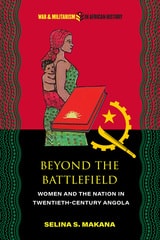
Beyond the Battlefield
Women and the Nation in Twentieth-Century AngolaSelina S. Makana
Ohio University Press, 0
Beyond the Battlefield offers a critical reappraisal of Angola’s nationalist history by centering the experiences and political agency of women during the country’s transition from Portuguese colonial rule to independence. Challenging dominant masculinist narratives that equate anticolonial resistance with armed combat, this study introduces maternalist nationalism as a theoretical framework to illuminate how women engaged in nation building through often-overlooked forms of labor and activism.
While men were largely visible on the battlefield, women fought a parallel struggle on the home front—mobilizing care work, reproductive labor, and political engagement in ways that were essential to the liberation movement and the postindependence state. Drawing on archival sources and women’s testimonies, Makana explores how patriotic motherhood—a concept defined as the fusion of nationalist politics with gendered expectations of women’s roles—enabled women to see themselves as vital contributors to the nation’s future.
This study contributes to scholarship in African history, gender studies, and postcolonial theory by offering a nuanced account of the intersections among militarism, nationalism, and gender. It invites readers to reconsider the frameworks through which political subjectivity and historical memory are constructed. Beyond the Battlefield is an essential resource for scholars and students interested in the gendered dimensions of colonialism, war, and state formation in modern Africa.
Black Identity
Rhetoric, Ideology, and Nineteenth-Century Black NationalismDexter B. Gordon
Southern Illinois University Press, 2006
Exploring the role of rhetoric in African American identity and political discourse
Dexter B. Gordon’s Black Identity: Rhetoric, Ideology, and Nineteenth-Century Black Nationalism explores the problem of racial alienation and the importance of rhetoric in the formation of black identity in the United States. Faced with alienation and disenfranchisement as a part of their daily experience, African Americans developed collective practices of empowerment that cohere as a constitutive rhetoric of black ideology. Exploring the origins of that rhetoric, Gordon reveals how the ideology of black nationalism functions in contemporary African American political discourse.
Rooting his study in the words and works of nineteenth-century black abolitionists such as Maria Stewart, David Walker, and Henry Garnet, Gordon explores the rapprochement between rhetorical theory, race, alienation, and the role of public memory in identity formation. He argues that abolitionists used language in their speeches, pamphlets, letters, petitions, and broadsides that established black identity in ways that would foster liberation and empowerment. The arguments presented here constitute the only sustained treatment of nineteenth-century black activists from a rhetorical perspective.
Gordon demonstrates the pivotal role of rhetoric in African American efforts to create a viable public voice. Understanding nineteenth-century black alienation—and its intersection with twentieth-century racism—is crucial to understanding the continued sense of alienation that African Americans express about their American experience. Gordon explains how the ideology of black nationalism disciplines and describes African American life for its own ends, exposing a central piece of the ideological struggle for the soul of America. The book is both a platform for further discussion and an invitation for more voices to join the discourse as we search for ways to comprehend the sense of alienation experienced and expressed by African Americans in contemporary society.

Black and Green
The Fight For Civil Rights in Northern Ireland & Black AmericaBrian Dooley
Pluto Press, 1998
'Focusing on the period from the 1960s onward, Brian Dooley suggests that the black rights struggle in the US had a formative influence on Northern Ireland's civil rights movement which adopted similar tactics of protest marches and sit-ins ... A well researched book, written from an unusual angle that illuminates this understudied international influence on the Ulster conflict' Political Studies
Ties between political activists in Black America and Ireland span several centuries, from the days of the slave trade to the close links between Frederick Douglass and Daniel O’Connell, and between Marcus Garvey and Eamon de Valera. This timely book traces those historic links and examines how the struggle for black civil rights in America in the 1960s helped shape the campaign against discrimination in Northern Ireland. The author includes interviews with key figures such as Angela Davis, Bernadette McAliskey and Eamonn McCann.
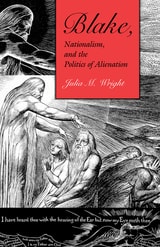
Blake, Nationalism, and the Politics of Alienation
Julia M. Wright
Ohio University Press, 2027
William Blake’s reputation as a staunch individualist is based in large measure on his repeated attacks on institutions and belief systems that constrain the individual’s imagination. Blake, however, rarely represents isolation positively, suggesting that the individual’s absolute freedom from communal pressures is not the ideal. Instead, as Julia Wright argues in her award-winning study Blake, Nationalism, and the Politics of Alienation, Blake’s concern lies with the kind of community that is being established. Moreover, writing at the moment of the emergence of modern nationalism, Blake reveals a concern with the national community in particular.
Beginning with a discussion of the priority of national narrative in late-eighteenth-century art theory and antiquarianism, Blake, Nationalism, and the Politics of Alienation traces its relevance in Blake’s printed works, from The Poetical Sketches and the Lambeth Prophecies to The Laocoön. Professor Wright then turns to Europe, America, and Visions of the Daughters of Albion, focusing on Blake’s portrayals of particular characters’ alienation from the groups and ideologies represented in the texts. The book closes by arguing that Blake’s major printed works, Milton and Jerusalem, are explicit and extensive engagements with the question of nation—and empire.
Although nationalism existed in various forms during the Romantic period, Blake’s contemporaries generally assumed that nations should progress continuously, producing a clear narrative line from an auspicious origin to the perfect fulfillment of that promise. Wright argues that these mutually determining constructs of national character and national narrative inform Blake’s handling of the problem of the individual-within-a-community.
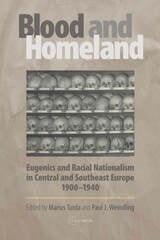
Blood and Homeland
Eugenics and Racial Nationalism in Central and Southeast Europe, 1900-1940Paul J. Weindling
Central European University Press, 2007
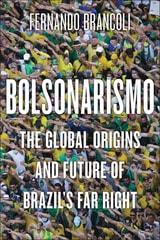
Bolsonarismo
The Global Origins and Future of Brazil’s Far RightFernando Brancoli
Rutgers University Press, 2024
Through interviews, archival research, and newly available public documents, this book presents a comprehensive and compelling portrait of the neo-evangelical pastors, military personnel, and meritocratic ideologues who are the actors behind the far-right movement. Adding to our understanding of Bolsonarismo's growth in Brazilian politics and the contributing factors behind it, the book also sheds light on the impact of Bolsonarismo on world politics. As a prominent leader of the far-right movement, Jair Bolsonaro's political views and policies have reverberated beyond Brazil's borders, influencing the discourse on issues such as climate change, democracy, and human rights around the world.
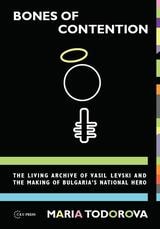
Bones of Contention
The living archive of Vasil Levski and the making of Bulgaria's national heroMaria Todorova
Central European University Press, 2009
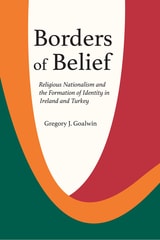
Borders of Belief
Religious Nationalism and the Formation of Identity in Ireland and TurkeyGregory J. Goalwin
Rutgers University Press, 2022

Burek
A Culinary MetaphorJernej Mlekuz
Central European University Press, 2015