Results by title
61 books match the query 'Nineteenth Century' and 4 start with b
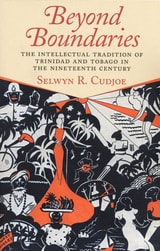
Beyond Boundaries
The Intellectual tradition of Trinidad and Tobago in the Nineteenth CenturySelwyn R. Cudjoe
University of Massachusetts Press, 2003
When V. S. Naipaul received the Nobel Prize for Literature in 2001, the award marked the culmination of a literary tradition that was almost two hundred years in the making. The island nation of Trinidad and Tobago has produced such important writers and thinkers as C. L. R. James, J. J. Thomas, Eric Williams, Oliver Cromwell Cox, Sylvester Williams, George Padmore, Earl Lovelace, Arnold Rampersad, and Merle Hodge. Yet this literary legacy is not well known, particularly with respect to works dating from the nineteenth century.
Beyond Boundaries traces the development of the country's literary and intellectual history from the “Narrative of Louisa Calderon” (1803) to Stephen Cobham's Rupert Gray: A Tale of Black and White (1907). Selwyn R. Cudjoe examines a wide range of narratives by and about the people of Trinidad and Tobago, from treatises in the natural sciences, to journals and memoirs, histories, slave narratives, travelers' accounts, poems, stories, novels, theatrical works, and writings in the popular press. Along the way, he discusses such seminal works as Jean Baptiste Philippe's Free Mulatto (1824) and Maxwell Philip's Emmanuel Appadocca (1854), the first indigenous novel. He explores books that shed light on ideological processes, such as J. J. Thomas's The Theory and Practice of Creole Grammar (1869) and Froudacity (1899). He examines how notions of savagery and civilization were deployed in the writings of the dominant class to stymie the growing self-awareness of the colonized. And he traces the rise of racial pride and nationalist sentiments among Indo- and Afro-Trinidadians.
Cudjoe demonstrates how Enlightenment concepts, English literature, African philosophy, Hindu theology, Islamic passion plays, and the culture of carnival all contributed to this body of ideas to create a vibrant literature, which in turn helped to shape a national identity.
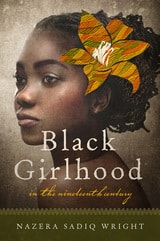
Black Girlhood in the Nineteenth Century
Nazera Sadiq Wright
University of Illinois Press, 2016
As Wright shows, the figure of the black girl in African American literature provided a powerful avenue for exploring issues like domesticity, femininity, and proper conduct. The characters' actions, however fictional, became a rubric for African American citizenship and racial progress. At the same time, their seeming dependence and insignificance allegorized the unjust treatment of African Americans. Wright reveals fascinating girls who, possessed of a premature knowing and wisdom beyond their years, projected a courage and resiliency that made them exemplary representations of the project of racial advance and citizenship.

Black Leaders of the Nineteenth Century
Edited by Leon Litwack and August Meier
University of Illinois Press, 1988

Bloody Tyrants and Little Pickles
Stage Roles of Anglo-American Girls in the Nineteenth CenturyMarles Schweitzer
University of Iowa Press, 2020
Bloody Tyrants and Little Pickles traces the theatrical repertoire of a small group of white Anglo-American actresses as they reshaped the meanings of girlhood in Britain, North America, and the British West Indies during the first half of the nineteenth century. It is a study of the possibilities and the problems girl performers presented as they adopted the manners and clothing of boys, entered spaces intended for adults, and assumed characters written for men. It asks why masculine roles like Young Norval, Richard III, Little Pickle, and Shylock came to seem “normal” and “natural” for young white girls to play, and it considers how playwrights, managers, critics, and audiences sought to contain or fix the at-times dangerous plasticity they exhibited both on and off the stage.
Schweitzer analyzes the formation of a distinct repertoire for girls in the first half of the nineteenth century, which delighted in precocity and playfulness and offered up a model of girlhood that was similarly joyful and fluid. This evolving repertoire reflected shifting perspectives on girls’ place within Anglo-American society, including where and how they should behave, and which girls had the right to appear at all.