Results by title
83 books match the query 'Northeast' and 5 start with b
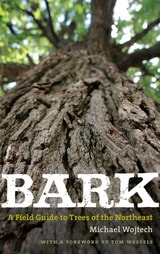
Bark
A Field Guide to Trees of the NortheastMichael Wojtech
Brandeis University Press, 2020
What kind of tree is that? Whether you’re hiking in the woods or simply sitting in your backyard, from Maine to New York you’ll never be without an answer to that question, thanks to this handy companion to the trees of the Northeast. Featuring detailed information and illustrations covering each phase of a tree’s lifecycle, this indispensable guidebook explains how to identify trees by their bark alone—no more need to wait for leaf season. Chapters on the structure and ecology of tree bark, descriptions of bark appearance, an easy-to-use identification key, and supplemental information on non-bark characteristics—all enhanced by more than 450 photographs, illustrations, and maps—will show you how to distinguish the textures, shapes, and colors of bark to recognize various tree species, and also understand why these traits evolved.
Whether you’re a professional naturalist or a parent leading a family hike, this new edition of Bark: A Field Guide to Trees of the Northeast is your essential guide to the region’s 67 native and naturalized tree species.

Battlefield Pennsylvania
A Guide to the Keystone State's Most Sacred GroundBrady J. Crytzer
Westholme Publishing, 2018
Pennsylvania is a battlefield. Fort Necessity. Brandywine. Gettysburg. The Homestead Strike. Flight 93. In many ways battlefields are like scars on the landscape. They remind us that history is real, and their effects stay with us forever. In Battlefield Pennsylvania: A Guide to the Keystone State’s Most Sacred Ground, award-winning historian Brady J. Crytzer takes the reader on a fascinating tour of over three hundred years of Pennsylvania history through twenty-nine of the state’s most significant battlegrounds, based on his popular Pennsylvania Cable Network television program. The author shows that debates and neighborly disputes have been present throughout the history of William Penn’s “Peaceable Kingdom,” but that battles are not the natural resolution of these conflicts; they are a failure of the system. Understanding how these systems break down and descend into violence and chaos is one of the most important purposes of this book. When the forces of Britain and France met on the battleground of North America, they each waged war in the name of a vision—a defense of the future, not merely the present. The same can be said for the Indian warriors and settlers of the backcountry, and the striking workers of the industrial age. When the young men of the American Civil War era donned the Butternut and Blue, they were not just fighting over a hill or a railroad junction, but for an American future. Illustrated with maps and period and contemporary images, Battlefield Pennsylvania presents each event through background information, a description of the battle itself, the legacy of the battle, and what a visitor can see today. Rather than viewing preserved battlefields as a hollow tribute to days gone by, the author demonstrates that these sites are a great inheritance provided by past generations, and just as they entrusted them to us, we will entrust them to future generations as well.
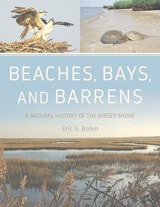
Beaches, Bays, and Barrens
A Natural History of the Jersey ShoreEric G. Bolen
Rutgers University Press, 2024
Beaches, Bays, and Barrens introduces readers to the natural wonders of the Jersey Shore, revealing its unique ecology and fascinating history. The journey begins with the contributions and discoveries of early naturalists who visited the region and an overview of endangered species and natural history, followed by chapters that explore different facets of the shore’s environments. These start with sandy beaches and dunes and culminate in the engaging Pine Barrens, the vital watershed for much of the state’s varied coastline. Along the way, readers will also learn about whaling, decoy carvers, an extinct duck, and the cultivation of wild blueberries.
Including over seventy color photographs, the book also features twenty-three infoboxes that go deep into areas of ecological or historical interest, such as the Forsythe National Wildlife Refuge or the Jaws-like shark attacks of 1916. From Cape May to Sandy Hook, biologist Eric G. Bolen takes you on a guided tour of the Jersey Shore’s rich ecological heritage.
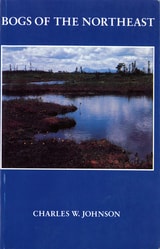
Bogs of the Northeast
Charles W. Johnson
University Press of New England, 1985

Borscht Belt Bungalows
Memoirs Of Catskill SummersIrwin Richman
Temple University Press, 2003
These were not glamorous places, and middle-class Jews today remember the colonies with either aversion or fondness. Irwin Richman's narrative, anecdotes, and photos recapture everything from the traffic jams leaving the city to the strategies for sneaking into the casinos of the big hotels. He brings to life the attitudes of the renters and the owners, the differences between the social activities and swimming pools advertised and what people actually received. He reminisces about the changing fashion of the guests and owners—everything that made summers memorable.
The author remembers his boyhood: what it was like to spend summers outside the city, swimming in the Neversink, "noodling around," and helping with the bungalow operation, while Grandpa charged the tenants and acted as president of Congregation B'nai Israel of Woodbourne, N.Y. He also traces the changes in the Catskills, including the influx of Hasidic families. Richman talks about what it's like to go back and to see the ghosts of resorts along the roads he once traveled.