Results by title
527 books match the query 'Novel' and 22 start with b
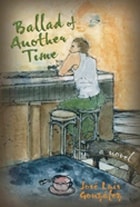
Ballad of Another Time
A NovelJose Luis Gonzalez; Translated by Asa Zatz
University of Wisconsin Press, 2004

Bealport
A Novel of a TownJeffrey Lewis
Haus Publishing, 2018
In Bealport, Jeffrey Lewis takes us inside the town, revealing its secrets, acknowledging its problems, and honoring its ambitions. Brilliantly deploying a large cast from all walks of life, this novel reveals small town America in the early twenty-first century through the interwoven secrets and desires of its residents, and through them delivers a striking portrait of America at a moment of national uncertainty.
Bealport, called “a hugely satisfying read” by the Evening Standard and “deeply appealing” by the Times Literary Supplement, is now available in paperback.
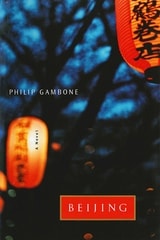
Beijing
A NovelPhilip Gambone
University of Wisconsin Press, 2003
Escaping his ghosts, AIDS widower David Masiello accepts a one-year position at a Western medical clinic in Beijing. Lonely but excited, he sets out to explore the city—both its bustling street life and its clandestine gay subculture.
David chronicles his adventures in China as he wrestles with cultural dislocation, loneliness, and sexual and spiritual longing. After a series of both comic and poignant encounters with gay Chinese men, he meets Bosheng, a handsome young artist. Though the attraction is strong, a difficult courtship ensues, during which Bosheng returns to his ancestral village to marry the girl his parents have chosen for him. Eventually, and quite unexpectedly, David and Bosheng reconnect and share an idyllic spring together. As the year ends, David must decide whether to say goodbye or face the uncertainties of a long-distance relationship.
Gambone’s novel is peopled with a host of wonderfully memorable characters: Owen, David’s forthright best friend back home; Auntie Chen, the clinic’s office mom, who wants to fix David up with a girlfriend; Stewart, David’s Beijing roommate, a graduate student doing research on Peking opera; Jiantao and Guoyang, two lovers who lecture David on the fleeting quality of American romance; and Tyson, the Australian doctor with a Chinese girlfriend, who hopes to teach David that love doesn’t need any explanations or justifications.

Below Grass Roots
A NovelFrank Waters
Ohio University Press, 2002
In Below Grass Roots, the second book in Frank Waters’s Pikes Peak saga, turn-of-the-century Colorado Springs is prospering with the mining boom and a growing tourist industry. Patriarch Joseph Rogier becomes ever more obsessed with the treasures of the towering mountain and tries to enlist his son-in-law Jonathan Cable in his mining schemes. Cable instead leaves for Navajo country with his young son. Rogier, convinced that new wealth lies deep within the mountain, below grass roots, sinks his mines and what remains of his fortune ever deeper into the mountain’s granite.
As in the other two novels in this semiautobiographical saga, Waters’s masterful narrative draws on his own keen perception of the human condition to bring us this compelling tale of struggle and hope in the American West.
Pike’s Peak is composed of three condensed novels: The Wild Earth’s Nobility, Below Grass Roots, and The Dust within the Rock.

Benefit Street
A NovelAdria Bernardi
University of Alabama Press, 2022
WINNER OF FC2's CATHERINE DOCTOROW INNOVATIVE FICTION PRIZE
A universal story of exile, of the refugee and emigrant, and of all those displaced who can reconstruct a sense of home only by weaving a new fabric of the imagination
For nearly two decades, Şiva has met after work on Tuesdays with four friends at a teahouse called the Kafiye. In interrupted conversations, the women explore what it is to live engaged lives inside and outside the home. Amidst joking and complaints, while drinking too much tea and eating too many sweets, they tell of their days: a son’s ninth birthday, the bruise on the arm of an aging parent, soldiers stationed outside the school, the funeral of an opposition political leader killed in a mysterious car accident.
Set in an unnamed provincial capital of an unnamed country, Benefit Street tells of a wide circle of friends—teachers, lawyers, missionaries, doctors, artisans—in a time of gathering and dispersal. It tells the story of mothers, daughters, sisters, wives, colleagues, and neighbors, as war to the East threatens and constitutional rights are daily eroded by an increasingly authoritarian regime.
The ideals of youth, freedom, and coexistence are severely tested with the shocking revelation that the charismatic leader of their group has sexually abused the women under his care. The limits of reconciliation are tested as Şiva makes an arduous journey into the mountains to meet an estranged mother with a genius for weaving complex rugs.
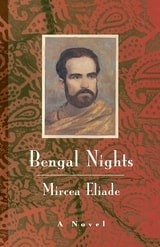
Bengal Nights
A NovelMircea Eliade
University of Chicago Press, 1994
Offered the hospitality of a senior Indian colleague, Alain grasps at the chance to discover the authentic India firsthand. He soon finds himself enchanted by his host's daughter, the lovely and inscrutable Maitreyi, a precocious young poet and former student of Tagore. What follows is a charming, tentative flirtation that soon, against all the proprieties and precepts of Indian society, blossoms into a love affair both impossible and ultimately tragic. This erotic passion plays itself out in Alain's thoughts long after its bitter conclusion. In hindsight he sets down the story, quoting from the diaries of his disordered days, and trying to make sense of the sad affair.
A vibrantly poetic love story, Bengal Nights is also a cruel account of the wreckage left in the wake of a young man's self discovery. At once horrifying and deeply moving, Eliade's story repeats the patterns of European engagement with India even as it exposes and condemns them. Invaluable for the insight it offers into Eliade's life and thought, it is a work of great intellectual and emotional power.
Translated into French in 1950, Bengal Nights was an immediate critical success. The film, Les Nuits Bengali, appeared in 1987.

Bernardo and the Virgin
A NovelSilvio Sirias
Northwestern University Press, 2007
Silvio Sirias' sweeping novel tells many stories: that of a humble man touched by the transcendent; that same man as a devout boy denied the priesthood because of poverty; and those in his orbit, past and present. It is also the stormy epic of Nicaragua through the long Somoza years to the Sandinista revolution. Sirias' beautiful language mixes English with Spanish and details of dusty village life with wondrous images of Catholic mysticism. His portrayal of the rich recent past of Central America resonates with the experiences of both the natives and the thriving communities of Nicaraguans, Salvadorans, and others putting down roots in the United States.
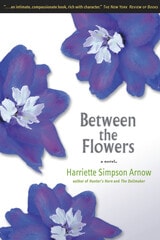
Between the Flowers
A NovelHarriette Simpson Arnow
Michigan State University Press, 1999
Between the Flowers is Harriette Simpson Arnow's second novel. Written in the late 1930s, but unpublished until 1997, this early work shows the development of social and cultural themes that would continue in Arnow's later work: the appeal of wandering and of modern life, the countervailing desire to stay within a traditional community, and the difficulties of communication between men and women in such a community.
Between the Flowers goes far beyond categories of "local color," literary regionalism, or the agrarian novel, to the heart of human relationships in a modernized world. Arnow, who went on to write Hunter's Horn (1949) and The Dollmaker (1952)—her two most famous works—has continually been overlooked by critics as a regional writer. Ironically, it is her stinging realism that is seen as evidence of her realism, evidence that she is of the Cumberland—an area somehow more "regional" than others.
Beginning with an edition of critical essays on her work in 1991 and a complete original edition of Hunter's Horn in 1997, the Michigan State University Press is pleased to continue its effort to make available the timeless insight of Arnow's work with the posthumous publication of Between the Flowers.
Bhopal Dance
A NovelJennifer Natalya Fink, Foreword by Mary Caponegro
University of Alabama Press, 2018
An imaginative, erotic rethinking of Bhopal’s disaster—and perhaps our own
On the night of December 2, in the midst of the Reaganomic era, an explosion at an American-owned factory in Bhopal, India, released untold amounts of toxic gas on uncounted numbers of people, creating a human and environmental disaster of insurmountable proportions. Known as the Bhopal disaster, it once dominated international headlines, and is now barely remembered.
Yet Bhopal remains emblematic of all the many quickly forgotten disasters that followed, and of the permanent state of globalized disaster in which we now dwell. What does it mean when corporations instead of states control not only the means to create environmental disasters, but also the tools to bury them? How does one revolt against these unelected entities? How do our most private desires get shaped by this stateless horror? Jennifer Natalya Fink’s Bhopal Dance is an epic and epochal tale of such a horror and its buried consequences.
At the center of the novel is Cordelia, an owlish woman with a ménage of lovers, who leads a revolutionary Canadian political movement catalyzed by the Bhopal disaster, only to end up imprisoned with just a toilet to talk to. Who she hallucinates is her father. Who is her father. Who is the State. Who may be her mother. Or her twin/lover. Cordelia is a remarkable bird in her own right, and ‘owlishness’ is a feathery conceit deployed in both the book’s form and content, a way of exploring queer possibilities for altering the terms of one’s imprisonment. For setting corporatized corporeality alight. Ablaze. Pets and punk rock, dentists and dyslexia, Shakespeare and salsa: they all dance together here.
Big Familia
A NovelTomas Moniz
Acre Books, 2019
Upon the unexpected death of one of the bar’s regulars, Juan is sent reeling, and a series of upheavals follow as he both seeks and spurns intimacy, pondering the legacy of distant parents and a failed marriage and grappling with his sexuality—all the while cycling and dating, drinking at Nicks Lounge, and parenting a determined and defiant child-become-woman.
When his incarcerated father dies and Stella reveals she’s pregnant, Juan is forced to examine the emotional bonds that both hold and hinder him, to reassess his ideas of commitment, of friendship, of love. His encounters with various characters—his mother, his ex-wife, a middle-aged punker, an aspiring acupuncturist, a dapper veteran—lead Juan to the realization that he himself must change to thrive.
This is a story of making family and making mistakes, of rending and of mending. As a Latinx queer father with a mixed-race daughter, Juan exemplifies the ways identity connects and divides us. With wit, insight, and tenderness, Big Familia explores the complexities of desire, devotion, and the mysteries of the heart.
Bless Me, Papi
A NovelAyendy Bonifacio
Northwestern University Press, 2026
A coming-of-age tale of a young Dominican American boy facing a grave loss and a feathered phantom
Between the looming buildings of Brooklyn, a young Dominican American boy only ever called mijo by his family has just lost his father to brain cancer. In the wake of his grief, he begins to see his deceased father take the form of a pigeon and ghost, acting as protector and advisor in moments of duress and confusion. Determined to find out the truth behind his father’s appearances, he sets out on the streets of Brooklyn with his outspoken friend Naño, and in the hills of the Dominican Republic with his cousin Matias, in search of answers, only to discover more ghostly apparitions and inexplicable occurrences. In a world of lost things and in-betweens, the grief-stricken son must choose whether he can bear to let go of his father or accept the consequences of what we let haunt us.
Blind Speed
A NovelJosh Barkan
Northwestern University Press, 2008
Not since Don DeLillo and George Saunders has a writer caught the humor and irreverent seriousness of our time like Barkan has through his protagonist Paul Berger, a flawed hero whose so-called fate drives him toward enlightenment just as surely as it propels him to destruction. Berger is stunned when he receives an ominous palm reading from a savvy guru at a health retreat in Iowa, of all places. And now it seems the prophecy is coming true. His fiancée, who is about to leave him, is shot at a historic reenactment of the Revolutionary War in Concord. One of his brothers, an astronaut, dies on 9/11 in the Pentagon. And his more famous brother, a lawyer and politician, kidnaps him in a media campaign to win an election. But is Paul’s life really controlled by fate? Or is the prophecy a lie he has latched onto ever since his band went under, leaving him almost famous yet unknown—a teacher at a community college, struggling to keep his job?
Blind Speed is a wildly entertaining exploration of intersecting lives in which what happens is never solely by chance or choice. Barkan has built a uniquely American satirical novel, a thoroughly twisted journey of discovery that pops and fires from its first shot in Concord to its last rifle blast, which echoes across the heartland. With global warming, 9/11, government and corporate deceit, and ecoterrorism, the novel dives into epic ideas, capturing America in all its dangerous myths.
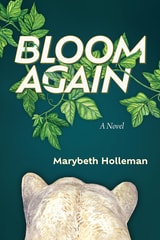
Bloom Again
A NovelMarybeth Holleman
University of Alaska Press, 2025
As the ground beneath them stirs, both women begin to recall their shared childhoods. Each must ignore the rumblings and fight for their comfortable existence—or leap. Before long, Elyse is following a Yup’ik marine mammal hunter along the windswept Siberian coast, and Astrid is risking her entire career to plant trees in India. As they navigate upheaval, they also confront the reminders of their past—a past whose full truth carries in it the promise of their future.
Bloom Again weaves together sophisticated narrative and characters, evocative travel and nature writing, and effective and reliable depictions of the climate change crisis in parts of the world underrepresented in mainstream literary fiction. A realistic work of ecoclimate fiction, it considers how people confront and respond to an amorphous yet unavoidable event like climate change in their everyday lives, as well as how women find new inspiration in their “second spring”—a time in life when career and family needs are fulfilled. It’s a book about waking up and finding our way, together.
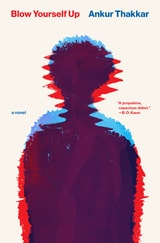
Blow Yourself Up
A NovelAnkur Thakkar
Northwestern University Press, 2026
A story of first love across cities spanning the decade that transformed the internet
In the halls of an elite East Coast high school, Arjun and Payal fall in love as the world begins to tilt toward the digital. Over the next eight years, their trajectories diverge as sharply as the fractured internet itself. Payal ascends to the dizzying, dopamine-fueled heights of New York’s influencer economy, finding fame on Boost, a looping video app that is as rewarding as it is demanding. Meanwhile, in a cavernous office in Chicago, Arjun, a musician whose dreams have quieted, now cleans up the same platform’s debris, moderating the internet’s darkest videos. When a brutal act of political violence against a beloved musician goes viral, this rip in reality forces the pair to confront the motivations of the platforms they inhabit. A sharp exploration of creative ambition and the multifarious nature of identity, this is a story of love in the time of infinite scroll and a look at what we sacrifice to be seen.
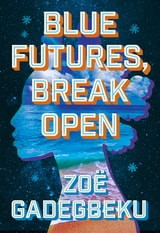
Blue Futures, Break Open
A NovelZoë Gadegbeku
West Virginia University Press, 2025
2026 IPPY Awards Gold Medal Winner, Visionary/New Age Fiction
Blue Basin Island is the final resting spot of formerly enslaved Africans whose souls have flown from Earth—not to heaven or purgatory but toward freedom and a new life. Lucille, the island’s seamstress, takes two forms. She lives among the inhabitants in human form and, along with the evil-repelling blue of the houses, her divine form protects people from the violence of the their former lives. Yet, even there, outside of time, the souls are not totally insulated from the world in which they were enslaved. Each time a Black person anywhere is harmed, a piece of Blue Basin disintegrates: an earthquake leaves hundreds of thousands dead, and bricks crumble on the island; when police kill a Black child asleep in her bed, the blue paint on homes throughout the island drips and then runs from the walls. Lucille must hold the island together, but she struggles to juggle the responsibility of ensuring everyone’s safety while also seeking and losing her own private love. Grounding the story in African folklore and dipping into the rich literary tradition around African people with the power of flight, Zoë Gadegbeku visualizes the destination at the end of the flight and the new life that awaits them.
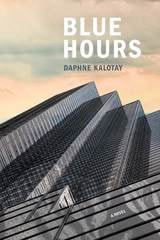
Blue Hours
A NovelDaphne Kalotay
Northwestern University Press, 2019
A mystery linking Manhattan circa 1991 to eastern Afghanistan in 2012, Blue Hours tells of a life-changing friendship between two memorable heroines. When we first meet Mim, she is a recent college graduate who has disavowed her lower middle class roots to befriend Kyra, a dancer and daughter of privilege, until calamity causes their estrangement. Twenty years later, Kyra has gone missing from her NGO’s headquarters in Jalalabad, and Mim—now a recluse in rural New England—embarks on a journey to find her. In its nuance, originality, and moral complexity, Blue Hours becomes an unexpected page-turner.
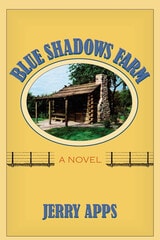
Blue Shadows Farm
A NovelJerry Apps
University of Wisconsin Press, 2009
Silas Starkweather, a Civil War veteran, is drawn to Wisconsin and homesteads 160 acres in Ames County, where he is known as the mysterious farmer forever digging holes. After years of hardship and toil, however, Silas develops a commitment to farming his land and respect for his new community. When Silas’s son Abe inherits Blue Shadows Farm he chooses to keep the land out of reluctant necessity, distilling and distributing “purified corn water” throughout Prohibition and the Great Depression in order to stay solvent. Abe’s daughter, Emma, willingly takes over the farm after her mother’s death. Emma’s love for this place inspires her to open the farm to school-children and families who share her respect for it. As she considers selling the land, Emma is confronted with a difficult question—who, through thick and thin, will care for Blue Shadows Farm as her family has done for over a century? In the midst of a controversy that disrupts the entire community, Emma looks into her family’s past to help her make crucial decisions about the future of its land.
Through the story of the Starkweather family’s changing fortunes, and each generation’s very different relationship with the farm and the land, Blue Shadows Farm is in some ways the narrative of all farmers and the increasingly difficult challenges they face as committed stewards of the land.
Bogotá
A NovelAlan Grostephan
Northwestern University Press, 2013
In Bogotá, a taut, moving novel set in present-day Colombia, Wilfredo decides to uproot his family from their small town, where his ferry service on the river subjects him to the gruesome errands demanded by the local paramilitary. Moving in with relatives in a slum in Bogotá, the family tries desperately to achieve the smallest measure of comfort and hope in a world of almost total ruin, wracked by deprivation, fear, and ceaseless violence.
Alan Grostephan depicts with startling immediacy an urban landscape of extreme harshness and oppressive instability. The tension between the desperate conditions surrounding his characters and their efforts to hold on to their humanity gives Bogotá a ferocious energy. As Wilfredo and his family fight to stay alive and stay together, their plight emerges as equally enraging and uplifting, constituting a portrait of a society always on the verge of disintegration.
Brain Fever
A NovelValerie Sayers
Northwestern University Press, 2013
Bricks Without Straw
A NovelAlbion W. Tourgée
Duke University Press, 2009
Bricks Without Straw is Tourgée’s fictionalized account of how Reconstruction was sabotaged. It is a chilling picture of violence against African Americans condoned, civil rights abrogated, constitutional amendments subverted, and electoral fraud institutionalized. Its plot revolves around a group of North Carolina freedpeople who strive to build new lives for themselves by buying land, marketing their own crops, setting up a church and school, and voting for politicians sympathetic to their interests, until Klan terrorism and the ascendancy of a white supremacist government reduce them to neo-slavery. This edition of Bricks Without Straw is enhanced by Carolyn L. Karcher’s introduction, which sets the novel in historical context and provides an overview of Albion W. Tourgée’s career, a chronology of the significant events of both the Reconstruction era and Tourgée’s life, and explanatory notes identifying actual events fictionalized in the novel.
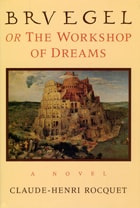
Bruegel, or the Workshop of Dreams
A NovelClaude-Henri Rocquet
University of Chicago Press, 1991
Butter Road
A NovelJaclyn Gilbert
Acre Books, 2026
A searing novel about a community irrevocably transformed by gun violence.
In 2006, a gunman entered a one-room Amish schoolhouse in Lancaster County, Pennsylvania, taking the students hostage and shooting ten girls before turning his weapon on himself. Set twelve years after this event, largely in the village of Nickel Mines, Butter Road explores the long-reaching ramifications of tragedy through the imagined lives of three women: Emma Walsh, an eighteen-year-old survivor of the shooting; her mother, Ruth, who lost her eldest daughter to the violence; and Sara Caldwell, an “English” outsider and wife of a doctor researching genetic disorders in the Amish population.
At the novel's outset, Sara enlists young Emma for housework and gardening to help the Walshes alleviate the debt they’ve accumulated caring for Emma’s disabled brother, who has the rare condition Sara’s husband is studying. Over the course of several months, Sara and Emma form a bond, and as Emma explores Sara's library, she begins writing fragments of memory on the backs of old feed calendars—a process that leads her to grapple with the devastating deaths of her sister and friends, and the insularity of Amish forgiveness. The more Emma writes, the more she questions her upbringing and ingrained beliefs, ultimately seeing her relationship to Isaac Ames, the man she is destined to marry, in a new light. The story culminates with the characters making breathtaking, self-searching decisions that alter the lives of others as well as their own.
Emotionally acute and lyrically spare, Butter Road centers on living with what we can’t control, on understanding trauma and collective grief, and on following one’s heart.