Results by title
80 books match the query 'Ontology' and 6 start with b
Being Unfolded
Edith Stein on the Meaning of BeingThomas Gricoski
Catholic University of America Press, 2020
Being Unfolded responds to the question, ‘What is the meaning of being for Edith Stein.’ In Finite and Eternal Being Stein tentatively concludes that ‘being is the unfolding of meaning.’ Neither Stein nor her commentators have elaborated much on this suggestive phrase. Thomas Gricoski argues that Stein’s mature metaphysical project can be developed into an ‘ontology of unfolding.’ The differentiating factor of this ontology is its resistance to both existentialism and essentialism. The ‘ontology of unfolding’ is irreducibly relational.
Being Unfolded proceeds by testing a relational hypothesis against Stein’s theory of the modes of being (actual, essential, and mental being). From the phenomenological perspective, Gricoski examines Stein’s theory of the relation of consciousness and being. From the scholastic perspective, he examines Stein’s account of the relation of essence and existence in material being, living being, and human being. And from both perspectives he considers the relation of divine being to actual being and their essences. This book is limited to Stein’s theory of the meaning of being, without making an explicit confrontation with Heidegger. It offers two primary contributions to Stein studies: a systematic analysis of Stein’s modes of being, especially essential being, and an exposition and expansion of her overlooked concept of unfolding. Being Unfolded also contributes to the broader field of contemporary metaphysics by developing Stein’s theory of being as an experiment in fundamental ontology. While other relational ontologies focus on relations between beings, this exploration of unfolding examines being’s inner self-relationality.
[more]
Being after Rousseau
Philosophy and Culture in QuestionRichard L. Velkley
University of Chicago Press, 2002
In Being after Rousseau, Richard L. Velkley presents Jean-Jacques Rousseau as the founder of a modern European tradition of reflection on the relation of philosophy to culture—a reflection that calls both into question. Tracing this tradition from Rousseau to Immanuel Kant, Friedrich Schelling, and Martin Heidegger, Velkley shows late modern philosophy as a series of ultimately unsuccessful attempts to resolve the dichotomies between nature and society, culture and civilization, and philosophy and society that Rousseau brought to the fore.
The Rousseauian tradition begins, for Velkley, with Rousseau's criticism of modern political philosophy. Although the German Idealists such as Schelling accepted much of Rousseau's critique, they believed, unlike Rousseau, that human wholeness could be attained at the level of society and history. Heidegger and Nietzsche questioned this claim, but followed both Rousseau and the Idealists in their vision of the philosopher-poet striving to recover an original wholeness that the history of reason has distorted.
The Rousseauian tradition begins, for Velkley, with Rousseau's criticism of modern political philosophy. Although the German Idealists such as Schelling accepted much of Rousseau's critique, they believed, unlike Rousseau, that human wholeness could be attained at the level of society and history. Heidegger and Nietzsche questioned this claim, but followed both Rousseau and the Idealists in their vision of the philosopher-poet striving to recover an original wholeness that the history of reason has distorted.
[more]
Being and God
A Systematic Approach in Confrontation with Martin Heidegger, Emmanuel Levinas, and Jean-Luc MarionLorenz B. Puntel and Alan White
Northwestern University Press, 2011
Being and God argues that defensible philosophical theorization concerning the topic “God” is both possible and necessary within the framework of an adequate systematic philosophy—which must include a theory of Being—but is not possible in the absence of such a framework. The book provides critiques of philosophical approaches to this topic that have not relied on such frameworks; targets include the most important and influential treatments presented by historical, contemporary analytic, and contemporary continental philosophers. The book also further develops the systematic framework presented in Puntel’s Structure and Being (2008), extending a line of argumentation to show that the absolutely necessary dimension of Being is, when more fully explicated, appropriately named “God.”
[more]
Being and the Cosmos
Robert E. Wood
Catholic University of America Press, 2018
Robert Wood’s aim in Being and the Cosmos<\i> is to reestablish a speculative view of the cosmos that goes back to the ancient Greeks and that corresponds to the holism of contemporary physics. There are two sets of problems in contemporary thought that militate against any such attempt. Most widespread is scientific reductionism in biology and neuroscience that explains awareness in terms of the mechanisms that underlie it. The second is the widespread attack in philosophy itself on speculative holism by deconstruction and anti-foundationalism.
In Being and the Cosmos<\i>, the tack against both is to make explicit the character of the mind that sees and thinks, that actively takes up commitment to the truth available in the disciplines involved. The basic ground of this position rests upon the functioning of the notion of Being that opens up the question of the character of the Whole and the human being’s place in it. Thus position the treatment of the notion of Being as foundation and as orientation toward the Whole between the attack on reductionism and on deconstruction and anti-foundationalism. Wood concludes with a multidimensional sketch of an evolutionary view of the cosmos whose initial phases contain the potentialities for life, sensibility, and intellect as cosmic telos. The holism of contemporary physics has to be reconfigured in terms of this observation. Both reductionists and dualists should know that matter itself has to be re-minded and that mind itself matters.
In Being and the Cosmos<\i>, the tack against both is to make explicit the character of the mind that sees and thinks, that actively takes up commitment to the truth available in the disciplines involved. The basic ground of this position rests upon the functioning of the notion of Being that opens up the question of the character of the Whole and the human being’s place in it. Thus position the treatment of the notion of Being as foundation and as orientation toward the Whole between the attack on reductionism and on deconstruction and anti-foundationalism. Wood concludes with a multidimensional sketch of an evolutionary view of the cosmos whose initial phases contain the potentialities for life, sensibility, and intellect as cosmic telos. The holism of contemporary physics has to be reconfigured in terms of this observation. Both reductionists and dualists should know that matter itself has to be re-minded and that mind itself matters.
[more]
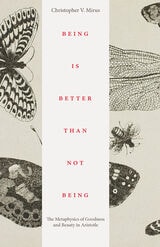
Being is Better Than Not Being
The Metaphysics of Goodness and Beauty in AristotleChristopher V. Mirus
Catholic University of America Press, 2022
In his contemplative works on nature, Aristotle twice appeals to the general principle that being is better than not being. Taking his cue from this claim, Christopher V. Mirus offers an extended, systematic account of how Aristotle understands being itself to be good.
Mirus begins with the human, examining Aristotle’s well-known claim that the end of a human life is the good of the human substance as such—which turns out to be the good of the human capacity for thought. Human thought, however, is not concerned with human affairs alone. It is also contemplative, and contemplation is oriented toward the beauty of its objects. In each of the three branches of contemplative thought—mathematics, natural science, and theology—the intelligibility of being renders it beautiful to thought. Both in nature and in human life, moreover, the being that is beautiful through its intelligibility serves also as an end of motion and of action; hence it counts not only as beautiful (kalon), but also as good (agathon).
The persistent concern of thought with the beautiful reveals what is at stake for human beings in Aristotle’s larger metaphysics of the good: in the connection between goodness and actuality that structures his natural science and metaphysics, in his explicit claim that being is better than not being, and in his concepts of order and determinacy, which help connect being with goodness. These in turn shed light on his concepts of the complete and the self-sufficient, on his teleological understanding of the four elements, and on the curious role of the honorable in his natural science and metaphysics.
[more]
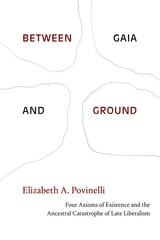
Between Gaia and Ground
Four Axioms of Existence and the Ancestral Catastrophe of Late LiberalismElizabeth A. Povinelli
Duke University Press, 2021
In Between Gaia and Ground Elizabeth A. Povinelli theorizes the climatic, environmental, viral, and social catastrophe present as an ancestral catastrophe through which that Indigenous and colonized peoples have been suffering for centuries. In this way, the violence and philosophies the West relies on now threaten the West itself. Engaging with the work of Glissant, Deleuze and Guattari, Césaire, and Arendt, Povinelli highlights four axioms of existence—the entanglement of existence, the unequal distribution of power, the collapse of the event as essential to political thought, and the legacies of racial and colonial histories. She traces these axioms' inspiration in anticolonial struggles against the dispossession and extraction that have ruined the lived conditions for many on the planet. By examining the dynamic and unfolding forms of late liberal violence, Povinelli attends to a vital set of questions about changing environmental conditions, the legacies of violence, and the limits of inherited Western social theory. Between Gaia and Ground also includes a glossary of the keywords and concepts that Povinelli has developed throughout her work.
[more]