Results by title
74 books match the query 'Origin' and 4 start with b

Ball, Bat and Bishop
THE ORIGIN OF BALL GAMESRobert W. Henderson
University of Illinois Press, 1947
Step aside, Abner Doubleday! In this impeccably researched history, Robert W. Henderson uncovers the true origins not only of baseball but of a score of related sports involving hitting, catching, throwing, or kicking a ball.
Henderson traces the origins of ball sports to religious rites in ancient Egypt, where the ball (perhaps a shrunken head) represented a fertility symbol and opposing teams engaged in mock combat signifying the struggle of good against evil. Centuries later, pagan fertility rites featuring the ball were adapted by the Christian church as rituals symbolic of Easter and the Resurrection. Court tennis was also firmly rooted in the church, the earliest players being the bishops, canons, and clerics who played it in their cloistered courtyards.
Henderson overturns the popular belief that the game of racquets originated in the debtors' prison on Fleet Street in the early nineteenth century. He also notes that polo, the most ancient of games played with stick and ball, originated in Persia and migrated to China and India, where it was eventually embraced by English imperialists. Other sports discussed include football, lawn tennis, cricket, and golf.
The most substantial portion of Henderson's study is devoted to the game of baseball. Providing copious evidence of early forms of baseball played in England and the United States before 1829, he offers a meticulous account of the legerdemain by which Abner Doubleday, the famous Civil War general, came to be identified as the inventor in 1839 of a game that was already at least two centuries old.
The new foreword by Leonard Koppett affirms the significance of this classic work of sports history, which was the first to dismantle the Doubleday/Cooperstown myth.
[more]
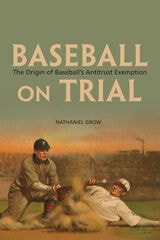
Baseball on Trial
The Origin of Baseball's Antitrust ExemptionNathaniel Grow
University of Illinois Press, 2014
The controversial 1922 Federal Baseball Supreme Court ruling held that the "business of base ball" was not subject to the Sherman Antitrust Act because it did not constitute interstate commerce. In Baseball on Trial, legal scholar Nathaniel Grow defies conventional wisdom to explain why the unanimous Supreme Court opinion authored by Justice Oliver Wendell Holmes, which gave rise to Major League Baseball's exemption from antitrust law, was correct given the circumstances of the time.
Currently a billion dollar enterprise, professional baseball teams crisscross the country while the games are broadcast via radio, television, and internet coast to coast. The sheer scope of this activity would seem to embody the phrase "interstate commerce." Yet baseball is the only professional sport--indeed the sole industry--in the United States that currently benefits from a judicially constructed antitrust immunity. How could this be?
Drawing upon recently released documents from the National Baseball Hall of Fame, Grow analyzes how the Supreme Court reached this seemingly peculiar result by tracing the Federal Baseball litigation from its roots in 1914 to its resolution in 1922, in the process uncovering significant new details about the proceedings. Grow observes that while interstate commerce was measured at the time by the exchange of tangible goods, baseball teams in the 1910s merely provided live entertainment to their fans, while radio was a fledgling technology that had little impact on the sport. The book ultimately concludes that, despite the frequent criticism of the opinion, the Supreme Court's decision was consistent with the conditions and legal climate of the early twentieth century.
[more]

Biocosmism
Vitality and the Utopian Imagination in Postrevolutionary MexicoJorge Quintana Navarrete
Vanderbilt University Press, 2024
Honorable Mention, Premio al Mejor Libro en Humanidades, Latin American Studies Association–Mexico Section, 2025
Most scholars study postrevolutionary Mexico as a period in which cultural production significantly shaped national identity through murals, novels, essays, and other artifacts that registered the changing political and social realities in the wake of the Revolution. In Biocosmism, Jorge Quintana Navarrete shifts the focus to examine how a group of scientists, artists, and philosophers conceived the manifold relations of the human species with cosmological forces and nonhuman entities (animals, plants, inorganic matter, and celestial bodies, among others).
Drawing from recent theoretical trends in new materialisms, biopolitics, and posthumanism, this book traces for the first time the intellectual constellation of biocosmism or biocosmic thought: the study of universal life understood as the vital vibrancy that animates everything in the cosmos from inorganic matter to living organisms to outer space. It combines both analysis of unexplored areas—such as Alfonso L. Herrera’s plasmogeny—and innovative readings of canonical texts like Vasconcelos’s La raza cósmica to examine how biocosmism produced a wide array of utopian projects and theorizations that continue to challenge anthropocentric, biopolitical frameworks.
[more]
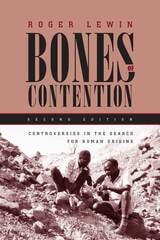
Bones of Contention
Controversies in the Search for Human OriginsRoger Lewin
University of Chicago Press, 1997
Bones of Contention is a behind-the-scenes look at the search for human origins. Analyzing how the biases and preconceptions of paleoanthropologists shaped their work, Roger Lewin's detective stories about the discovery of Neanderthal Man, the Taung Child, Lucy, and other major fossils provide insight into this most subjective of scientific endeavors. The new afterword looks at ways in which paleoanthropology, while becoming more scientific
in many ways, remains contentious.
"[An] un-put-downable book."—John Gribbon, Times Educational Supplement
"Not just another 'stones and bones' account of human evolution. It is Lewin's thesis, amply demonstrated, that paleoanthropology is the most subjective of sciences because it engages the emotions of virtually everyone; and since the evidence is scrappy, interpretation is everything. . . . A splendid, stirring, and eye-opening account, to be devoured."—Kirkus Reviews, starred review
"[Lewin shows] 'how very unscientific the process of scientific inquiry can be.'. . . Bones of Contention is . . . serious intellectual history."—Edward Dolnick, Wall Street Journal
"[Lewin] documents his thesis in persuasive detail. . . . The reader is carried along by the power of Mr. Lewin's reporting."—Robert Wright, New York Times Book Review
[more]