126 books match the query 'People with disabilities' and 9 start with b
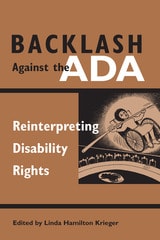
cover of Backlash Against the ADA: Reinterpreting Disability Rights

Backlash Against the ADA

Reinterpreting Disability Rights

Linda Hamilton Krieger, Editor

University of Michigan Press, 2003
For civil rights lawyers who toiled through the 1980s in the increasingly barren fields of race and sex discrimination law, the approval of the Americans with Disabilities Act in 1990 by a nearly unanimous U.S. House and Senate and a Republican President seemed almost fantastic. Within five years of the Act's effective date, however, observers were warning of an unfolding assault on the ADA by federal judges, the media, and other national opinion-makers. A year after the Supreme Court issued a trio of decisions in the summer of 1999 sharply limiting the ADA's reach, another decision invalidated an entire title of the act as it applied to the states. By this time, disability activists and disability rights lawyers were speaking openly of a backlash against the ADA.
What happened, why did it happen, and what can we learn from the patterns of public, media, and judicial response to the ADA that emerged in the 1990s? In this book, a distinguished group of disability activists, disability rights lawyers, social scientists and humanities scholars grapple with these questions. Taken together, these essays construct and illustrate a new and powerful theoretical model of sociolegal change and retrenchment that can inform both the conceptual and theoretical work of scholars and the day-to-day practice of social justice activists.
Contributors include Lennard J. Davis, Matthew Diller, Harlan Hahn, Linda Hamilton Krieger, Vicki A. Laden, Stephen L. Percy, Marta Russell, and Gregory Schwartz.
Backlash Against the ADA will interest disability rights activists, lawyers, law students and legal scholars interested in social justice and social change movements, and students and scholars in disability studies, political science, media studies, American studies, social movement theory, and legal history.
Linda Hamilton Krieger is Professor of Law, University of California School of Law, Berkeley.
[more]
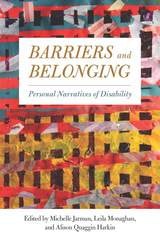
cover of Barriers and Belonging: Personal Narratives of Disability

Barriers and Belonging

Personal Narratives of Disability

Michelle Jarman

Temple University Press, 2017

What is the direct impact that disability studies has on the lives of disabled people today? The editors and contributors to this essential anthology, Barriers and Belonging, provide thirty-seven personal narratives thatexplore what it means to be disabled and why the field of disability studies matters. 

The editors frame the volume by introducing foundational themes of disability studies. They provide a context of how institutions—including the family, schools, government, and disability peer organizations—shape and transform ideas about disability. They explore how disability informs personal identity, interpersonal and community relationships, and political commitments. In addition, there are heartfelt reflections on living with mobility disabilities, blindness, deafness, pain, autism, psychological disabilities, and other issues. Other essays articulate activist and pride orientations toward disability, demonstrating the importance of reframing traditional narratives of sorrow and medicalization. 

The critical, self-reflective essays in Barriers and Belonging provide unique insights into the range and complexity of disability experience.
[more]
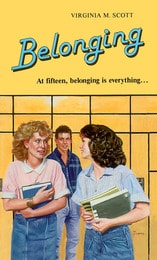
cover of Belonging

Belonging

Virginia Tibbs-Brelje

Gallaudet University Press, 1986
"A 1987 Outstanding Book for Young Adults" --University of Iowa Poll "Gustie Blaine is 15 when she contracts meningitis. After a long recovery period during which she loses the small amount of residual hearing she had seemed to retain, Gustie tries to pick up the pieces of her life. Her parents are unrealistic and over protective; her best friend rejects her; her teachers run the gamut from being convinced Gustie cannot function in the mainstream to being supportive... through a new boyfriend who has a deaf brother and sister-in-law, and through Gustie's visit with an understanding special education teacher to a class of predominately congenitally deaf students, readers are made aware of the tremendous range of difference among deaf and hard of hearing people, the ways in which they communicate and the technical aids available to them. Realistic and involving...[Young Adults] will identify with Gustie and her wish to belong; the book should touch them and be popular." --School Library Journal Virginia M. Scott is a writer. Like Gustie, the main character in her novel, Ms. Scott became deaf as an adolescent.
[more]
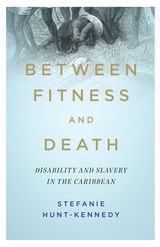
cover of Between Fitness and Death: Disability and Slavery in the Caribbean

Between Fitness and Death

Disability and Slavery in the Caribbean

Stefanie Hunt-Kennedy

University of Illinois Press, 2020

Long before the English became involved in the African slave trade, they imagined Africans as monstrous and deformed beings. The English drew on pre-existing European ideas about monstrosity and deformity to argue that Africans were a monstrous race, suspended between human and animal, and as such only fit for servitude. Joining blackness to disability transformed English ideas about defective bodies and minds. It also influenced understandings of race and ability even as it shaped the embodied reality of people enslaved in the British Caribbean.

Stefanie Hunt-Kennedy provides a three-pronged analysis of disability in the context of Atlantic slavery. First, she examines the connections of enslavement and representations of disability and the parallel development of English anti-black racism. From there, she moves from realms of representation to reality in order to illuminate the physical, emotional, and psychological impairments inflicted by slavery and endured by the enslaved. Finally, she looks at slave law as a system of enforced disablement.

Audacious and powerful, Between Fitness and Death is a groundbreaking journey into the entwined histories of racism and ableism.
[more]
cover of Black Disability Politics

Black Disability Politics

Sami Schalk

Duke University Press, 2022
In Black Disability Politics Sami Schalk explores how issues of disability have been and continue to be central to Black activism from the 1970s to the present. Schalk shows how Black people have long engaged with disability as a political issue deeply tied to race and racism. She points out that this work has not been recognized as part of the legacy of disability justice and liberation because Black disability politics differ in language and approach from the mainstream white-dominant disability rights movement. Drawing on the archives of the Black Panther Party and the National Black Women’s Health Project alongside interviews with contemporary Black disabled cultural workers, Schalk identifies common qualities of Black disability politics, including the need to ground public health initiatives in the experience and expertise of marginalized disabled people so that they can work in antiracist, feminist, and anti-ableist ways. Prioritizing an understanding of disability within the context of white supremacy, Schalk demonstrates that the work of Black disability politics not only exists but is essential to the future of Black liberation movements.
[more]
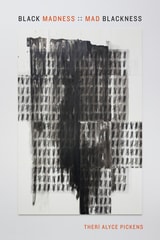
cover of Black Madness :: Mad Blackness

Black Madness

: Mad Blackness

Therí Alyce Pickens

Duke University Press, 2019
In Black Madness :: Mad Blackness Therí Alyce Pickens rethinks the relationship between Blackness and disability, unsettling the common theorization that they are mutually constitutive. Pickens shows how Black speculative and science fiction authors such as Octavia Butler, Nalo Hopkinson, and Tananarive Due craft new worlds that reimagine the intersection of Blackness and madness. These creative writer-theorists formulate new parameters for thinking through Blackness and madness. Pickens considers Butler's Fledgling as an archive of Black madness that demonstrates how race and ability shape subjectivity while constructing the building blocks for antiracist and anti-ableist futures. She examines how Hopkinson's Midnight Robber theorizes mad Blackness and how Due's African Immortals series contests dominant definitions of the human. The theorizations of race and disability that emerge from these works, Pickens demonstrates, challenge the paradigms of subjectivity that white supremacy and ableism enforce, thereby pointing to the potential for new forms of radical politics.
[more]
cover of Blackness and Disability: Critical Examinations and Cultural Interventions

Blackness and Disability

Critical Examinations and Cultural Interventions

Christopher M. Bell

Michigan State University Press, 2012

Disability Studies diverge from the medical model of disability (which argues that disabled subjects can and should be “fixed”) to view disability as socially constructed, much in the same way other identities are. The work of reading black and disabled bodies is not only recovery work, but work that requires a willingness to deconstruct the systems that would keep those bodies in separate spheres. This pivotal volume uncovers the misrepresentations of black disabled bodies and demonstrates how those bodies transform systems and culture. Drawing on key themes in Disability Studies and African American Studies, these collected essays complement one another in interesting and dynamic ways, to forge connections across genres and chronotopes, an invitation to keep blackness and disability in conversation. With an analysis of disability as a result of war, studies of cognitive impairment and slavery in fiction, representations of slavery and violence in photography, deconstructions of illness (cancer and AIDS) narratives, comparative analyses of black and Latina/o and black and African subjects, analysis of treatments of disability in hip-hop, and commentary on disability, blackness, and war, this volume shows that the historical lines of demarcation in this field are permeable and should be challenged.
[more]
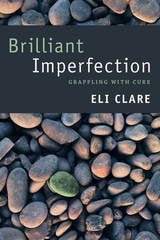
cover of Brilliant Imperfection: Grappling with Cure

Brilliant Imperfection

Grappling with Cure

Eli Clare

Duke University Press, 2017

In Brilliant Imperfection Eli Clare uses memoir, history, and critical analysis to explore cure—the deeply held belief that body-minds considered broken need to be fixed. Cure serves many purposes. It saves lives, manipulates lives, and prioritizes some lives over others. It provides comfort, makes profits, justifies violence, and promises resolution to body-mind loss. Clare grapples with this knot of contradictions, maintaining that neither an anti-cure politics nor a pro-cure worldview can account for the messy, complex relationships we have with our body-minds. The stories he tells range widely, stretching from disability stereotypes to weight loss surgery, gender transition to skin lightening creams. At each turn, Clare weaves race, disability, sexuality, class, and gender together, insisting on the nonnegotiable value of body-mind difference. Into this mix, he adds environmental politics, thinking about ecosystem loss and restoration as a way of delving more deeply into cure. Ultimately Brilliant Imperfection reveals cure to be an ideology grounded in the twin notions of normal and natural, slippery and powerful, necessary and damaging all at the same time.
[more]
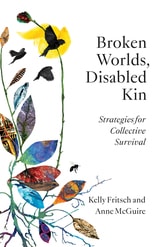
cover of Broken Worlds, Disabled Kin: Strategies for Collective Survival

Broken Worlds, Disabled Kin

Strategies for Collective Survival

Kelly Fritsch

University of Minnesota Press, 2026

A call to remake our world through a new politics of disabled kin-making

We live in a world broken by design: a web of systems that debilitate and kill through racist and ableist infrastructural neglect, socioeconomic abandonment, and ecological negligence. Fixes for these forms of breakage often conceal and amplify harm—but what happens if we refuse to rehabilitate this inhospitable world? In Broken Worlds, Disabled Kin, Kelly Fritsch and Anne McGuire urge an alternative response through abolition, access, care, and interdependence.

Bringing a much-needed disability studies lens to discussions of public policy, legal reform, and social change, Fritsch and McGuire show how hostile social and economic structures such as racial capitalism, neoliberalism, and settler colonialism unevenly target certain populations and environments. As they trace how everyday encounters with broken infrastructures like inaccessible transit, fragmented mental health care, and crumbling educational institutions reflect broader patterns of structural abandonment and slow violence, they pose a radical means of response: the making of disabled kin. Ranging from mundane disruptions to global crises like pandemics, wars, genocides, and climate collapse, they demonstrate how disabled kin-making nurtures connection and support between people, ecologies, infrastructures, and objects, cultivating a collective “we” that can contest systems broken by design.

Urgent and passionate, Broken Worlds, Disabled Kin asks readers to reexamine conceptions of breakage, maintenance, and repair, viewing them as tools of abolition and justice. Against relentless fragmentation and atomization, this book equips us with a politics of solidarity and collectivity with which to begin making a more life-supporting world.

Retail e-book files for this title are screen-reader friendly with images accompanied by short alt text and/or extended descriptions.

[more]