Results by title
111 books match the query 'Personal narratives, American' and 5 start with b
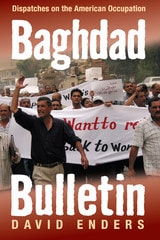
Baghdad Bulletin
Dispatches on the American OccupationDavid Enders
University of Michigan Press, 2009
-Joe Sacco, author of Safe Area Gorazde
"Baghdad Bulletin takes us where mainstream news accounts do not go. Disrupting the easy clichés that dominate U.S. journalism, Enders blows away the media fog of war. The result is a book that challenges Americans to see through double speak and reconsider the warfare being conducted in their names."
-Norman Solomon, author of War Made Easy: How Presidents and Pundits Keep Spinning Us to Death
"Journalism at its finest and on a shoestring to boot. David Enders shows that courage and honesty can outshine big-budget mainstream media. Wry but self-critical, Baghdad Bulletin tells a story that a few of us experienced but every journalist, nay every citizen, should read."
-Pratap Chatterjee, Managing Editor and Project Director, CorpWatch
"Young and tenacious, Dave Enders went, saw, and wrote it down. Here it is-a well-informed and detailed tale of Iraq's decline under American rule. Baghdad Bulletin offers tragic politics, wacky people, and keen insights about what really matters on the ground in Iraq."
-Christian Parenti
"I wrote my first piece for Baghdad Bulletin after visiting the mass graves at Al-Hilla in 2003. The Baghdad Bulletin was essential reading in the first few months after the end of the war. I handed that particular copy to Prime Minister Tony Blair. I am only sorry that I cannot read it anymore. David Enders and his team were brave, enterprising, and idealistic."
-Rt. Hon. Ann Clwyd, member of the British Parliament
Baghdad Bulletin is a street-level account of the war and turbulent postwar period as seen through the eyes of the young independent journalist David Enders. The book recounts Enders's story of his decision to go to Iraq, where he opened the only English-language newspaper completely written, printed, and distributed there during the war.
Young, courageous, and anti-authoritarian, Enders is the first reporter to cover the war as experienced by ordinary Iraqis. Deprived of the press credentials that gave his embedded colleagues access to press conferences and officially sanitized information, Enders tells the story of a different war, outside the Green Zone. It is a story in which the struggle of everyday life is interspersed with moments of sheer terror and bizarre absurdity: wired American troops train their guns on terrified civilians; Iraqi musicians prepare a recital for Coalition officials who never show; traveling clowns wreak havoc in a Baghdad police station.
Orphans and intellectuals, activists and insurgents: Baghdad Bulletin depicts the unseen complexity of Iraqi society and gives us a powerful glimpse of a new kind of warfare, one that coexists with-and sometimes tragically veers into-the everyday rhythms of life.
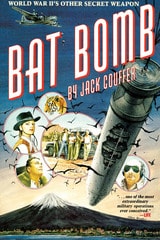
Bat Bomb
World War II's Other Secret WeaponBy Jack Couffer
University of Texas Press, 1992
It was a crazy way to win World War II in the Pacific—
All the United States had to do was to attach small incendiary bombs to millions of bats and release them over Japan's major cities. As the bats went to roost, a million fires would flare up in remote crannies of the wood and paper buildings common throughout Japan. When their cities were reduced to ashes, the Japanese would surely capitulate...
The plan made sense to a handful of eccentric promoters and researchers, who convinced top military brass and even President Roosevelt to back the scheme. It might have worked, except that another secret weapon—something to do with atoms—was chosen to end the war.
Told here by the youngest member of the team, this is the story of the bat bomb project, or Project X-Ray, as it was officially known. In scenes worthy of a Capra or Hawks comedy, Jack Couffer recounts the unorthodox experiments carried out in the secrecy of Bandera, Texas; Carlsbad, New Mexico; and El Centro, California, in 1942-1943 by "Doc" Adams' private army. This oddball cast of characters included an eccentric inventor, a distinguished Harvard scientist, a biologist with a chip on his shoulder, a movie star, a Texas guano collector, a crusty Marine Corps colonel, a Maine lobster fisherman, an ex-mobster, and a tiger.
Not to be defeated by minor logistical hurdles, the bat bomb researchers risked life and limb to explore uncharted bat caves and "recruit" thousands of bats to serve their country. Through months of personality conflicts, military snafus, and technical failures the team pressed on, certain that bats could end the war with Japan. And they might have—in their first airborne test, the bat bombers burned an entire brand-new military airfield to the ground.
For everyone who relishes true tales of action and adventure, Bat Bomb is a must-read. Bat enthusiasts will also discover the beginnings of the scientific study of bats.
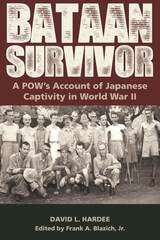
Bataan Survivor
A POW’s Account of Japanese Captivity in World War IIDavid L. Hardee, Edited by Frank A. Blazich, Jr.
University of Missouri Press, 2026
A forgotten account, written in the immediate aftermath of World War II, which vividly portrays the valor, sacrifice, suffering, and liberation of the defenders of Bataan and Corregidor through the eyes of one survivor.
The personal memoir of Colonel David L. Hardee, first drafted at sea from April-May 1945 following his liberation from Japanese captivity, is a thorough treatment of his time in the Philippines. A career infantry officer, Hardee fought during the Battle of Bataan as executive officer of the Provisional Air Corps Regiment. Captured in April 1942 after the American surrender on Bataan, Hardee survived the Bataan Death March and proceeded to endure a series of squalid prison camps. A debilitating hernia left Hardee too ill to travel to Japan in 1944, making him one of the few lieutenant colonels to remain in the Philippines and subsequently survive the war. As a primary account written almost immediately after his liberation, Hardee’s memoir is fresh, vivid, and devoid of decades of faded memories or contemporary influences associated with memoirs written years after an experience. This once-forgotten memoir has been carefully edited, illustrated and annotated to unlock the true depths of Hardee’s experience as a soldier, prisoner, and liberated survivor of the Pacific War.

Between Tedium and Terror
A Soldier's World War II Diary, 1943-45Sy M. KahnForeword by Ronald Spector
University of Illinois Press, 1993
Often writing in tents by candlelight, in foxholes, or on board ships, Kahn documents life during four campaigns and over three hundred air attacks. He describes the 244th Port Company's backbreaking work of loading and unloading ships, the suffocating heat, the debilitating tropical diseases, and the relentless, sometimes terrifying bombings, accidents, casualties, and deaths.
His wartime odyssey also includes encounters with civilians in Australia, in the Philippines, and, as among the earliest occupation troops, in Japan. A detailed record of the daily cost of war, Kahn's journal reflects his increasing maturity and his personal coming of age, representative of thousands of young Americans who served in World War II.
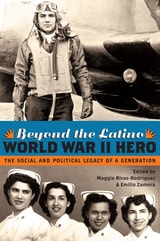
Beyond the Latino World War II Hero
The Social and Political Legacy of a GenerationEdited by Maggie Rivas-Rodríguez and Emilio Zamora
University of Texas Press, 2009
Maggie Rivas-Rodríguez 's edited volume Mexican Americans & World War II brought pivotal stories from the shadows, contributing to the growing acknowledgment of Mexican American patriotism as a meaningful force within the Greatest Generation. In this latest anthology, Rivas-Rodríguez and historian Emilio Zamora team up with scholars from various disciplines to add new insights. Beyond the Latino World War II Hero focuses on home-front issues and government relations, delving into new arenas of research and incorporating stirring oral histories.
These recollections highlight realities such as post-traumatic stress disorder and its effects on veterans' families, as well as Mexican American women of this era, whose fighting spirit inspired their daughters to participate in Chicana/o activism of the 1960s and 1970s. Other topics include the importance of radio as a powerful medium during the war and postwar periods, the participation of Mexican nationals in World War II, and intergovernmental negotiations involving Mexico and Puerto Rico. Addressing the complexity of the Latino war experience, such as the tandem between the frontline and the disruption of the agricultural migrant stream on the home front, the authors and contributors unite diverse perspectives to harness the rich resources of an invaluable oral history.