Results by title
125 books match the query 'Perspectives' and 4 start with b
Bosnian Studies
Perspectives from an Emerging FieldDzeneta Karabegovic
University of Missouri Press, 2023
Diaspora communities have formed in North America (especially in St. Louis), Europe, and Australia because of war and displacement, and have themselves become a considerable topic of study spanning the disciplines of anthropology, migration studies, political science, memory studies, conflict and security studies, psychology, and geography.
This volume seeks to illuminate how Bosnian migrant and diaspora scholars are contributing to the development of Bosnian Studies. The authors included in this volume are either writing from their (new) home bases in Australia, Austria, Canada, Switzerland, the United Kingdom, and the United States, among others, or they have returned to Bosnia after a period of migration. Their chapters have distinct entry points of inquiry, demonstrating how scholars have integrated Bosnia as a theme across the range of disciplines in which they are situated. The selections included in the volume range from literary analysis to personal memoirs of the conflict, from studies of heritage and identity to political science analysis of diaspora voting, to genocide studies and questions of (or lack of) ethics in the growing field of Bosnian Studies.
Bridging the Gap
Perspectives on Nationally Competitive ScholarshipsSuzanne McCray
University of Arkansas Press, 2019
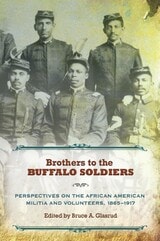
Brothers to the Buffalo Soldiers
Perspectives on the African American Militia and Volunteers, 1865-1917Bruce A. Glasrud
University of Missouri Press, 2011
Many black Americans continued to serve in times of military need. Nearly 180,000 African Americans served in units of the U.S. Colored Troops during the Civil War, and others, from states such as Massachusetts, Rhode Island, Missouri, and Kansas, participated in state militias organized to protect local populations from threats of Confederate invasion. As such, the Civil War was a turning point in the acceptance of black soldiers for national defense. By 1900, twenty-two states and the District of Columbia had accepted black men into some form of military service, usually as state militiamen—brothers to the “buffalo soldiers” of the regular army regiments, but American military men regardless.
Little has been published about them, but Brothers to the Buffalo Soldiers: Perspectives on the African American Militia and Volunteers, 1865–1919, offers insights into the varied experiences of black militia units in the post–Civil War period. The book includes eleven articles that focus either on “Black Participation in the Militia” or “Black Volunteer Units in the War with Spain.” The articles, collected and introduced by author and scholar Bruce A. Glasrud, provide an overview of the history of early black citizen-soldiers and offer criticism from prominent academics interested in that experience.
Brothers to the Buffalo Soldiers discusses a previously little-known aspect of the black military experience in U.S. history, while deliberating on the discrimination these men faced both within and outside the military. Chosen on the bases of scholarship, balance, and readability, these articles provide a rare composite picture of the black military man’s life during this period. Brothers to the Buffalo Soldiers offers both a valuable introductory text for students of military studies and a solid source of material for African American historians.
Building a Green Economy
Perspectives from Ecological EconomicsRobert B. Richardson
Michigan State University Press, 2013
The first decade of the twenty-first century has been characterized by a growing global awareness of the tremendous strains that human economic activity place on natural resources and the environment. As the world’s population increases, so does the demand for energy, food, and other resources, which adds to existing stresses on ecosystems, with potentially disastrous consequences. Humanity is at a crossroads in our pathway to future prosperity, and our next steps will impact our long-term sustainability immensely. In this timely volume, leading ecological economics scholars offer a variety of perspectives on building a green economy. Grounded in a critique of conventional thinking about unrestrained economic expansion and the costs of environmental degradation, this book presents a roadmap for an economy that prioritizes human welfare over consumerism and growth. As the authors represented here demonstrate, the objective of ecological economics is to address contemporary problems and achieve long-term socioeconomic well-being without undermining the capacity of the ecosphere. The volume is organized around three sections: “Perspectives on a Green Economy,” “Historical and Theoretical Perspectives,” and “Applications and Practice.” A rich resource in its own right, Building a Green Economy contains the most innovative thinking in ecological economics at a critical time in the reexamination of the human relationship with the natural world.