283 books match the query 'Phenomenology' and 10 start with b
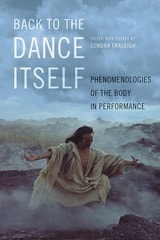
cover of Back to the Dance Itself: Phenomenologies of the Body in Performance

Back to the Dance Itself

Phenomenologies of the Body in Performance

Edited with Essays by Sondra Fraleigh

University of Illinois Press, 2018

In Back to the Dance Itself, Sondra Fraleigh edits essays that illuminate how scholars apply a range of phenomenologies to explore questions of dance and the world; performing life and language; body and place; and self-knowing in performance. Some authors delve into theoretical perspectives, while others relate personal experiences and reflections that reveal fascinating insights arising from practice. Collectively, authors give particular consideration to the interactive lifeworld of making and doing that motivates performance. Their texts and photographs study body and the environing world through points of convergence, as correlates in elemental and constant interchange modeled vividly in dance. Selected essays on eco-phenomenology and feminism extend this view to the importance of connections with, and caring for, all life.

Contributors: Karen Barbour, Christine Bellerose, Robert Bingham, Kara Bond, Hillel Braude, Sondra Fraleigh, Kimerer LaMothe, Joanna McNamara, Vida Midgelow, Ami Shulman, and Amanda Williamson.
[more]
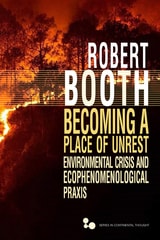
cover of Becoming a Place of Unrest: Environmental Crisis and Ecophenomenological Praxis

Becoming a Place of Unrest

Environmental Crisis and Ecophenomenological Praxis

Robert Booth

Ohio University Press, 2021
The key to mitigating the environmental crisis isn’t just based on science; it depends upon a profound philosophical revision of how we think about and behave in relation to the world. Our ongoing failure to interrupt the environmental crisis in a meaningful way stems, in part, from how we perceive the environment—what Robert Booth calls the "more-than-human world.” Anthropocentric presumptions of this world, inherited from natural science, have led us to better scientific knowledge about environmental problems and more science-based—yet inadequate—practical “solutions.” That’s not enough, Booth argues. Rather, he asserts that we must critically and self-reflexively revise how we perceive and consider ourselves within the more-than-human world as a matter of praxis in order to arrest our destructive impact on it. Across six chapters, Booth brings ecophenomenology—environmentally focused phenomenology—into productive dialogue with a rich array of other philosophical approaches, such as ecofeminism, new materialism, speculative realism, and object-oriented ontology. The book thus outlines and justifies why and how a specifically ecophenomenological praxis may lead to the disruption of the environmental crisis at its root. Booth’s observations and arguments make the leap from theory to practice insofar as they may influence how we fundamentally grasp the environmental crisis and what promising avenues of practical activism might look like. In Booth’s view, this is not about achieving a global scientific consensus regarding the material causes of the environmental crisis or the responsible use of “natural resources.” Instead, Booth calls for us to habitually resist our impetus to uncritically reduce more-than-human entities to “natural resources” in the first place. As Booth recognizes, Becoming a Place of Unrest cannot and does not tell us how we should act. Instead, it outlines and provides the basic means by which to instill positive and responsible conceptual and behavioral relationships with the rest of the world. Based on this, there is hope that we may begin to develop more concrete, actionable policies that bring about profound and lasting change.
[more]
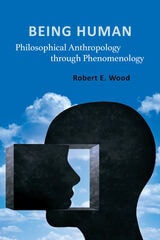
cover of Being Human: Philosophical Anthropology through Phenomenology

Being Human

Philosophical Anthropology through Phenomenology

Robert E. Wood

Catholic University of America Press, 2022
Being Human is the fruit of many years teaching Philosophical Anthropology, conducting Phenomenological Workshops, and reading classic texts in the light of a reflective awareness of the field of experience. Being Human is intended to look to what is typically assumed but not examined in much of current philosophical literature. Today what typically appear as philosophical are textual studies that draw upon wide-ranging scholarship to learn how past thinkers used to think; or works that tend either to be “high-flying,” operating at levels of abstraction far removed from experience and written in arcane style, and thus, for both reasons, difficult to assess (much of Continental thought); or minutely focused upon particular claims and the arguments that can be advanced for and against them (Analytical thought); or deconstructing texts to show how they do not fully work (the followers of Jacques Derrida). Scholarly study, abstract constructions, refined arguments, and deconstructive strategies are each important in their own way; but all take place within the structure of the field of experience which is typically assumed without paying explicit attention to it. Especially in philosophy of mind, the overall field of experience has too often been ignored, usually in favor of some conjecture as to how our ordinary categories would have to be changed when neuro-physiology will be far enough advanced to explain all our behavior. Robert E. Wood claims that it is best to understand what it is that is supposed to be explained before conjecturing about possible explanations. But when you do that, you will have to come to terms with what it means to seek explanation, what a Who is that seeks it, and why it is sought.
[more]
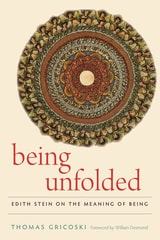
cover of Being Unfolded: Edith Stein on the Meaning of Being

Being Unfolded

Edith Stein on the Meaning of Being

Thomas Gricoski

Catholic University of America Press, 2020

Being Unfolded responds to the question, ‘What is the meaning of being for Edith Stein.’ In Finite and Eternal Being Stein tentatively concludes that ‘being is the unfolding of meaning.’ Neither Stein nor her commentators have elaborated much on this suggestive phrase. Thomas Gricoski argues that Stein’s mature metaphysical project can be developed into an ‘ontology of unfolding.’ The differentiating factor of this ontology is its resistance to both existentialism and essentialism. The ‘ontology of unfolding’ is irreducibly relational. Being Unfolded proceeds by testing a relational hypothesis against Stein’s theory of the modes of being (actual, essential, and mental being). From the phenomenological perspective, Gricoski examines Stein’s theory of the relation of consciousness and being. From the scholastic perspective, he examines Stein’s account of the relation of essence and existence in material being, living being, and human being. And from both perspectives he considers the relation of divine being to actual being and their essences. This book is limited to Stein’s theory of the meaning of being, without making an explicit confrontation with Heidegger. It offers two primary contributions to Stein studies: a systematic analysis of Stein’s modes of being, especially essential being, and an exposition and expansion of her overlooked concept of unfolding. Being Unfolded also contributes to the broader field of contemporary metaphysics by developing Stein’s theory of being as an experiment in fundamental ontology. While other relational ontologies focus on relations between beings, this exploration of unfolding examines being’s inner self-relationality.
[more]
cover of Between Heidegger and Novalis

Between Heidegger and Novalis

Peter Hanly

Northwestern University Press, 2021

This book brings a central figure of the early German Romantic movement—the poet and philosopher Novalis—into dialogue with the work of Martin Heidegger. Looking beyond the question of direct influence, the book demonstrates that Novalis and Heidegger pursued complementary endeavors as thinkers of relation. Implicitly operative in their thinking, Peter Hanly argues, is an excavation of the Greek conception of harmonia found in the fragments of the pre-Socratic thinker Heraclitus. This is a conception that understands harmony not as concordance but as primal dissonance. It is this experience of harmonia, Hanly proposes, that allows both Novalis and Heidegger to think relation in terms of dynamic and contradictory energies of separation and convergence. Between Heidegger and Novalis thus is a study of the “in-between,” associated in Novalis with energies of fertility and productivity and in Heidegger with energies of agonistic difference.
 
An entirely new approach to both Novalis and Heidegger, this book will interest scholars and students engaged with continental philosophy and the legacy of German Romanticism.  

 
[more]
cover of Between You and I: Dialogical Phenomenology

Between You and I

Dialogical Phenomenology

Beata Stawarska

Ohio University Press, 2009

Classical phenomenology has suffered from an individualist bias and a neglect of the communicative structure of experience, especially the phenomenological importance of the addressee, the inseparability of I and You, and the nature of the alternation between them. Beata Stawarska remedies this neglect by bringing relevant contributions from cognate empirical disciplines—such as sociolinguistics and developmental psychology, as well as the dialogic tradition in philosophy—to bear on phenomenological inquiry. Taken together, these contributions substantiate an alternative view of primary I-You connectedness and help foreground the dialogic dimension of both prediscursive and discursive experience. Between You and I suggests that phenomenology is best practiced in a dialogical engagement with other disciplines.
[more]
cover of Beyond Being: Gadamer's Post-Platonic Hermeneutic Ontology

Beyond Being

Gadamer's Post-Platonic Hermeneutic Ontology

Brice R. Wachterhauser

Northwestern University Press, 1999

Hans Georg-Gadamer is best known in the English-speaking world for his major work on philosophical hermeneutics, Truth and Method; he has also written extensively on the subject of Plato. Most commentators on Gadamer's work therefore view Gadamer either as a historian of philosophy or as a philosopher in his own right, critically engaged in the philosophical issues of our time.

In Beyond Being, Brice R. Wachterhauser contends that this perceived bifurcation in Gadamer's work oversimplifies and distorts important parts of Gadamer's thought. Wachterhauser argues that only by viewing Gadamer's contribution to philosophy as an integrated whole and by reading Gadamer's hermeneutical studies in light of his Plato studies are we able to avoid certain key misunderstandings of Gadamer, as well as to comprehend more clearly the radical implications of Gadamer's thought.
[more]
cover of Beyond: The Philosophy of Emmanuel Levinas

Beyond

The Philosophy of Emmanuel Levinas

Adriaan Theodoor Peperzak

Northwestern University Press, 1997

Although Emmanuel Levinas is widely respected as one of the classic thinkers of our century, the debate about his place within Continental philosophy continues. In Beyond: The Philosophy of Emmanuel Levinas, Adriaan Theodoor Peperzak shows Levinas's thought to be a persistent attempt to point beyond the borders of an economy where orderly interests and ways of reasoning make us feel at home--beyond the world of needs, beyond the self, beyond politics and administration, beyond logic and ontology, even beyond freedom and autonomy.

Peperzak's examination begins with a general overview of Levinas's life and thought, and shows how issues of ethics, politics, and religion are intertwined in Levinas's philosophy. Peperzak also discusses the development of Levinas's relations with Husserl and Heidegger, demonstrating thematically the evolution of both Levinas's anti-Heideggerian view of technology and his critical attitude toward nature.

[more]
cover of Binding Words: Conscience and Rhetoric in Hobbes, Hegel, and Heidegger

Binding Words

Conscience and Rhetoric in Hobbes, Hegel, and Heidegger

Karen Feldman

Northwestern University Press, 2006

In a provactive work that brings new tools to the history of philosophy, Karen S. Feldman offers an elegant account of how philosophical language appears to produce the very thing it claims to describe. She demonstrates that conscience can only be described and understood through tropes and figures of langugae. If description in literal terms is impossible, as Binding Words convincingly argues, perhaps there is no such thing. But if the word "conscience" has no tangible referent, then how can conscience be constructed as binding? Does our conscience move us to do things, or is this yet another figure of speech?

Hobbes's Leviathan, Hegel's Phenomenology of Spirit, and Heidegger's Being and Time dramatize conscience's relation to language and knowledge, morality and duty, and ontology. Feldman investigates how, within these works, conscience is described as binding upon us while at the same time asking how texts themselves may be read as binding. 
[more]
cover of Bodies of Resistance: New Phenomenologies of Politics, Agency, and Culture

Bodies of Resistance

New Phenomenologies of Politics, Agency, and Culture

Laura Doyle

Northwestern University Press, 2001

This startling volume explores the traumas and possibilities of embodiment as it is lived in a political world. Unveiling the influence of phenomenology, particularly that of Maurice Merleau-Ponty, on contemporary thought. Bodies of Resistance cuts across the disciplines of philosophy, political theory, literature, and cultural studies to explore anew how we are at once produced by yet resistant to cultural norms.
[more]