Results by title
68 books match the query 'Philosophical anthropology' and 5 start with b
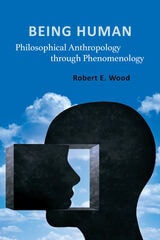
Being Human
Philosophical Anthropology through PhenomenologyRobert E. Wood
Catholic University of America Press, 2022
Being Human is the fruit of many years teaching Philosophical Anthropology, conducting Phenomenological Workshops, and reading classic texts in the light of a reflective awareness of the field of experience. Being Human is intended to look to what is typically assumed but not examined in much of current philosophical literature.
Today what typically appear as philosophical are textual studies that draw upon wide-ranging scholarship to learn how past thinkers used to think; or works that tend either to be “high-flying,” operating at levels of abstraction far removed from experience and written in arcane style, and thus, for both reasons, difficult to assess (much of Continental thought); or minutely focused upon particular claims and the arguments that can be advanced for and against them (Analytical thought); or deconstructing texts to show how they do not fully work (the followers of Jacques Derrida). Scholarly study, abstract constructions, refined arguments, and deconstructive strategies are each important in their own way; but all take place within the structure of the field of experience which is typically assumed without paying explicit attention to it. Especially in philosophy of mind, the overall field of experience has too often been ignored, usually in favor of some conjecture as to how our ordinary categories would have to be changed when neuro-physiology will be far enough advanced to explain all our behavior.
Robert E. Wood claims that it is best to understand what it is that is supposed to be explained before conjecturing about possible explanations. But when you do that, you will have to come to terms with what it means to seek explanation, what a Who is that seeks it, and why it is sought.
[more]

Beneath the Veil of the Strange Verses
Reading Scandalous TextsJeremiah L. Alberg
Michigan State University Press, 2013
Jeremiah Alberg’s fascinating book explores a phenomenon almost every news reader has experienced: the curious tendency to skim over dispatches from war zones, political battlefields, and economic centers, only to be drawn in by headlines announcing a late-breaking scandal. Rationally we would agree that the former are of more significance and importance, but they do not pique our curiosity in quite the same way. The affective reaction to scandal is one both of interest and of embarrassment or anger at the interest. The reader is at the same time attracted to and repulsed by it. Beneath the Veil of the Strange Verses describes the roots out of which this conflicted desire grows, and it explores how this desire mirrors the violence that undergirds the scandal itself. The book shows how readers seem to be confronted with a stark choice: either turn away from scandal completely or become enthralled and thus trapped by it. Using examples from philosophy, literature, and the Bible, Alberg leads the reader on a road out of this false dichotomy. By its nature, the author argues, scandal is the basis of our reading; it is the source of the obstacles that prevent us from understanding what we read, and of the bridges that lead to a deeper grasp of the truth.
[more]
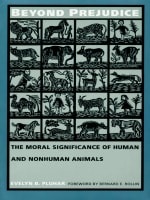
Beyond Prejudice
The Moral Significance of Human and Nonhuman AnimalsEvelyn B. Pluhar
Duke University Press, 1995
In Beyond Prejudice, Evelyn B. Pluhar defends the view that any sentient conative being—one capable of caring about what happens to him or herself—is morally significant, a view that supports the moral status and rights of many nonhuman animals. Confronting traditional and contemporary philosophical arguments, she offers in clear and accessible fashion a thorough examination of theories of moral significance while decisively demonstrating the flaws in the arguments of those who would avoid attributing moral rights to nonhumans.
Exposing the traditional view—which restricts the moral realm to autonomous, fully fledged "persons"—as having horrific implications for the treatment of many humans, Pluhar goes on to argue positively that sentient individuals of any species are no less morally significant than the most automomous human. Her position provides the ultimate justification that is missing from previous defenses of the moral status of nonhuman animals. In the process of advancing her position, Pluhar discusses the implications of determining moral significance for children and "abnormal" humans as well as its relevance to population policies, the raising of animals for food or product testing, decisions on hunting and euthanasia, and the treatment of companion animals. In addition, the author scrutinizes recent assertions by environmental ethicists that all living things or that natural objects and ecosystems be considered highly morally significant. This powerful book of moral theory challenges all defenders of the moral status quo—which decrees that animals decidedly do not count—to reevaluate their convictions.
Exposing the traditional view—which restricts the moral realm to autonomous, fully fledged "persons"—as having horrific implications for the treatment of many humans, Pluhar goes on to argue positively that sentient individuals of any species are no less morally significant than the most automomous human. Her position provides the ultimate justification that is missing from previous defenses of the moral status of nonhuman animals. In the process of advancing her position, Pluhar discusses the implications of determining moral significance for children and "abnormal" humans as well as its relevance to population policies, the raising of animals for food or product testing, decisions on hunting and euthanasia, and the treatment of companion animals. In addition, the author scrutinizes recent assertions by environmental ethicists that all living things or that natural objects and ecosystems be considered highly morally significant. This powerful book of moral theory challenges all defenders of the moral status quo—which decrees that animals decidedly do not count—to reevaluate their convictions.
[more]
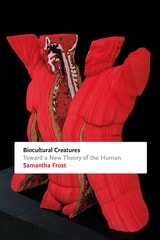
Biocultural Creatures
Toward a New Theory of the HumanSamantha Frost
Duke University Press, 2016
In Biocultural Creatures, Samantha Frost brings feminist and political theory together with findings in the life sciences to recuperate the category of the human for politics. Challenging the idea of human exceptionalism as well as other theories of subjectivity that rest on a distinction between biology and culture, Frost proposes that humans are biocultural creatures who quite literally are cultured within the material, social, and symbolic worlds they inhabit. Through discussions about carbon, the functions of cell membranes, the activity of genes and proteins, the work of oxygen, and the passage of time, Frost recasts questions about the nature of matter, identity, and embodiment. In doing so, she elucidates the imbrication of the biological and cultural within the corporeal self. In remapping the relation of humans to their habitats and arriving at the idea that humans are biocultural creatures, Frost provides new theoretical resources for responding to political and environmental crises and for thinking about how to transform the ways we live.
[more]
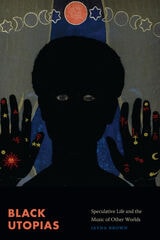
Black Utopias
Speculative Life and the Music of Other WorldsJayna Brown
Duke University Press, 2021
In Black Utopias Jayna Brown takes up the concept of utopia as a way of exploring alternative states of being, doing, and imagining in Black culture. Musical, literary, and mystic practices become utopian enclaves in which Black people engage in modes of creative worldmaking. Brown explores the lives and work of Black women mystics Sojourner Truth and Rebecca Cox Jackson, musicians Alice Coltrane and Sun Ra, and the work of speculative fiction writers Samuel Delany and Octavia Butler as they decenter and destabilize the human, radically refusing liberal humanist ideas of subjectivity and species. Brown demonstrates that engaging in utopian practices Black subjects imagine and manifest new genres of existence and forms of collectivity. For Brown, utopia consists of those moments in the here and now when those excluded from the category human jump into other onto-epistemological realms. Black people—untethered from the hope of rights, recognition, or redress—celebrate themselves as elements in a cosmic effluvium.
[more]