Results by title
426 books match the query 'Philosophy & Social Aspects' and 20 start with b
Bacteria to AI
Human Futures with Our Nonhuman SymbiontsN. Katherine Hayles
University of Chicago Press, 2025
A new theory of mind that includes nonhuman and artificial intelligences.
The much-lauded superiority of human intelligence has not prevented us from driving the planet into ecological disaster. For N. Katherine Hayles, the climate crisis demands that we rethink basic assumptions about human and nonhuman intelligences. In Bacteria to AI, Hayles develops a new theory of mind—what she calls an integrated cognitive framework (ICF)—that includes the meaning-making practices of lifeforms from bacteria to plants, animals, humans, and some forms of artificial intelligence. Through a sweeping survey of evolutionary biology, computer science, and contemporary literature, Hayles insists that another way of life, with ICF at its core, is not only possible but necessary to safeguard our planet’s future.
Battle of the Big Bang
The New Tales of Our Cosmic OriginsNiayesh Afshordi and Phil Halper
University of Chicago Press, 2025
“Excellent.”—Steven Poole, The Wall Street Journal • “Terrific.”—Liz Else, New Scientist (Best Popular Science Books of 2025 So Far) • “A brilliant overview of the state of modern cosmology.”—Alex O'Connor, alexoconnor.com • “This will expand readers’ minds.”—Publishers Weekly • One of Smithsonian's Ten Best Science Books of 2025
“An intellectual feast.”—Carlo Rovelli • “A must-read.”—Sabine Hossenfelder • “Wonderfully broad and open-minded.”—Roger Penrose • “Remarkable.”—Brian Keating
A thrilling exploration of competing cosmological origin stories, comparing new scientific ideas that upend our very notions of space, time, and reality.
By most popular accounts, the universe started with a bang some 13.8 billion years ago. But what happened before the Big Bang? And how do we know it happened at all? Here prominent cosmologist Niayesh Afshordi and science communicator Phil Halper offer a tour of the peculiar possibilities: bouncing and cyclic universes, time loops, creations from nothing, multiverses, black hole births, string theories, and holograms. Along the way, they offer both a call for new physics and a riveting story of scientific debate.
Incorporating insights from Afshordi’s cutting-edge research and Halper’s original interviews with scientists like Stephen Hawking, Roger Penrose, and Alan Guth, Battle of the Big Bang compares these models for the origin of our origins, showing each theory’s strengths and weaknesses and explaining new attempts to test these notions. Battle of the Big Bang is a tale of rivalries and intrigue, of clashes of ideas that have raged from Greek antiquity to the present day over whether the universe is eternal or had a beginning, whether it is unique or one of many. But most of all, Afshordi and Halper show that this search is filled with wonder, discovery, and community—all essential for remembering a forgotten cosmic past.
Beauty and the Brain
The Science of Human Nature in Early AmericaRachel E. Walker
University of Chicago Press, 2023
Between the 1770s and the 1860s, people all across the globe relied on physiognomy and phrenology to evaluate human worth. These once-popular but now-discredited disciplines were based on a deceptively simple premise: that facial features or skull shape could reveal a person’s intelligence, character, and personality. In the United States, these were culturally ubiquitous sciences that both elite thinkers and ordinary people used to understand human nature.
While the modern world dismisses phrenology and physiognomy as silly and debunked disciplines, Beauty and the Brain shows why they must be taken seriously: they were the intellectual tools that a diverse group of Americans used to debate questions of race, gender, and social justice. While prominent intellectuals and political thinkers invoked these sciences to justify hierarchy, marginalized people and progressive activists deployed them for their own political aims, creatively interpreting human minds and bodies as they fought for racial justice and gender equality. Ultimately, though, physiognomy and phrenology were as dangerous as they were popular. In addition to validating the idea that external beauty was a sign of internal worth, these disciplines often appealed to the very people who were damaged by their prejudicial doctrines. In taking physiognomy and phrenology seriously, Beauty and the Brain recovers a vibrant—if largely forgotten—cultural and intellectual universe, showing how popular sciences shaped some of the greatest political debates of the American past.

Beauty and the Brain
The Science of Human Nature in Early AmericaRachel E. Walker
University of Chicago Press, 2023
Examining the history of phrenology and physiognomy, Beauty and the Brain proposes a bold new way of understanding the connection between science, politics, and popular culture in early America.
Between the 1770s and the 1860s, people all across the globe relied on physiognomy and phrenology to evaluate human worth. These once-popular but now discredited disciplines were based on a deceptively simple premise: that facial features or skull shape could reveal a person’s intelligence, character, and personality. In the United States, these were culturally ubiquitous sciences that both elite thinkers and ordinary people used to understand human nature.
While the modern world dismisses phrenology and physiognomy as silly and debunked disciplines, Beauty and the Brain shows why they must be taken seriously: they were the intellectual tools that a diverse group of Americans used to debate questions of race, gender, and social justice. While prominent intellectuals and political thinkers invoked these sciences to justify hierarchy, marginalized people and progressive activists deployed them for their own political aims, creatively interpreting human minds and bodies as they fought for racial justice and gender equality. Ultimately, though, physiognomy and phrenology were as dangerous as they were popular. In addition to validating the idea that external beauty was a sign of internal worth, these disciplines often appealed to the very people who were damaged by their prejudicial doctrines. In taking physiognomy and phrenology seriously, Beauty and the Brain recovers a vibrant—if largely forgotten—cultural and intellectual universe, showing how popular sciences shaped some of the greatest political debates of the American past.
Becoming Beside Ourselves
The Alphabet, Ghosts, and Distributed Human BeingBrian Rotman
Duke University Press, 2008
Alphabetic texts do not convey the bodily gestures of human speech: the hesitations, silences, and changes of pitch that infuse spoken language with affect. Rotman suggests that by removing the body from communication, alphabetic texts enable belief in singular, disembodied, authoritative forms of being such as God and the psyche. He argues that while disembodied agencies are credible and real to “lettered selves,” they are increasingly incompatible with selves and subjectivities formed in relation to new virtual technologies and networked media. Digital motion-capture technologies are restoring gesture and even touch to a prominent role in communication. Parallel computing is challenging the linear thought patterns and ideas of singularity facilitated by alphabetic language. Barriers between self and other are breaking down as the networked self is traversed by other selves to become multiple and distributed, formed through many actions and perceptions at once. The digital self is going plural, becoming beside itself.
Beyond Matter
Why Science Needs MetaphysicsRoger Trigg
Templeton Press, 2016
Does science have all the answers? Can it even deal with abstract reasoning beyond the world we experience? How can we ensure that the physical world is sufficiently ordered to be intelligible to humans? How can mathematics, a product of human minds, unlock the secrets of the physical universe? Should all such questions be considered inadmissible if science cannot settle them?
Metaphysics has traditionally been understood as reasoning beyond the reach of science, sometimes even claiming realities beyond its grasp. Because of this, metaphysics is often contemptuously dismissed by scientists and philosophers who wish to remain within the bounds of what can be scientifically proven. Yet scientists at the frontiers of physics unwittingly engage in metaphysics, as they are now happy to contemplate whole universes that are, in principle, beyond human reach.
Roger Trigg challenges those who deny that science needs philosophical assumptions. Trigg claims that the foundations of science themselves have to lie beyond science. It takes reasoning apart from experience to discover what is not yet known and this metaphysical reasoning to imagine realities beyond what can be accessed.
“In Beyond Matter, Roger Trigg advances a powerful, persuasive, fair-minded argument that the sciences require a philosophical, metaphysical foundation. This is a brilliant book for newcomers to the philosophy of science and experts alike.” —Charles Taliaferro, professor of philosophy, St. Olaf College
Beyond Sputnik
U.S. Science Policy in the Twenty-First CenturyHomer A. Neal, Tobin L. Smith, and Jennifer B. McCormick
University of Michigan Press, 2008
Science and technology are responsible for almost every advance in our modern quality of life. Yet science isn't just about laboratories, telescopes and particle accelerators. Public policy exerts a huge impact on how the scientific community conducts its work. Beyond Sputnik is a comprehensive survey of the field for use as an introductory textbook in courses and a reference guide for legislators, scientists, journalists, and advocates seeking to understand the science policy-making process. Detailed case studies---on topics from cloning and stem cell research to homeland security and science education---offer readers the opportunity to study real instances of policymaking at work. Authors and experts Homer A. Neal, Tobin L. Smith, and Jennifer B. McCormick propose practical ways to implement sound public policy in science and technology and highlight how these policies will guide the results of scientific discovery for years to come.
Homer A. Neal is the Samuel A. Goudsmit Distinguished University Professor of Physics, Interim President Emeritus, and Vice President for Research Emeritus at the University of Michigan, and is a former member of the U.S. National Science Board.
Tobin L. Smith is Associate Vice President for Federal Relations at the Association of American Universities. He was formerly Assistant Director of the University of Michigan and MIT Washington, DC, offices.
Jennifer B. McCormick is an Assistant Professor of Biomedical Ethics in the Division of General Internal Medicine at the Mayo College of Medicine in Rochester, Minnesota, and is the Associate Director of the Research Ethics Resource, part of the Mayo Clinic's NIH Clinical Translational Science Award research programs.
GO BEYOND SPUTNIK ONLINE--Visit www.science-policy.net for the latest news, teaching resources, learning guides, and internship opportunities in the 21st-Century field of science policy.
Beyond Weird
Why Everything You Thought You Knew about Quantum Physics Is DifferentPhilip Ball
University of Chicago Press, 2018
Since Niels Bohr said this many years ago, quantum mechanics has only been getting more shocking. We now realize that it’s not really telling us that “weird” things happen out of sight, on the tiniest level, in the atomic world: rather, everything is quantum. But if quantum mechanics is correct, what seems obvious and right in our everyday world is built on foundations that don’t seem obvious or right at all—or even possible.
An exhilarating tour of the contemporary quantum landscape, Beyond Weird is a book about what quantum physics really means—and what it doesn’t. Science writer Philip Ball offers an up-to-date, accessible account of the quest to come to grips with the most fundamental theory of physical reality, and to explain how its counterintuitive principles underpin the world we experience. Over the past decade it has become clear that quantum physics is less a theory about particles and waves, uncertainty and fuzziness, than a theory about information and knowledge—about what can be known, and how we can know it. Discoveries and experiments over the past few decades have called into question the meanings and limits of space and time, cause and effect, and, ultimately, of knowledge itself. The quantum world Ball shows us isn’t a different world. It is our world, and if anything deserves to be called “weird,” it’s us.
Beyond the Meme
Development and Structure in Cultural EvolutionAlan C. Love
University of Minnesota Press, 2019
Interdisciplinary perspectives on cultural evolution that reject meme theory in favor of a complex understanding of dynamic change over time
How do cultures change? In recent decades, the concept of the meme, posited as a basic unit of culture analogous to the gene, has been central to debates about cultural transformation. Despite the appeal of meme theory, its simplification of complex interactions and other inadequacies as an explanatory framework raise more questions about cultural evolution than it answers.
In Beyond the Meme, William C. Wimsatt and Alan C. Love assemble interdisciplinary perspectives on cultural evolution, providing a nuanced understanding of it as a process in which dynamic structures interact on different scales of size and time. By focusing on the full range of evolutionary processes across distinct contexts, from rice farming to scientific reasoning, this volume demonstrates how a thick understanding of change in culture emerges from multiple disciplinary vantage points, each of which is required to understand cultural evolution in all its complexity. The editors provide an extensive introductory essay to contextualize the volume, and Wimsatt contributes a separate chapter that systematically organizes the conceptual geography of cultural processes and phenomena.
Any adequate account of the transmission, elaboration, and evolution of culture must, this volume argues, recognize the central roles that cognitive and social development play in cultural change and the complex interplay of technological, organizational, and institutional structures needed to enable and coordinate these processes.
Contributors: Marshall Abrams, U of Alabama at Birmingham; Claes Andersson, Chalmers U of Technology; Mark A. Bedau, Reed College; James A. Evans, U of Chicago; Jacob G. Foster, U of California, Los Angeles; Michel Janssen, U of Minnesota; Sabina Leonelli, U of Exeter; Massimo Maiocchi, U of Chicago; Joseph D. Martin, U of Cambridge; Salikoko S. Mufwene, U of Chicago; Nancy J. Nersessian, Georgia Institute of Technology and Harvard U; Paul E. Smaldino, U of California, Merced; Anton Törnberg, U of Gothenburg; Petter Törnberg, U of Amsterdam; Gilbert B. Tostevin, U of Minnesota.
Bioaesthetics
Making Sense of Life in Science and the ArtsCarsten Strathausen
University of Minnesota Press, 2017
In recent years, bioaesthetics has used the latest discoveries in evolutionary studies and neuroscience to provide new ways of looking at art and aesthetics. Carsten Strathausen’s remarkable exploration of this emerging field is the first comprehensive account of its ideas, as well as a timely critique of its limitations.
Strathausen familiarizes readers with the basics of bioaesthetics, grounding them in its philosophical underpinnings while articulating its key components. Importantly, he delves into the longstanding problem of the “two cultures” that separate the arts and the sciences. Seeking to make bioaesthetics a more robust way of thinking, Strathausen then critiques it for failing to account for science’s historical and cultural assumptions. At its worst, he says, biologism reduces artworks to mere automatons that rubber-stamp pre-established scientific truths.
Written with a sensitive understanding of science’s strengths, and willing to refute its best arguments, Bioaesthetics helps readers separate the sensible from the specious. At a time when humanities departments are shrinking—and when STEM education is on the rise—Bioaesthetics makes vital points about the limitations of science, while lodging a robust defense of the importance of the humanities.
Bioinsecurities
Disease Interventions, Empire, and the Government of SpeciesNeel Ahuja
Duke University Press, 2016
Biological Individuality
Integrating Scientific, Philosophical, and Historical PerspectivesEdited by Scott Lidgard and Lynn K. Nyhart
University of Chicago Press, 2017
Bringing together biologists, historians, and philosophers, this book provides a multifaceted exploration of biological individuality that identifies leading and less familiar perceptions of individuality both past and present, what they are good for, and in what contexts. Biological practice and theory recognize individuals at myriad levels of organization, from genes to organisms to symbiotic systems. We depend on these notions of individuality to address theoretical questions about multilevel natural selection and Darwinian fitness; to illuminate empirical questions about development, function, and ecology; to ground philosophical questions about the nature of organisms and causation; and to probe historical and cultural circumstances that resonate with parallel questions about the nature of society. Charting an interdisciplinary research agenda that broadens the frameworks in which biological individuality is discussed, this book makes clear that in the realm of the individual, there is not and should not be a direct path from biological paradigms based on model organisms through to philosophical generalization and historical reification.
Biology and Ideology from Descartes to Dawkins
Edited by Denis R. Alexander and Ronald L. Numbers
University of Chicago Press, 2010
Over the course of human history, the sciences, and biology in particular, have often been manipulated to cause immense human suffering. For example, biology has been used to justify eugenic programs, forced sterilization, human experimentation, and death camps—all in an attempt to support notions of racial superiority. By investigating the past, the contributors to Biology and Ideology from Descartes to Dawkins hope to better prepare us to discern ideological abuse of science when it occurs in the future.
Denis R. Alexander and Ronald L. Numbers bring together fourteen experts to examine the varied ways science has been used and abused for nonscientific purposes from the fifteenth century to the present day. Featuring an essay on eugenics from Edward J. Larson and an examination of the progress of evolution by Michael J. Ruse, Biology and Ideology examines uses both benign and sinister, ultimately reminding us that ideological extrapolation continues today. An accessible survey, this collection will enlighten historians of science, their students, practicing scientists, and anyone interested in the relationship between science and culture.
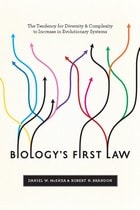
Biology's First Law
The Tendency for Diversity and Complexity to Increase in Evolutionary SystemsDaniel W. McShea and Robert N. Brandon
University of Chicago Press, 2010
Life on earth is characterized by three striking phenomena that demand explanation: adaptation—the marvelous fit between organism and environment; diversity—the great variety of organisms; and complexity—the enormous intricacy of their internal structure. Natural selection explains adaptation. But what explains diversity and complexity? Daniel W. McShea and Robert N. Brandon argue that there exists in evolution a spontaneous tendency toward increased diversity and complexity, one that acts whether natural selection is present or not. They call this tendency a biological law—the Zero-Force Evolutionary Law, or ZFEL. This law unifies the principles and data of biology under a single framework and invites a reconceptualization of the field of the same sort that Newton’s First Law brought to physics.
Biology’s First Law shows how the ZFEL can be applied to the study of diversity and complexity and examines its wider implications for biology. Intended for evolutionary biologists, paleontologists, and other scientists studying complex systems, and written in a concise and engaging format that speaks to students and interdisciplinary practitioners alike, this book will also find an appreciative audience in the philosophy of science.
Biomedicalization
Technoscience, Health, and Illness in the U.S.Adele E. Clarke, Laura Mamo, Jennifer Ruth Fosket, Jennifer R. Fishman, and Janet K. Shim, eds.
Duke University Press, 2010
Contributors. Natalie Boero, Adele E. Clarke, Jennifer R. Fishman, Jennifer Ruth Fosket, Kelly Joyce, Jonathan Kahn, Laura Mamo, Jackie Orr, Elianne Riska, Janet K. Shim, Sara Shostak
Biosemiotics
An Examination into the Signs of Life and the Life of SignsJesper Hoffmeyer
University of Scranton Press, 2008
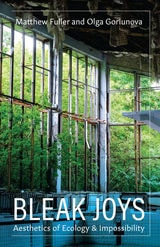
Bleak Joys
Aesthetics of Ecology and ImpossibilityMatthew Fuller
University of Minnesota Press, 2019
A philosophical and cultural distillation of the bleak joys in today’s ambivalent ecologies and patterns of life
Bleak Joys develops an understanding of complex entities and processes—from plant roots to forests to ecological damage and its calculation—as aesthetic. It is also a book about “bad” things, such as anguish and devastation, which relate to the ecological and technical but are also constitutive of politics, the ethical, and the formation of subjects.
Avidly interdisciplinary, Bleak Joys draws on scientific work in plant sciences, computing, and cybernetics, as well as mathematics, literature, and art in ways that are not merely illustrative of but foundational to our understanding of ecological aesthetics and the condition in which the posthumanities are being forged. It places the sensory world of plants next to the generalized and nonlinear infrastructure of irresolvability—the economics of indifference up against the question of how to make a home on Planet Earth in a condition of damaged ecologies. Crosscutting chapters on devastation, anguish, irresolvability, luck, plant, and home create a vivid and multifaceted approach that is as remarkable for its humor as for its scholarly complexity.
Engaging with Deleuze, Guattari, and Bakhtin, among others, Bleak Joys captures the modes of crises that constitute our present ecological and political condition, and reckons with the means by which they are not simply aesthetically known but aesthetically manifest.
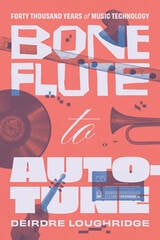
Bone Flute to Auto-Tune
Forty Thousand Years of Music TechnologyDeirdre Loughridge
University of Chicago Press, 2026
An accessible history of music technology from the earliest days to the present.
For more than forty thousand years, humans have been using technologies simple and complex to fashion instruments for making music, the earliest surviving examples being simple bone flutes. The first book to offer a history of western music through the lens of tools, Bone Flute to Auto-Tune explores the relationship between music and technology from the Paleolithic Age to the present day. Taking an expansive view of music technology, Deirdre Loughridge develops critical perspectives on on the ways the past is built into the present, the affordances and constraints of tools, and the trade-offs made in adopting one tool rather than another. By examining music-technological transitions from across history, including the violin, piano, cymbal, electric guitar, and synthesizer, Bone Flute to Auto-Tune shows how earlier eras have been built into later technologies, influencing not only the sound of our music but also how our tools can both help and hinder us.
The result is a music history attuned to the possibilities that new technologies open up or reveal and those they foreclose or conceal, and that considers what is gained and lost in the transition from one technology to another. By identifying turning points and trade-offs, a long historical perspective enables us to see alternate paths along which music technologies might have developed, and to grapple with our own moment in the ongoing interplay between technological change and the enduring human need for music.
Borrowed Knowledge
Chaos Theory and the Challenge of Learning across DisciplinesStephen H. Kellert
University of Chicago Press, 2008
Using the recent explosion in the use (and abuse) of chaos theory, Borrowed Knowledge and the Challenge of Learning across Disciplines examines the relationship between science and other disciplines as well as the place of scientific knowledge within our broader culture. Stephen H. Kellert’s detailed investigation of the myriad uses of chaos theory reveals serious problems that can arise in the interchange between science and other knowledge-making pursuits, as well as opportunities for constructive interchange. By engaging with recent debates about interdisciplinary research, Kellert contributes a theoretical vocabulary and a set of critical frameworks for the rigorous examination of borrowing.
Break Up the Anthropocene
Steve Mentz
University of Minnesota Press, 2019
Takes the singular eco-catastrophic “Age of Man” and redefines this epoch
We live in a new world: the Anthropocene. The Age of Man is defined in many ways, and most dramatically through climate change, mass extinction, and human marks in the geological record. Ideas of the Anthropocene spill out from the geophysical sciences into the humanities, social sciences, the arts, and mainstream debates—but it’s hard to know what the new coinage really means. Break Up the Anthropocene argues that this age should subvert imperial masculinity and industrial conquest by opening up the plural possibilities of Anthropocene debates of resilience, adaptation, and the struggle for environmental justice.
Forerunners: Ideas First
Short books of thought-in-process scholarship, where intense analysis, questioning, and speculation take the lead