Results by title
230 books match the query 'Physics' and 5 start with b
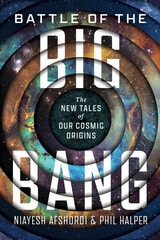
Battle of the Big Bang
The New Tales of Our Cosmic OriginsNiayesh Afshordi and Phil Halper
University of Chicago Press, 2025
“Excellent.”—Steven Poole, The Wall Street Journal • “Terrific.”—Liz Else, New Scientist (Best Popular Science Books of 2025 So Far) • “A brilliant overview of the state of modern cosmology.”—Alex O'Connor, alexoconnor.com • “This will expand readers’ minds.”—Publishers Weekly • One of Smithsonian's Ten Best Science Books of 2025
“An intellectual feast.”—Carlo Rovelli • “A must-read.”—Sabine Hossenfelder • “Wonderfully broad and open-minded.”—Roger Penrose • “Remarkable.”—Brian Keating
A thrilling exploration of competing cosmological origin stories, comparing new scientific ideas that upend our very notions of space, time, and reality.
By most popular accounts, the universe started with a bang some 13.8 billion years ago. But what happened before the Big Bang? And how do we know it happened at all? Here prominent cosmologist Niayesh Afshordi and science communicator Phil Halper offer a tour of the peculiar possibilities: bouncing and cyclic universes, time loops, creations from nothing, multiverses, black hole births, string theories, and holograms. Along the way, they offer both a call for new physics and a riveting story of scientific debate.
Incorporating insights from Afshordi’s cutting-edge research and Halper’s original interviews with scientists like Stephen Hawking, Roger Penrose, and Alan Guth, Battle of the Big Bang compares these models for the origin of our origins, showing each theory’s strengths and weaknesses and explaining new attempts to test these notions. Battle of the Big Bang is a tale of rivalries and intrigue, of clashes of ideas that have raged from Greek antiquity to the present day over whether the universe is eternal or had a beginning, whether it is unique or one of many. But most of all, Afshordi and Halper show that this search is filled with wonder, discovery, and community—all essential for remembering a forgotten cosmic past.
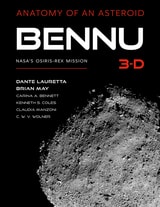
Bennu 3-D
Anatomy of an AsteroidDante Lauretta, Brian May, Carina A. Bennett, Kenneth S. Coles, Claudia Manzoni, and C. W. V. Wolner
University of Arizona Press, 2023
In 2020 the OSIRIS-REx spacecraft successfully landed on the surface of Bennu and collected pristine asteroid material for delivery to Earth in September 2023. Scientific studies of the samples, along with data collected during the rendezvous, promise to help find answers to some of humanity’s deepest questions: Where did we come from? What is our destiny in space?
This book, the world’s first complete (and stereoscopic) atlas of an asteroid, is the result of a unique collaboration between OSIRIS-REx mission leader Dante Lauretta and Brian May’s London Stereoscopic Company. Lauretta’s colleagues include Carina Bennett, Kenneth Coles, and Cat Wolner, as well as Brian May and Claudia Manzoni, who became part of the ultimately successful effort to find a safe landing site for sampling. The text details the data collected by the mission so far, and the stereo images have been meticulously created by Manzoni and May from original images collected by the OSIRIS-REx cameras.
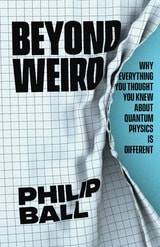
Beyond Weird
Why Everything You Thought You Knew about Quantum Physics Is DifferentPhilip Ball
University of Chicago Press, 2018
Since Niels Bohr said this many years ago, quantum mechanics has only been getting more shocking. We now realize that it’s not really telling us that “weird” things happen out of sight, on the tiniest level, in the atomic world: rather, everything is quantum. But if quantum mechanics is correct, what seems obvious and right in our everyday world is built on foundations that don’t seem obvious or right at all—or even possible.
An exhilarating tour of the contemporary quantum landscape, Beyond Weird is a book about what quantum physics really means—and what it doesn’t. Science writer Philip Ball offers an up-to-date, accessible account of the quest to come to grips with the most fundamental theory of physical reality, and to explain how its counterintuitive principles underpin the world we experience. Over the past decade it has become clear that quantum physics is less a theory about particles and waves, uncertainty and fuzziness, than a theory about information and knowledge—about what can be known, and how we can know it. Discoveries and experiments over the past few decades have called into question the meanings and limits of space and time, cause and effect, and, ultimately, of knowledge itself. The quantum world Ball shows us isn’t a different world. It is our world, and if anything deserves to be called “weird,” it’s us.

Black Holes and Relativistic Stars
Edited by Robert M. Wald
University of Chicago Press, 1998
Volume contributors: Valeria Ferrari, John L. Friedman, James B. Hartle, Stephen W. Hawking, Gary T. Horowitz, Werner Israel, Roger Penrose, Martin J. Rees, Rafael D. Sorkin, Saul A. Teukolsky, Kip S. Thorne, and Robert M. Wald.
Black-Body Theory and the Quantum Discontinuity, 1894-1912
Thomas S. Kuhn
University of Chicago Press, 1987
"Every scientist should have this book."—Paul Davies, New Scientist