Results by title
56 books match the query 'Pictorials' and 3 start with b
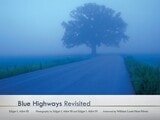
BLUE HIGHWAYS Revisited
Edgar I. Ailor III, Photography by Edgar I. Ailor III and Edgar I. Ailor IV, Foreword by William Least Heat-Moon
University of Missouri Press, 2012
Through illustrative photography and text, Ailor and his son capture once more the local color and beauty of the back roads, cafes, taverns, and people of Heat-Moon’s original trek. Almost every photograph in Blue Highways Revisited is referenced to a page in the original work. With side-by-side photographic comparisons of eleven of Heat-Moon’s characters, this new volume reflects upon and develops the memoir of Heat-Moon’s cross-country study of American culture and spirit. Photographs of Heat-Moon’s logbook entries, original manuscript pages, Olympia typewriter, Ford van, and other artifacts also give readers insight into Heat-Moon’s approach to his trip. Discussions with Heat-Moon about these archival images provide the reader insight into the travels and the writing of Blue Highways that only the perspective of the author could provide.
Blue Highways Revisited reaffirms that the "blue highway" serves as a romantic symbol of the free and restless American spirit, as the Ailors lose themselves to the open road as Heat-Moon did thirty years previously. This book reminds readers of the insatiable attraction of the “blue highway”—“But in those brevities just before dawn and a little after dusk—times neither day or night—the old roads return to the sky some of its color. Then, in truth, they carry a mysterious cast of blue, and it's that time when the pull of the blue highway is strongest, when the open road is a beckoning, a strangeness, a place where a man can lose himself” (Introduction to Blue Highways).

Baltimore Portraits
Amos Badertscher
Duke University Press, 1999
The photographer’s focus on content rather than on elaborate technique reveals the intensely personal—and, indeed, autobiographical—nature of his portraits. Their simplicity along with the text’s intimacy affects the viewer in ways not easily forgotten. An introduction by Tyler Curtain contextualizes the photographs both within the history of Baltimore and its queer subculture and in relationship to contemporaneous work by photographers Nan Goldin, Robert Mapplethorpe, Cindy Sherman, Duane Michaels, and others. Curtain also positions the underlying concerns of Bardertscher’s art in relation to gay and lesbian cultural politics.
This striking collection of portraits, along with the photographer’s moving text, will impact not only a general audience of photographers and enthusiasts of the art but also those engaged with gay and lesbian studies, queer theory, and cultural studies in general. It is published in association with the Duke University Museum of Art.
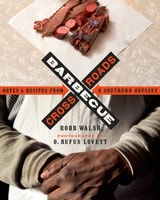
Barbecue Crossroads
Notes and Recipes from a Southern OdysseyBy Robb Walsh
University of Texas Press, 2013
In stories, recipes, and photographs, James Beard Award–winning writer Robb Walsh and acclaimed documentary photographer O. Rufus Lovett take us on a barbecue odyssey from East Texas to the Carolinas and back. In Barbecue Crossroads, we meet the pitmasters who still use old-fashioned wood-fired pits, and we sample some of their succulent pork shoulders, whole hogs, savory beef, sausage, mutton, and even some barbecued baloney. Recipes for these and the side dishes, sauces, and desserts that come with them are painstakingly recorded and tested.
But Barbecue Crossroads is more than a cookbook; it is a trip back to the roots of our oldest artisan food tradition and a look at how Southern culture is changing. Walsh and Lovett trace the lineage of Southern barbecue backwards through time as they travel across a part of the country where slow-cooked meat has long been part of everyday life. What they find is not one story, but many. They visit legendary joints that don’t live up to their reputations—and discover unknown places that deserve more attention. They tell us why the corporatizing of agriculture is making it difficult for pitmasters to afford hickory wood or find whole hogs that fit on a pit.
Walsh and Lovett also remind us of myriad ways that race weaves in and out of the barbecue story, from African American cooking techniques and recipes to the tastes of migrant farmworkers who ate their barbecue in meat markets, gas stations, and convenience stores because they weren’t welcome in restaurants. The authors also expose the ways that barbecue competitions and TV shows are undermining traditional barbecue culture. And they predict that the revival of the community barbecue tradition may well be its salvation.