95 books match the query 'Plato' and 3 start with b
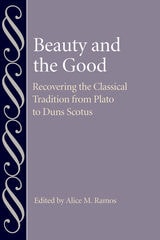
cover of Beauty and the Good: Recovering the Classical Tradition from Plato to Duns Scotus

Beauty and the Good

Recovering the Classical Tradition from Plato to Duns Scotus

Alice M. Ramos

Catholic University of America Press, 2021

In the past twenty years or more, there has been a growing interest among philosophers and theologians alike in the transcendentals and especially in the beautiful. This seems fortuitous since so much of contemporary culture is fixated in many ways on beauty, on what might be called a superficial or man-made beauty, intent on outward appearance, with little or no concern for the human person’s interiority and distinctive nature. The Ancients and the Medievals, on the contrary, were sensitive not only to the beauty of nature and art but also to beauty as intelligible, that is, to the beauty of moral harmony and of metaphysical splendor. While the question of whether the beautiful is in fact a transcendental aspect of being continues to be a subject of dispute in contemporary scholarship, the relationship between the beautiful and the good has been accepted since ancient times and has been attended to in recent publications. None of these publications, however, offers a systematic treatment of this relationship by drawing from the wisdom of both ancient and medieval thought in such a way as to bring together the work of scholars in this tradition. Beauty and the Good intends therefore to make a singular contribution by presenting a richer alternative to the contemporary cult of beauty and appearance on the one hand, and to the concomitant decline of real beauty on the other hand. In addition to highlighting the centrality of beauty in the Aristotelian account of moral virtue, where virtue is kalon and virtuous actions are done for the sake of kalon—an account which is found echoed in the medieval notion of intrinsic goodness (bonum honestum), understood as intelligible or spiritual beauty—this volume will provide the metaphysical and theological grounding for beauty, as influenced in part by Plato and Neoplatonism, together with a much needed account of how we know and judge beauty, and how for the recognition of true good and real beauty we need to be properly disposed. The integration of philosophical and theological reflection on the nature and relationship of beauty and the good, on our perception and judgment of beauty and of the good as beautiful, and on the motivational role of beauty in human action has as its goal to produce a coherent volume of essays.
[more]
cover of Beginning with Plato: Poems

Beginning with Plato

Poems

Joseph Warren Beach

University of Minnesota Press, 1944

Beginning with Plato was first published in 1944. Minnesota Archive Editions uses digital technology to make long-unavailable books once again accessible, and are published unaltered from the original University of Minnesota Press editions.

These selected poems of Joseph Warren Beach range in time from the present year to the age of Pericles; in place from California to Shangri-La, from Paris to the Middle West; in theme from current political issues to the timeless problems of Greek philosophy; in mood from tender love to trenchant satire. In these fifty-odd poems is a rich variety—Anthony Eden and Cordell Hull, the French capital in the summer preceding the first World War, the skylines of the American West, the skylines of Minneapolis, soldier and swan maiden, and the inner life of man wherever lived. Mr. Beach can tell home truths without bitterness, and handle nostalgic emotion without sentimentality.
[more]
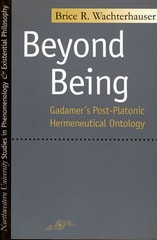
cover of Beyond Being: Gadamer's Post-Platonic Hermeneutic Ontology

Beyond Being

Gadamer's Post-Platonic Hermeneutic Ontology

Brice R. Wachterhauser

Northwestern University Press, 1999

Hans Georg-Gadamer is best known in the English-speaking world for his major work on philosophical hermeneutics, Truth and Method; he has also written extensively on the subject of Plato. Most commentators on Gadamer's work therefore view Gadamer either as a historian of philosophy or as a philosopher in his own right, critically engaged in the philosophical issues of our time.

In Beyond Being, Brice R. Wachterhauser contends that this perceived bifurcation in Gadamer's work oversimplifies and distorts important parts of Gadamer's thought. Wachterhauser argues that only by viewing Gadamer's contribution to philosophy as an integrated whole and by reading Gadamer's hermeneutical studies in light of his Plato studies are we able to avoid certain key misunderstandings of Gadamer, as well as to comprehend more clearly the radical implications of Gadamer's thought.
[more]