Results by title
87 books match the query 'Political Freedom' and 3 start with b
Beyond Gated Politics
Reflections for the Possibility of DemocracyRomand Coles
University of Minnesota Press, 2005
In Beyond Gated Politics, political theorist and grassroots activist Romand Coles argues that the survival of democracy depends on recognizing the failings of disengaged liberal democracy—the exclusions and subjugations that accompany every democratic “we,” for example—and experimenting with more radical modes of democratic theory and action. Among those brought into the conversation are John Howard Yoder, John Rawls, Alisdair MacIntyre, Jacques Derrida, Jean-Luc Nancy, Gloria Anzaldúa, and Audre Lorde.
Coles, whose work is deeply informed by his own experiences as an activist, pays close attention to the actual practice of democracy with particular interest in emerging social movements. In doing so, he not only moves beyond the paradigms of political liberalism, deliberative democracy, and communitarian republicanism, but also cultivates multidimensional modes of public discourse that reflect and sustain the creative tension at the heart of democratic life and responsibility.
Romand Coles is professor of political theory at Duke University. His previous books include Rethinking Generosity: Critical Theory and the Politics of Caritas and Self/Power/Other: Political Theory and Dialogical Ethics.

Black and Green
The Fight For Civil Rights in Northern Ireland & Black AmericaBrian Dooley
Pluto Press, 1998
'Focusing on the period from the 1960s onward, Brian Dooley suggests that the black rights struggle in the US had a formative influence on Northern Ireland's civil rights movement which adopted similar tactics of protest marches and sit-ins ... A well researched book, written from an unusual angle that illuminates this understudied international influence on the Ulster conflict' Political Studies
Ties between political activists in Black America and Ireland span several centuries, from the days of the slave trade to the close links between Frederick Douglass and Daniel O’Connell, and between Marcus Garvey and Eamon de Valera. This timely book traces those historic links and examines how the struggle for black civil rights in America in the 1960s helped shape the campaign against discrimination in Northern Ireland. The author includes interviews with key figures such as Angela Davis, Bernadette McAliskey and Eamonn McCann.
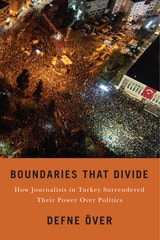
Boundaries That Divide
How Journalists in Turkey Surrendered Their Power over PoliticsDefne Över
Rutgers University Press, 2026
Turkey presents a striking example of the most recent wave of global authoritarian turns. The two-decade-long transition in the country’s political system also transformed its media environment. As mainstream journalists gradually yielded their places to sycophants, much more willing to praise the government in their news, the mainstream media that once oversaw—however imperfectly—political decisions started devoting its full service to cheerleading the government. Simultaneously, a new sphere of critical journalism began to emerge, with mainstream media journalists joining their fellows in the peripheries of the media. Considering the transformation of Turkey’s news media as the decay of a democratic institution, this book asks, How does the media break down under the rule of an elected government?
Drawing on fieldwork and in-depth interviews, the book traces the ruling AKP’s manipulation of social divides to consolidate power and journalists’ navigation of the resulting climate of fear, hope, doubt, and anger. The book shows how Turkey’s news media surrendered its power over politics as some journalists embraced disinformation as a path to heightened status, others turned to self-censorship for protection, and still others resisted capture through continuous but fragmented efforts.
The book portrays journalists as central actors in media decay, while also revealing that resilience to decay emerges where rising demand for “news” meets the contentious mobilization of journalists. Although focused on Turkey, the book’s insights extend far beyond, offering urgent lessons about the future of journalism in an age of populism, polarization, and institutional erosion.