Results by title
233 books match the query 'Political culture' and 7 start with b
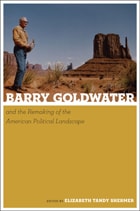
Barry Goldwater and the Remaking of the American Political Landscape
Edited by Elizabeth Tandy Shermer
University of Arizona Press, 2013
Nearly four million Americans worked on Barry Goldwater’s behalf in the presidential election of 1964. These citizens were as dedicated to their cause as those who fought for civil rights and against the Vietnam War. Arguably, the conservative agenda that began with Goldwater has had effects on American politics and society as profound and far reaching as the liberalism of the 1960s. According to the essays in this volume, it’s high time for a reconsideration of Barry Goldwater’s legacy.
Since Goldwater’s death in 1998, politicians, pundits, and academics have been assessing his achievements and his shortcomings. The twelve essays in this volume thoroughly examine the life, times, and impact of “Mr. Conservative.” Scrutinizing the transformation of a Phoenix department store owner into a politician, de facto political philosopher, and five-time US senator, contributors highlight the importance of power, showcasing the relationship between the nascent conservative movement’s cadre of elite businessmen, newsmen, and intellectuals and their followers at the grassroots—or sagebrush—level.
Goldwater, who was born in the Arizona Territory in 1909, was deeply influenced by his Western upbringing. With his appearance on the national stage in 1964, he not only articulated a new brand of conservatism but gave a voice to many Americans who were not enamored with the social and political changes of the era. He may have lost the battle for the presidency, but he energized a coalition of journalists, publishers, women’s groups, and Southerners to band together in a movement that reshaped the nation.
[more]
Before Norms
Institutions and Civic CultureRobert W. Jackman and Ross A. Miller
University of Michigan Press, 2005
The potato famines of the nineteenth century were long attributed to Irish indolence. The Stalinist system was blamed on a Russian proclivity for autocracy. Muslim men have been accused of an inclination to terrorism. Is political behavior really the result of cultural upbringing, or does the vast range of human political action stem more from institutional and structural constraints?
This important new book carefully examines the role of institutions and civic culture in the establishment of political norms. Jackman and Miller methodically refute the Weberian cultural theory of politics and build in its place a persuasive case for the ways in which institutions shape the political behavior of ordinary citizens. Their rigorous examination of grassroots electoral participation reveals no evidence for even a residual effect of cultural values on political behavior, but instead provides consistent support for the institutional view. Before Norms speaks to urgent debates among political scientists and sociologists over the origins of individual political behavior.
Robert W. Jackman is Professor of Political Science at the University of California, Davis. Ross A. Miller is Associate Professor of Political Science at Santa Clara University.
[more]
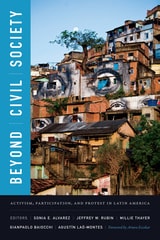
Beyond Civil Society
Activism, Participation, and Protest in Latin AmericaSonia E. Alvarez, Jeffrey W. Rubin, Millie Thayer, Gianpaolo Baiocchi, and Agustín Laó-Montes, editors
Duke University Press, 2017
The contributors to Beyond Civil Society argue that the conventional distinction between civic and uncivic protest, and between activism in institutions and in the streets, does not accurately describe the complex interactions of forms and locations of activism characteristic of twenty-first-century Latin America. They show that most contemporary political activism in the region relies upon both confrontational collective action and civic participation at different moments. Operating within fluid, dynamic, and heterogeneous fields of contestation, activists have not been contained by governments or conventional political categories, but rather have overflowed their boundaries, opening new democratic spaces or extending existing ones in the process. These essays offer fresh insight into how the politics of activism, participation, and protest are manifest in Latin America today while providing a new conceptual language and an interpretive framework for examining issues that are critical for the future of the region and beyond.
Contributors. Sonia E. Alvarez, Kiran Asher, Leonardo Avritzer, Gianpaolo Baiocchi, Andrea Cornwall, Graciela DiMarco, Arturo Escobar, Raphael Hoetmer, Benjamin Junge, Luis E. Lander, Agustín Laó-Montes, Margarita López Maya, José Antonio Lucero, Graciela Monteagudo, Amalia Pallares, Jeffrey W. Rubin, Ana Claudia Teixeira, Millie Thayer
Contributors. Sonia E. Alvarez, Kiran Asher, Leonardo Avritzer, Gianpaolo Baiocchi, Andrea Cornwall, Graciela DiMarco, Arturo Escobar, Raphael Hoetmer, Benjamin Junge, Luis E. Lander, Agustín Laó-Montes, Margarita López Maya, José Antonio Lucero, Graciela Monteagudo, Amalia Pallares, Jeffrey W. Rubin, Ana Claudia Teixeira, Millie Thayer
[more]

Black Girlhood in the Nineteenth Century
Nazera Sadiq Wright
University of Illinois Press, 2016
Long portrayed as a masculine endeavor, the African American struggle for progress often found expression through an unlikely literary figure: the black girl. Nazera Sadiq Wright uses heavy archival research on a wide range of texts about African American girls to explore this understudied phenomenon.
As Wright shows, the figure of the black girl in African American literature provided a powerful avenue for exploring issues like domesticity, femininity, and proper conduct. The characters' actions, however fictional, became a rubric for African American citizenship and racial progress. At the same time, their seeming dependence and insignificance allegorized the unjust treatment of African Americans. Wright reveals fascinating girls who, possessed of a premature knowing and wisdom beyond their years, projected a courage and resiliency that made them exemplary representations of the project of racial advance and citizenship.
As Wright shows, the figure of the black girl in African American literature provided a powerful avenue for exploring issues like domesticity, femininity, and proper conduct. The characters' actions, however fictional, became a rubric for African American citizenship and racial progress. At the same time, their seeming dependence and insignificance allegorized the unjust treatment of African Americans. Wright reveals fascinating girls who, possessed of a premature knowing and wisdom beyond their years, projected a courage and resiliency that made them exemplary representations of the project of racial advance and citizenship.
[more]
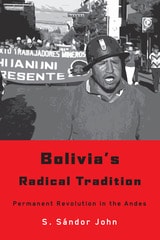
Bolivia's Radical Tradition
Permanent Revolution in the AndesS. Sándor John
University of Arizona Press, 2012
In December 2005, following a series of convulsive upheavals that saw the overthrow of two presidents in three years, Bolivian peasant leader Evo Morales became the first Indian president in South American history. Consequently, according to S. Sándor John, Bolivia symbolizes new shifts in Latin America, pushed by radical social movements of the poor, the dispossessed, and indigenous people once crossed off the maps of "official" history. But, as John explains, Bolivian radicalism has a distinctive genealogy that does not fit into ready-made patterns of the Latin American left.
According to its author, this book grew out of a desire to answer nagging questions about this unusual place. Why was Bolivia home to the most persistent and heroically combative labor movement in the Western Hemisphere? Why did this movement take root so deeply and so stubbornly? What does the distinctive radical tradition of Trotskyism in Bolivia tell us about the past fifty years there, and what about the explosive developments of more recent years? To answer these questions, John clearly and carefully pieces together a fragmented past to show a part of Latin American radical history that has been overlooked for far too long. Based on years of research in archives and extensive interviews with labor, peasant, and student activists—as well as Chaco War veterans and prominent political figures—the book brings together political, social, and cultural history, linking the origins of Bolivian radicalism to events unfolding today in the country that calls itself "the heart of South America."
[more]
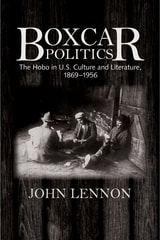
Boxcar Politics
The Hobo in U.S. Culture and Literature, 1869-1956John Lennon
University of Massachusetts Press, 2014
The hobo is a figure ensconced in the cultural fabric of the United States. Once categorized as a member of a homeless army who ought to be jailed or killed, the hobo has evolved into a safe, grandfatherly exemplar of Americana. Boxcar Politics reestablishes the hobo's political thorns.
John Lennon maps the rise and demise of the political hobo from the nineteenth-century introduction of the transcontinental railroad to the Federal Aid Highway Act of 1956. Intertwining literary, historical, and theoretical representations of the hobo, he explores how riders and writers imagined alternative ways that working-class people could use mobility to create powerful dissenting voices outside of fixed hierarchal political organizations. Placing portrayals of hobos in the works of Jack London, Jim Tully, John Dos Passos, and Jack Kerouac alongside the lived reality of people hopping trains (including hobos of the IWW, the Scottsboro Boys, and those found in numerous long-forgotten memoirs), Lennon investigates how these marginalized individuals exerted collective political voices through subcultural practices.
John Lennon maps the rise and demise of the political hobo from the nineteenth-century introduction of the transcontinental railroad to the Federal Aid Highway Act of 1956. Intertwining literary, historical, and theoretical representations of the hobo, he explores how riders and writers imagined alternative ways that working-class people could use mobility to create powerful dissenting voices outside of fixed hierarchal political organizations. Placing portrayals of hobos in the works of Jack London, Jim Tully, John Dos Passos, and Jack Kerouac alongside the lived reality of people hopping trains (including hobos of the IWW, the Scottsboro Boys, and those found in numerous long-forgotten memoirs), Lennon investigates how these marginalized individuals exerted collective political voices through subcultural practices.
[more]

Burek
A Culinary MetaphorJernej Mlekuz
Central European University Press, 2015
“As simple as burek” is a popular phrase used by many young people in Slovenia. In this book Jernej Mlekuž maintains that the truth is just the opposite. The burek is a pie made of pastry dough filled with various fillings that is well-known in the Balkans, and also in Turkey and the Near East by other names. Whether on the plate or as a cultural artifact, it is in fact, not that simple. After a brief stroll through its innocent history, Mlekuž focuses on the present state of the burek, after parasitical ideologies had attached themselves to it and poisoned its discourses. In Slovenia, the burek has become a loaded metaphor for the Balkans and immigrants from the republics of the former Socialist Federal Republic of Yugoslavia. Without the burek it would be equally difficult to consider the jargon of Slovenian youth, the imagined world of Slovenian chauvinism and the rhetorical arsenal of advertising agents when promoting healthy foods. In this analysis, Mlekuž refers to the burek as the “metaburek.” All at the same time it is greasy, Balkan, Slovene, not-Slovene, Yugoslavian, familiar, foreign, the greatest, the worst, disturbingly unhealthy, plebeian, junk food, and finally, a cherub (burek spelled backwards is kerub, the Slovene word for cherub). And this metaburek, the protagonist of this book, is never a completely pure, innocent, unconditioned burek. It is much more. A word of warning: after consuming this text, the burek will never be the same.
[more]