Results by title
191 books match the query 'Politics and literature' and 6 start with b
Beleaguered Poets and Leftist Critics
Stevens, Cummings, Frost, and Williams in the 1930sMilton A. Cohen
University of Alabama Press, 2011
A critical examination of modernist poetry and the demands of leftist literary theory.
Different as they were as poets, Wallace Stevens, E. E. Cummings, Robert Frost, and William Carlos Williams grappled with the highly charged literary politics of the 1930s in comparable ways. As other writers moved sharply to the Left, and as leftist critics promulgated a proletarian aesthetics, these modernist poets keenly felt the pressure of the times and politicized literary scene. All four poets saw their reputations critically challenged in these years and felt compelled to respond to the new politics, literary and national, in distinct ways, ranging from rejection to involvement.
Beleaguered Poets and Leftist Critics closely examines the dynamics of these responses: what these four poets wrote—in letters, essays, lectures, fiction (for Williams), and most importantly, in their poems; what they believed politically and aesthetically; how critics, particularly leftist critics, reviewed their work; how these poets reacted to that criticism and to the broader milieu of leftism. Each poet’s response and its subsequent impact on his poetic output is a unique case study of the conflicting demands of art and politics in a time of great social change.
Beowulf and the Grendel-Kin
Politics and Poetry in Eleventh-Century EnglandHelen Damico
West Virginia University Press, 2014
In Beowulf and the Grendel-kin: Politics and Poetry in Eleventh-Century England, Helen Damico presents the first concentrated discussion of the initiatory two-thirds of Beowulf’s 3,182 lines in the context of the sociopolitically turbulent years that composed the first half of the eleventh century in Anglo-Danish England.
Damico offers incisive arguments that major historical events and personages pertaining to the reign of Cnut and those of his sons recorded in the Anglo-Saxon Chronicle, the Encomium Emmae Reginae, and major continental and Scandinavian historical texts, hold striking parallels with events and personages found in at least eight vexing narrative units, as recorded by Scribe A in BL, Cotton Vitellius A.xv, that make up the poem’s quasi sixth-century narrative concerning the fall of the legendary Scyldings.
Given the poet’s compositional skill—widely relational and eclectic at its core—and his affinity with the practicing skalds, these strings of parallelisms could scarcely have been coincidental. Rather, Damico argues that examined within the context of other eleventh-century texts that either bemoaned or darkly satirized or obversely celebrated the rise of the Anglo-Danish realm, the Beowulfian units may bring forth a deeper understanding of the complexity of the poet’s compositional process.
Damico illustrates the poet’s use of the tools of his trade—compression, substitution, skillful encoding of character—to reinterpret and transform grave sociopolitical “facts” of history, to produce what may be characterized as a type of historical allegory, whereby two parallel narratives, one literal and another veiled are simultaneously operative.
Beowulf and the Grendel-Kin lays out the story of Beowulf, not as a monster narrative nor a folklorish nor solely a legendary tale, but rather as a poem of its time, a historical allegory coping with and reconfiguring sociopolitical events of the first half of eleventh-century Anglo-Saxon England.

Beyond Boundaries
C.L.R. James and Postnational StudiesEdited by Christopher Gair
Pluto Press, 2006
Invaluable for students of post-colonial studies, the book examines points where James crosses with other theorists, such as Lacan and Gramsci. Racial identity and cultural politics are key themes in his work, not to mention his unique writings on cricket. Contributors including Donald E Pease, Nicole King, Christopher Gair and Anthony Bogues illuminate the key themes in James's writing, and put forward the idea that the breath of James's thinking can be identified as the beginning of 'post-national' studies.
Christopher Gair is a lecturer in the Department of American and Canadian Studies, University of Birmingham. He is the author of Complicity and Resistance in Jack London¹ s Novels (Edwin Mullen Press, 1997), of The American Counterculture (forthcoming, Edinburgh University Press, 2006), and of numerous essays on American literature and culture. He is the editor of the journal Symbiosis.
Black Girlhood in the Nineteenth Century
Nazera Sadiq Wright
University of Illinois Press, 2016
As Wright shows, the figure of the black girl in African American literature provided a powerful avenue for exploring issues like domesticity, femininity, and proper conduct. The characters' actions, however fictional, became a rubric for African American citizenship and racial progress. At the same time, their seeming dependence and insignificance allegorized the unjust treatment of African Americans. Wright reveals fascinating girls who, possessed of a premature knowing and wisdom beyond their years, projected a courage and resiliency that made them exemplary representations of the project of racial advance and citizenship.
Bleak Liberalism
Amanda Anderson
University of Chicago Press, 2016
Amanda Anderson examines canonical works of high realism, political novels from England and the United States, and modernist works to argue that liberalism has engaged sober and even stark views of historical development, political dynamics, and human and social psychology. From Charles Dickens’s Bleak House and Hard Times to E. M. Forster’s Howards End to Doris Lessing’s The Golden Notebook, this literature demonstrates that liberalism has inventive ways of balancing sociological critique and moral aspiration. A deft blend of intellectual history and literary analysis, Bleak Liberalism reveals a richer understanding of one of the most important political ideologies of the modern era.
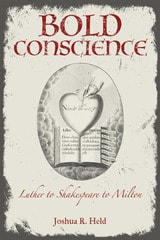
Bold Conscience
Luther to Shakespeare to MiltonJoshua R. Held
University of Alabama Press, 2023
Traces how conscience—inner moral conviction—came to shape public life, fueling martyrdom, free speech, and political revolts
Bold Conscience: Luther to Shakespeare to Milton is a sweeping, original study of how conscience became one of the most powerful ideas in early modern England. Tracing the emergence of what Joshua R. Held calls the “bold conscience,” the book shows how inner moral conviction moved from the realm of private guilt to public action, fueling debates about authority, obedience, free speech, and resistance. By placing conscience at the center of literary, religious, and political conflict, Bold Conscience reveals a vital intellectual throughline linking the Reformation to the birth of modern ideas of liberty and toleration.
The book unfolds chronologically, beginning with Martin Luther and Henry VIII and moving through Shakespeare’s Hamlet and Henry VIII, John Donne’s court sermons, and John Milton’s polemical and poetic works, including Areopagitica and Paradise Lost. Each chapter combines close literary reading with historical and theological analysis, showing how conscience operates across genres—drama, sermon, pamphlet, and epic poetry. Joshua R. Held is a distinguished scholar of early modern literature whose work bridges literary criticism, intellectual history, and religious studies, bringing clarity and narrative energy to complex debates.
Bold Conscience will appeal to scholars and students of early modern literature, Shakespeare, Milton, and Reformation history, as well as readers interested in the origins of religious freedom and political dissent. It will also engage anyone concerned with how moral conviction shapes public life then and now.