Results by title
88 books match the query 'Population' and 6 start with b
Balkan Family Structure and the European Pattern
Demographic Developments in Ottoman BulgariaMaria Todorova
Central European University Press, 2006
Beyond Germs
Native Depopulation in North AmericaEdited by Catherine M. Cameron, Paul Kelton, and Alan C. Swedlund
University of Arizona Press, 2015
Beyond Germs: Native Depopulation in North America challenges the “virgin soil” hypothesis that was used for decades to explain the decimation of the indigenous people of North America. This hypothesis argues that the massive depopulation of the New World was caused primarily by diseases brought by European colonists that infected Native populations lacking immunity to foreign pathogens. In Beyond Germs, contributors expertly argue that blaming germs lets Europeans off the hook for the enormous number of Native American deaths that occurred after 1492.
Archaeologists, anthropologists, and historians come together in this cutting-edge volume to report a wide variety of other factors in the decline in the indigenous population, including genocide, forced labor, and population dislocation. These factors led to what the editors describe in their introduction as “systemic structural violence” on the Native populations of North America.
While we may never know the full extent of Native depopulation during the colonial period because the evidence available for indigenous communities is notoriously slim and problematic, what is certain is that a generation of scholars has significantly overemphasized disease as the cause of depopulation and has downplayed the active role of Europeans in inciting wars, destroying livelihoods, and erasing identities.
Biocultural Histories in La Florida
A Bioarchaeological PerspectiveChristopher Stojanowski
University of Alabama Press, 2005
Examines the effects of the Spanish mission system on population structure and genetic variability in indigenous communities in northern Florida and southern Georgia during the 16th and 17th centuries
This book examines the effects of the Spanish mission system on population structure and genetic variability in indigenous communities living in northern Florida and southern Georgia during the 16th and 17th centuries. Data on tooth size were collected from 26 archaeological samples representing three time periods: Late Precontact (~1200-1500), Early Mission (~1600-1650), and Late Mission (~1650-1700) and were subjected to a series of statistical tests evaluating genetic variability. Predicted changes in phenotypic population variability are related to models of group interaction, population demo-graphy, and genetic admixture as suggested by ethnohistoric and archaeological data.
Results suggest considerable differences in diachronic responses to the mission environment for each cultural province. The Apalachee demonstrate a marked increase in variability while the Guale demonstrate a decline in variability. Demographic models of population collapse are therefore inconsistent with predicted changes based on population geneticsl, and the determinants of population structure seem largely local in nature. This book highlights the specificity with which indigenous communities responded to European contact and the resulting transformations in their social worlds.
Birth Quake
The Baby Boom and Its AftershocksDiane J. Macunovich
University of Chicago Press, 2002
Macunovich focuses on the pervasive effects of changes in "relative cohort size," the ratio of young to middle-aged adults, as masses of young people tried to achieve the standard of living to which they had become accustomed in their parents' homes despite dramatic reductions in their earning potential relative to that of their parents. Macunovich presents the results of detailed empirical analyses that illustrate how varied and important cohort effects can be on a wide range of economic indicators, social factors, and even on more tumultuous events including the stock market crash of 1929, the "oil shock" of 1973, and the "Asian flu" of the 1990s. Birth Quake demonstrates that no discussion of business or economic trends can afford to ignore the effects of population.
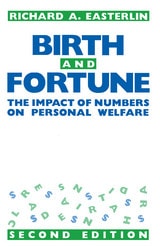
Birth and Fortune
The Impact of Numbers on Personal WelfareRichard A. Easterlin
University of Chicago Press, 1987
"[Easterlin] has made clear, I think unambiguously, that the baby-boom generation is economically underprivileged merely because of its size. And in showing this, he demonstrates that population size can be as restrictive as a factor as sex, race, or class on equality of opportunity in the U.S."—Jeffrey Madrick, Business Week
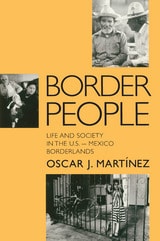
Border People
Life and Society in the U.S.-Mexico BorderlandsOscar J. Martínez
University of Arizona Press, 1994