Results by title
137 books match the query 'Poverty' and 4 start with b
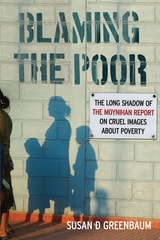
Blaming the Poor
The Long Shadow of the Moynihan Report on Cruel Images about PovertyGreenbaum, Susan D
Rutgers University Press, 2015
In 1965, the late Senator Daniel Patrick Moynihan—then a high-ranking official in the Department of Labor—sparked a firestorm when he released his report “The Negro Family,” which came to be regarded by both supporters and detractors as an indictment of African American culture. Blaming the Poor examines the regrettably durable impact of the Moynihan Report for race relations and social policy in America, challenging the humiliating image the report cast on poor black families and its misleading explanation of the causes of poverty.
A leading authority on poverty and racism in the United States, Susan D. Greenbaum dismantles Moynihan’s main thesis—that the so called matriarchal structure of the African American family “feminized” black men, making them inadequate workers and absent fathers, and resulting in what he called a tangle of pathology that led to a host of ills, from teen pregnancy to adult crime. Drawing on extensive scholarship, Greenbaum highlights the flaws in Moynihan’s analysis. She reveals how his questionable ideas have been used to redirect blame for substandard schools, low wages, and the scarcity of jobs away from the societal forces that cause these problems, while simultaneously reinforcing stereotypes about African Americans. Greenbaum also critiques current policy issues that are directly affected by the tangle of pathology mindset—the demonization and destruction of public housing; the criminalization of black youth; and the continued humiliation of the poor by entrepreneurs who become rich consulting to teachers, non-profits, and social service personnel.
A half century later, Moynihan’s thesis remains for many a convenient justification for punitive measures and stingy indifference to the poor. Blaming the Poor debunks this infamous thesis, proposing instead more productive and humane policies to address the enormous problems facing us today.
[more]

Blaming the Victim
How Global Journalism Fails Those in PovertyJairo Lugo-Ocando
Pluto Press, 2014
Poverty, it seems, is a constant in today's news, usually the result of famine, exclusion or conflict. In Blaming the Victim, Jairo Lugo-Ocando sets out to deconstruct and reconsider the variety of ways in which the global news media misrepresent and decontextualise the causes and consequences of poverty worldwide. The result is that the fundamental determinant of poverty - inequality - is removed from their accounts.
The books asks many biting questions. When - and how - does poverty become newsworthy? How does ideology come into play when determining the ways in which 'poverty' is constructed in newsrooms - and how do the resulting narratives frame the issue? And why do so many journalists and news editors tend to obscure the structural causes of poverty?
In analysing the processes of news production and presentation around the world, Lugo-Ocando reveals that the news-makers' agendas are often as problematic as the geopolitics they seek to represent. This groundbreaking study reframes the ways in which we can think and write about the enduring global injustice of poverty.
[more]
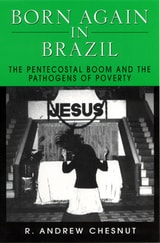
Born Again in Brazil
The Pentecostal Boom and the Pathogens of PovertyR. Andrew Chesnut
Rutgers University Press, 1997
A spiritual revolution is transforming the religious landscape of Latin America. Evangelical Protestantism, particularly Pentecostalism, has replaced Catholicism as the leading religion in thousands of barrios on the urban periphery. But in few Latin American nations have Protestants multiplied as rapidly as in Brazil. What accounts for this rise? Combining historical, political, and ethnographic research, R. Andrew Chestnut shows that the relationship between faith healing and illness in the conversion process is integral to the popularity of Pentecostalism among Brazil's poor. He augments his analysis of the economic and political factors with extensive interview material to capture his informants' conversion experience. In doing so, he presents both a historical framework for a broad understanding of Pentecostalism in Latin America and insight into the personal motivations and beliefs of the crentes themselves.
[more]
Britain's War on Poverty
Jane Waldfogel
Russell Sage Foundation, 2010
In 1999, one in four British children lived in poverty—the third highest child poverty rate among industrialized countries. Five years later, the child poverty rate in Britain had fallen by more than half in absolute terms. How did the British government accomplish this and what can the United States learn from the British experience? Jane Waldfogel offers a sharp analysis of the New Labour government's anti-poverty agenda, its dramatic early success and eventual stalled progress. Comparing Britain's anti-poverty initiative to U.S. welfare reform, the book shows how the policies of both countries have affected child poverty, living standards, and well-being in low-income families and suggests next steps for future reforms. Britain's War on Poverty evaluates the three-pronged anti-poverty strategy employed by the British government and what these efforts accomplished. British reforms sought to promote work and make work pay, to increase financial support for families with children, and to invest in the health, early-life development, and education of children. The latter two features set the British reforms apart from the work-oriented U.S. welfare reforms, which did not specifically target income or program supports for children. Plagued by premature initiatives and what some experts called an overly ambitious agenda, the British reforms fell short of their intended goal but nevertheless significantly increased single-parent employment, raised incomes for low-income families, and improved child outcomes. Poverty has fallen, and the pattern of low-income family expenditures on child enrichment and healthy food has begun to converge with higher-income families. As Waldfogel sees it, further success in reducing child poverty in Britain will rely on understanding who is poor and who is at highest risk. More than half of poor children live in families where at least one parent is working, followed by unemployed single- and two-parent homes, respectively. Poverty rates are also notably higher for children with disabled parents, large families, and for Pakistani and Bangladeshi children. Based on these demographics, Waldfogel argues that future reforms must, among other goals, raise working-family incomes, provide more work for single parents, and better engage high-risk racial and ethnic minority groups. What can the United States learn from the British example? Britain's War on Poverty is a primer in the triumphs and pitfalls of protracted policy. Notable differences distinguish the British and U.S. models, but Waldfogel asserts that a future U.S. poverty agenda must specifically address child poverty and the income inequality that helps create it. By any measurement and despite obstacles, Britain has significantly reduced child poverty. The book's key lesson is that it can be done.
[more]