Results by title
272 books match the query 'Presidents' and 10 start with b
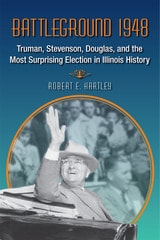
Battleground 1948
Truman, Stevenson, Douglas, and the Most Surprising Election in Illinois HistoryRobert E. Hartley
Southern Illinois University Press, 2013
The election year of 1948 remains to this day one of the most astonishing in U.S. political history. During this first general election after World War II, Americans looked to their governments for change. As the battle for the nation’s highest office came to a head in Illinois, the state was embroiled in its own partisan showdowns—elections that would prove critical in the course of state and national history.
In Battleground 1948, Robert E. Hartley offers the first comprehensive chronicle of this historic election year and its consequences, which still resonate today. Focusing on the races that ushered Adlai Stevenson, Paul Douglas, and Harry Truman into office—the last by the slimmest of margins—Battleground 1948 details the pivotal events that played out in the state of Illinois, from the newspaper wars in Chicago to tragedy in the mine at Centralia.
In addition to in-depth revelations on the saga of the American election machine in 1948, Hartley probes the dark underbelly of Illinois politics in the 1930s and 1940s to set the stage, spotlight key party players, and expose the behind-the-scenes influences of media, money, corruption, and crime. In doing so, he draws powerful parallels between the politics of the past and those of the present. Above all, Battleground 1948 tells the story of grassroots change writ large on the American political landscape—change that helped a nation move past an era of conflict and depression, and forever transformed Illinois and the U.S. government.
Before the Convention
Strategies and Choices in Presidential Nomination CampaignsJohn H. Aldrich
University of Chicago Press, 1980
Campaigns to win the Democratic and Republican presidential nominations are longer, more complex, and more confusing to the observer than the general election itself. The maze of delegate-selection procedures includes state primaries and caucuses as well as the traditional "smoke-filled room." Complicated federal election laws govern campaign financing. Sometimes many candidates enter and drop out of the race, while sometimes a stable two-way contest occurs: the 1976 nomination campaigns of Jimmy Carter and Gerald Ford exemplified each extreme. Is it possible to propose general principles to explain the apparent chaos of our presidential nomination system? Can those principles account for two such starkly different campaigns as occurred in 1976? In Before the Convention, political scientist John H. Aldrich presents a systematic analysis of presidential nomination politics, based on application of rational-choice models to candidate behavior. Aldrich views the candidates as decision makers with limited resources in a highly competitive environment. From this perspective, he seeks to determine why and how candidates choose to run, why some succeed and others fail, and what consequences the nomination process has for the general election and, later, for the President in office.
Aldrich begins with a brief history of the presidential selection process, focusing on the continuing shift of power from political elites to the mass electorate. He then turns to a detailed analysis of the 1976 nomination campaigns. Using data from a variety of sources, Aldrich demonstrates that the very different patterns in these races both conform to the rational-choice model. The analysis includes consideration of numerous questions of strategy. Is there a "momentum" to campaigns? How does a candidate identify and exploit this intangible quality? How do candidates decide where to contend and where not to contend? What is the nature of policy competition among candidates? When does a candidate prefer a "fuzzy" position to a clearly stated one? Other topics include reforms in campaign financing and the expanded and changed role of news coverage.
Before the Convention fills a significant gap in the literature on presidential politics, and therefore should be of particular importance to specialists in this area. It will be ofinterest also to everyone who is concerned with understanding the "rules of the game" for a complicated but vitally important exercise of American democracy.
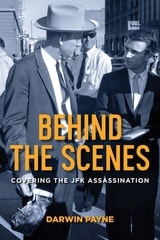
Behind the Scenes
Covering the JFK AssassinationDarwin Payne
University of North Texas Press, 2023
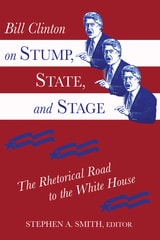
Bill Clinton on Stump, State, and Stage
The Rhetorical Road to the White HouseStephen A. Smith
University of Arkansas Press, 1994
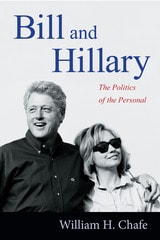
Bill and Hillary
The Politics of the PersonalWilliam H. Chafe
Duke University Press, 2012
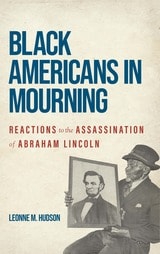
Black Americans in Mourning
Reactions to the Assassination of Abraham LincolnLeonne M. Hudson
Southern Illinois University Press, 2025
Centering Black grief in the aftermath of Lincoln’s assassination
On April 14, 1865, John Wilkes Booth carried out the first presidential assassination in United States history. The euphoria resulting from General Lee’s surrender evaporated at the news of Abraham Lincoln’s murder. The nation—excepting many white Southerners—found itself consumed with grief, and no group mourned Lincoln more deeply than people of color. African Americans did not speak with a monolithic voice on social or political issues, but even Lincoln’s Black contemporaries who may not have approved of him while he was alive mourned his death, understanding its implications for their future.
Beginning with the assassination itself and chronicling Lincoln’s three-week-long national funeral, historian Leonne M. Hudson captures the profound sadness of Black Americans as they mourned the crafter of the Emancipation Proclamation and the man they thought of as their earthly Moses, father, friend, and benefactor. Hudson continues the narrative by detailing the postwar efforts of African Americans to gain citizenship and voting rights.
Black Americans in Mourning includes the tributes of prominent figures such as Frederick Douglass, Martin R. Delany, and Elizabeth Keckley, who raised their voices to honor Lincoln, as well as formal expressions of grief by institutions and organizations such as the United States Colored Troops. In a triumph of research, Hudson also features the voices of lesser-known Black people who mourned Lincoln across the country, showing that the outpouring of individual and collective grief helped set the stage for his enduring glorification.
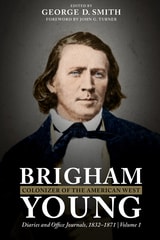
Brigham Young, Colonizer of the American West
Diaries and Office Journals, 1832–1871George D. Smith
Signature Books, 2019
Thus, by 1877, some 400 Mormon settlements spanned the western frontier from Salt Lake City to outposts in Idaho, Nevada, Arizona, Wyoming, and California. As prophet of the LDS Church and governor of the proposed State of Deseret, Young led several campaigns for Utah statehood while defending polygamy and local sovereignty. His skillful and authoritarian leadership led historian Bernard de Voto to classify him as an “American genius,” responsible for turning Joseph Smith’s visions “into the seed of life.”
Young’s diaries and journals reveal a man dedicated to his church, defensive of his spiritual and temporal claims to authority, and determined to create a modern Zion within the Utah desert. Editor George D. Smith’s careful organization and annotation of Young’s personal writings provide insights into the mind of Mormonism’s dynamic church leader and frontier statesman.
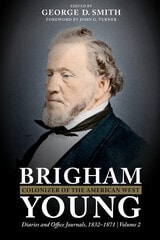
Brigham Young, Colonizer of the American West
Diaries and Office Journals, 1832–1871: Volume 2George D. Smith
Signature Books, 2021
Thus, by 1877, some 400 Mormon settlements spanned the western frontier from Salt Lake City to outposts in Idaho, Nevada, Arizona, Wyoming, and California. As prophet of the LDS Church and governor of the proposed State of Deseret, Young led several campaigns for Utah statehood while defending polygamy and local sovereignty. His skillful and authoritarian leadership led historian Bernard de Voto to classify him as an “American genius,” responsible for turning Joseph Smith’s visions “into the seed of life.”
Young’s diaries and journals reveal a man dedicated to his church, defensive of his spiritual and temporal claims to authority, and determined to create a modern Zion within the Utah desert. Editor George D. Smith’s careful organization and annotation of Young’s personal writings provide insights into the mind of Mormonism’s dynamic church leader and frontier statesman.
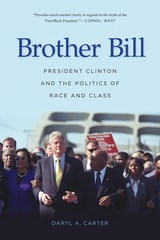
Brother Bill
President Clinton and the Politics of Race and ClassDaryl A Carter
University of Arkansas Press, 2016
“This book is a fascinating analysis of race and class in the age of President Bill Clinton. It provides much-needed clarity in regards to the myth of the ‘First Black President.’ It contributes much to our understanding of the history that informs our present moment!”
—Cornel West
As President Barack Obama was sworn into office on January 20, 2009, the United States was abuzz with talk of the first African American president. At this historic moment, one man standing on the inaugural platform, seemingly a relic of the past, had actually been called by the moniker the “first black president” for years.
President William Jefferson Clinton had long enjoyed the support of African Americans during his political career, but the man from Hope also had a complex and tenuous relationship with this faction of his political base. Clinton stood at the nexus of intense political battles between conservatives’ demands for a return to the past and African Americans’ demands for change and fuller equality. He also struggled with the class dynamics dividing the American electorate, especially African Americans. Those with financial means seized newfound opportunities to go to college, enter the professions, pursue entrepreneurial ambitions, and engage in mainstream politics, while those without financial means were essentially left behind. The former became key to Clinton’s political success as he skillfully negotiated the African American class structure while at the same time maintaining the support of white Americans. The results were tremendously positive for some African Americans. For others, the Clinton presidency was devastating.
Brother Bill examines President Clinton’s political relationship with African Americans and illuminates the nuances of race and class at the end of the twentieth century, an era of technological, political, and social upheaval.
Bullets, Ballots, and Rhetoric
Confederate States Policy for the United States Presidential ContestLarry E. Nelson
University of Alabama Press, 1980
The Confederacy's hopes for independence were founded less on the belief that the South could defeat the North than on a strategy of staving off defeat long enough for the North to weary of the fight. The South’s single biggest opportunity to effect political change in the North was the presidential contest of 1864. If Lincoln’s support foundered and the North elected a president with a more flexible vision of peace on the continent, the South might realize its dream of independence.
Praised as an important contribution to understanding the Davis administration, in Bullets, Ballots, and Rhetoric, Larry Nelson vividly brings to life the complex state of Northern and Southern internal politics during the election year of 1863. He recounts fluctuations in the value of the dollar, draft resistance and riots, protests against emancipation, political defeats suffered by the Republicans in the elections of 1862, and growing discontent in the border states and Midwest. This gripping account explores a mission Davis sent to Canada in 1864 seeking to influence the election of a new US president, a strategy Nelson's persuasive analysis shows to have been intelligent and reasonable. Nevertheless, Davis's haphazard leadership contributed to its failure. Nelson hypothesizes that had Davis drawn the North into negotiations before the Democratic convention for the upcoming elections, a temporary armistice might well have proved permanent.
Nelson offers an insider’s look at the administration of Jefferson Davis as it searched for cracks in Northern unity and electoral opportunities to exploit—and yet also as it overlooked war-weariness in the South itself. Bullets, Ballots, and Rhetoric is an engrossing account of a little-known but critical aspect of Civil War statecraft and politics.