Results by title
54 books match the query 'Psychiatry' and 4 start with b

Bad Souls
Madness and Responsibility in Modern GreeceElizabeth Anne Davis
Duke University Press, 2012

Black Dogs and Blue Words
Depression and Gender in the Age of Self-CareKimberly K. Emmons
Rutgers University Press, 2014
Black Dogs and Blue Words analyzes the rhetoric surrounding depression. Kimberly K. Emmons maintains that the techniques and language of depression marketing strategies--vague words such as "worry," "irritability," and "loss of interest"--target women and young girls and encourage self-diagnosis and self-medication. Further, depression narratives and other texts encode a series of gendered messages about health and illness.
As depression and other forms of mental illness move from the medical-professional sphere into that of the consumer-public, the boundary at which distress becomes disease grows ever more encompassing, the need for remediation and treatment increasingly warranted. Black Dogs and Blue Words demonstrates the need for rhetorical reading strategies as one response to these expanding and gendered illness definitions.
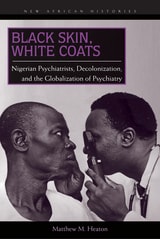
Black Skin, White Coats
Nigerian Psychiatrists, Decolonization, and the Globalization of PsychiatryMatthew M. Heaton
Ohio University Press, 2013
Black Skin, White Coats is a history of psychiatry in Nigeria from the 1950s to the 1980s. Working in the contexts of decolonization and anticolonial nationalism, Nigerian psychiatrists sought to replace racist colonial psychiatric theories about the psychological inferiority of Africans with a universal and egalitarian model focusing on broad psychological similarities across cultural and racial boundaries. Particular emphasis is placed on Dr. T. Adeoye Lambo, the first indigenous Nigerian to earn a specialty degree in psychiatry in the United Kingdom in 1954. Lambo returned to Nigeria to become the medical superintendent of the newly founded Aro Mental Hospital in Abeokuta, Nigeria’s first “modern” mental hospital. At Aro, Lambo began to revolutionize psychiatric research and clinical practice in Nigeria, working to integrate “modern” western medical theory and technologies with “traditional” cultural understandings of mental illness. Lambo’s research focused on deracializing psychiatric thinking and redefining mental illness in terms of a model of universal human similarities that crossed racial and cultural divides.
Black Skin, White Coats is the first work to focus primarily on black Africans as producers of psychiatric knowledge and as definers of mental illness in their own right. By examining the ways that Nigerian psychiatrists worked to integrate their psychiatric training with their indigenous backgrounds and cultural and civic nationalisms, Black Skin, White Coats provides a foil to Frantz Fanon’s widely publicized reactionary articulations of the relationship between colonialism and psychiatry. Black Skin, White Coats is also on the cutting edge of histories of psychiatry that are increasingly drawing connections between local and national developments in late-colonial and postcolonial settings and international scientific networks. Heaton argues that Nigerian psychiatrists were intimately aware of the need to engage in international discourses as part and parcel of the transformation of psychiatry at home.

Blue
A History of Postpartum Depression in AmericaRachel Louise Moran
University of Chicago Press, 2024
New motherhood is often seen as a joyful moment in a woman’s life; for some women, it is also their lowest moment. For much of the twentieth century, popular and medical voices blamed women who had emotional and mental distress after childbirth for their own suffering. By the end of the century, though, women with postpartum mental illnesses sought to take charge of this narrative. In Blue: A History of Postpartum Depression in America, Rachel Louise Moran explores the history of the naming and mainstreaming of postpartum depression. Coalitions of maverick psychiatrists, psychologists, and women who themselves had survived substantial postpartum distress fought to legitimize and normalize women’s experiences. They argued that postpartum depression is an objective and real illness and fought to avoid it being politicized alongside other fraught medical and political battles over women’s health.
Based on insightful oral histories and in-depth archival research, Blue reveals a secret history of American motherhood, women’s political activism, and the rise of postpartum depression advocacy amid an often-censorious conservative culture. By breaking new ground with the first book-length history of postpartum mental illness in the twentieth century, Moran brings mothers’ battles with postpartum depression out of the shadows and into the light.