Results by title
52 books match the query 'Public administration' and 2 start with b
Bridging the Information Gap
Legislative Member Organizations as Social Networks in the United States and the European UnionNils Ringe and Jennifer Nicoll Victor with Christopher J. Carman
University of Michigan Press, 2013
Legislative member organizations (LMOs)—such as caucuses in the U.S. Congress and intergroups in the European Parliament—exist in lawmaking bodies around the world. Unlike parties and committees, LMOs play no obvious, predefined role in the legislative process. They provide legislators with opportunities to establish social networks with colleagues who share common interests. In turn, such networks offer valuable opportunities for the efficient exchange of policy-relevant—and sometimes otherwise unattainable—information between legislative offices. Building on classic insights from the study of social networks, the authors provide a comparative overview of LMOs across advanced, liberal democracies. In two nuanced case studies of LMOs in the European Parliament and the U.S. Congress, the authors rely on a mix of social network analysis, sophisticated statistical methods, and careful qualitative analysis of a large number of in-depth interviews.
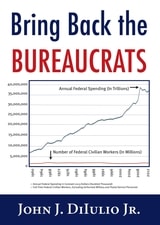
Bring Back the Bureaucrats
Why More Federal Workers Will Lead to Better (and Smaller!) GovernmentJohn DiIulio
Templeton Press, 2014
In Bring Back the Bureaucrats, John J. DiIulio Jr., one of America’s most respected political scientists and an adviser to presidents in both parties, summons the facts and statistics to show us how America’s big government works and why reforms that include adding a million more people to the federal workforce by 2035 might help to slow government’s growth while improving its performance.
Starting from the underreported reality that the size of the federal workforce hasn’t increased since the early 1960s, even though the federal budget has skyrocketed. The number of federal programs has ballooned; Bring Back the Bureaucrats tells us what our elected leaders won’t: there are not enough federal workers to work for our democracy effectively.
DiIulio reveals that the government in America is Leviathan by Proxy, a grotesque form of debt-financed big government that guarantees terrible government. Washington relies on state and local governments, for-profit firms, and nonprofit organizations to implement federal policies and programs. Big-city mayors, defense industry contractors, nonprofit executives, and other national proxies lobby incessantly for more federal spending. This proxy system chokes on chores such as cleaning up toxic waste sites, caring for hospitalized veterans, collecting taxes, handling plutonium, and policing more than $100 billion annually in “improper payments.” The lack of competent, well-trained federal civil servants resulted in the failed federal response to Hurricane Katrina and the troubled launch of Obamacare’s “health exchanges.”
Bring Back the Bureaucrats is further distinguished by the presence of E. J. Dionne Jr. and Charles Murray, two of the most astute voices from the political left and right, respectively, who offer their candid responses to DiIulio at the end of the book.