262 books match the query 'Public health' and 8 start with b
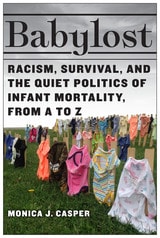
cover of Babylost: Racism, Survival, and the Quiet Politics of Infant Mortality, from A to Z

Babylost

Racism, Survival, and the Quiet Politics of Infant Mortality, from A to Z

Monica J. Casper

Rutgers University Press, 2021
The U.S. infant mortality rate is among the highest in the industrialized world, and Black babies are far more likely than white babies to die in their first year of life. Maternal mortality rates are also very high. Though the infant mortality rate overall has improved over the past century with public health interventions, racial disparities have not. Racism, poverty, lack of access to health care, and other causes of death have been identified, but not yet adequately addressed. The tragedy is twofold: it is undoubtedly tragic that babies die in their first year of life, and it is both tragic and unacceptable that most of these deaths are preventable. Despite the urgency of the problem, there has been little public discussion of infant loss. The question this book takes up is not why babies die; we already have many answers to this question. It is, rather, who cares that babies, mostly but not only Black and Native American babies, are dying before their first birthdays? More importantly, what are we willing to do about it? This book tracks social and cultural dimensions of infant death through 58 alphabetical entries, from Absence to ZIP Code. It centers women’s loss and grief, while also drawing attention to dimensions of infant death not often examined. It is simultaneously a sociological study of infant death, an archive of loss and grief, and a clarion call for social change.
[more]
cover of Becoming Gods: Medical Training in Mexican Hospitals

Becoming Gods

Medical Training in Mexican Hospitals

Vania Smith-Oka

Rutgers University Press, 2021
Through rich ethnographic narrative, Becoming Gods examines how a cohort of doctors-in-training in the Mexican city of Puebla learn to become doctors. Smith-Oka draws from compelling fieldwork, ethnography, and interviews with interns, residents, and doctors that tell the story of how medical trainees learn to wield new tools, language, and technology and how their white coat, stethoscope, and newfound technical, linguistic, and sensory skills lend them an authority that they cultivate with each practice, transforming their sense of self. Becoming Gods illustrates the messy, complex, and nuanced nature of medical training, where trainees not only have to acquire a monumental number of skills but do so against a backdrop of strict hospital hierarchy and a crumbling national medical system that deeply shape who they are.
[more]
cover of Between HIV Prevention and LGBTI Rights: The Political Economy of Queer Activism in Ghana

Between HIV Prevention and LGBTI Rights

The Political Economy of Queer Activism in Ghana

Ellie Gore

University of Michigan Press, 2024

Between HIV Prevention and LGBTI Rights investigates the transformative impacts of global development's sexual rights agenda on queer politics and activism in Ghana. With queer men bearing a disproportionate burden of HIV in Africa, rights-based health interventions have sought to tackle the epidemic by bringing together, educating, and ‘empowering’ queer African communities. Gore argues that queer Ghanaian men are not benefiting from development’s turn to sexual health and sexual rights. Instead, HIV and other sexual rights–based initiatives operate through neoliberal paradigms that reinforce class divides and de-politicize queer struggle. These dynamics are further shaping and shaped by the politicization of homophobia within the contemporary Ghanaian state.

Gore combines original ethnography, documentary analysis, and the examination of development and global health data to connect the struggle for queer liberation in Ghana to broader trajectories of capitalist transformation and crisis and the afterlives of colonialism. In doing so, Between HIV Prevention and LGBTI Rights offers fascinating insights into the political economy of sexuality and global development for scholars, activists, and policymakers seeking to understand and address sexual injustice and oppression, both in Africa and beyond.

The open access edition of this book was made possible through the support of the Economic and Social Research Council (UK).
[more]
cover of Beyond Health, Beyond Choice: Breastfeeding Constraints and Realities

Beyond Health, Beyond Choice

Breastfeeding Constraints and Realities

Edited by Paige Hall Smith, Bernice L Hausman, and Miriam Labbok

Rutgers University Press, 2012

Current public health promotion of breastfeeding relies heavily on health messaging and individual behavior change. Women are told that “breast is best” but too little serious attention is given to addressing the many social, economic, and political factors that combine to limit women’s real choice to breastfeed beyond a few days or weeks. The result: women’s, infants’, and public health interests are undermined.  Beyond Health, Beyond Choice examines how feminist perspectives can inform public health support for breastfeeding.

Written by authors from diverse disciplines, perspectives, and countries, this collection of essays is arranged thematically and considers breastfeeding in relation to public health and health care; work and family; embodiment (specifically breastfeeding in public); economic and ethnic factors; guilt; violence; and commercialization. By examining women’s experiences and bringing feminist insights to bear on a public issue, the editors attempt to reframe the discussion to better inform public health approaches and political action. Doing so can help us recognize the value of breastfeeding for the public’s health and the important productive and reproductive contributions women make to the world.
[more]
cover of Beyond Obamacare: Life, Death, and Social Policy

Beyond Obamacare

Life, Death, and Social Policy

James S. House is Angus Campbell Distinguished University Professor Emeritus of Survey Research, Public Policy, and Sociology at the University of Michigan, Ann Arbor.

Russell Sage Foundation, 2015
Health care spending in the United States today is approaching 20 percent of GDP, yet levels of U.S. population health have been declining for decades relative to other wealthy and even some developing nations. How is it possible that the United States, which spends more than any other nation on health care and insurance, now has a population markedly less healthy than those of many other nations? Sociologist and public health expert James S. House analyzes this paradoxical crisis, offering surprising new explanations for how and why the United States has fallen into this trap. In Beyond Obamacare, House shows that health care reforms, including the Affordable Care Act, cannot resolve this crisis because they do not focus on the underlying causes for the nation’s poor health outcomes, which are largely social, economic, environmental, psychological, and behavioral. House demonstrates that the problems of our broken health care and insurance system are interconnected with our large and growing social disparities in education, income, and other conditions of life and work, and calls for a complete reorientation of how we think about health. He concludes that we need to move away from our misguided and almost exclusive focus on biomedical determinants of health, and to place more emphasis on addressing social, economic, and other inequalities. House’s review of the evidence suggests that the landmark Affordable Care Act of 2010, and even universal access to health care, are likely to yield only marginal improvements in population health or in reducing health care expenditures. In order to rein in spending and improve population health, we need to refocus health policy from the supply side—which makes more and presumably better health care available to more citizens—to the demand side—which would improve population health though means other than health care and insurance, thereby reducing need and spending for health care. House shows how policies that provide expanded educational opportunities, more and better jobs and income, reduced racial-ethnic discrimination and segregation, and improved neighborhood quality enhance population health and quality of life as well as help curb health spending. He recommends redirecting funds from inefficient supply-side health care measures toward broader social initiatives focused on education, income support, civil rights, housing and neighborhoods, and other reforms, which can be paid for from savings in expenditures for health care and insurance. A provocative reconceptualization of health in America, Beyond Obamacare looks past partisan debates to show how cost-efficient and effective health policies begin with more comprehensive social policy reforms.
[more]
cover of Biomedicine in an Unstable Place: Infrastructure and Personhood in a Papua New Guinean Hospital

Biomedicine in an Unstable Place

Infrastructure and Personhood in a Papua New Guinean Hospital

Alice Street

Duke University Press, 2014

Biomedicine in an Unstable Place is the story of people's struggle to make biomedicine work in a public hospital in Papua New Guinea. It is a story encompassing the history of hospital infrastructures as sites of colonial and postcolonial governance, the simultaneous production of Papua New Guinea as a site of global medical research and public health, and people's encounters with urban institutions and biomedical technologies. In Papua New Guinea, a century of state building has weakened already inadequate colonial infrastructures, and people experience the hospital as a space of institutional, medical, and ontological instability.

In the hospital's clinics, biomedical practitioners struggle amid severe resource shortages to make the diseased body visible and knowable to the clinical gaze. That struggle is entangled with attempts by doctors, nurses, and patients to make themselves visible to external others—to kin, clinical experts, global scientists, politicians, and international development workers—as socially recognizable and valuable persons. Here hospital infrastructures emerge as relational technologies that are fundamentally fragile but also offer crucial opportunities for making people visible and knowable in new, unpredictable, and powerful ways.

[more]
cover of Blood Work: Life and Laboratories in Penang

Blood Work

Life and Laboratories in Penang

Janet Carsten

Duke University Press, 2019

What is blood? How can we account for its enormous range of meanings and its extraordinary symbolic power? In Blood Work Janet Carsten traces the multiple meanings of blood as it moves from donors to labs, hospitals, and patients in Penang, Malaysia. She tells the stories of blood donors, their varied motivations, and the paperwork, payment, and other bureaucratic processes involved in blood donation, tracking the interpersonal relations between lab staff and revealing how their work with blood reflects the social, cultural, and political dynamics of modern Malaysia. Carsten follows hospital workers into factories and community halls on blood drives and brings readers into the operating theater as a machine circulates a bypass patient's blood. Throughout, she foregrounds blood's symbolic power, uncovering the processes that make the hospital, the blood bank, the lab, and science itself work. In this way, blood becomes a privileged lens for understanding the entanglements of modern life.
[more]
cover of Breeding Bio Insecurity: How U.S. Biodefense Is Exporting Fear, Globalizing Risk, and Making Us All Less Secure

Breeding Bio Insecurity

How U.S. Biodefense Is Exporting Fear, Globalizing Risk, and Making Us All Less Secure

Lynn C. Klotz and Edward J. Sylvester

University of Chicago Press, 2009

In the years since the 9/11 attacks—and the subsequent lethal anthrax letters—the United States has spent billions of dollars on measures to defend the population against the threat of biological weapons. But as Lynn C. Klotz and Edward J. Sylvester argue forcefully in Breeding Bio Insecurity, all that money and effort hasn’t made us any safer—in fact, it has made us more vulnerable.

Breeding Bio Insecurity reveals the mistakes made to this point and lays out the necessary steps to set us on the path toward true biosecurity. The fundamental problem with the current approach, according to the authors, is the danger caused by the sheer size and secrecy of our biodefense effort. Thousands of scientists spread throughout hundreds of locations are now working with lethal bioweapons agents—but their inability to make their work public causes suspicion among our enemies and allies alike, even as the enormous number of laboratories greatly multiplies the inherent risk of deadly accidents or theft. Meanwhile, vital public health needs go unmet because of this new biodefense focus. True biosecurity, the authors argue, will require a multipronged effort based in an understanding of the complexity of the issue, guided by scientific ethics, and watched over by a vigilant citizenry attentive to the difference between fear mongering and true analysis of risk.

An impassioned warning that never loses sight of political and scientific reality, Breeding Bio Insecurity is a crucial first step toward meeting the evolving threats of the twenty-first century.

[more]