Results by title
74 books match the query 'Puerto Rico' and 4 start with b
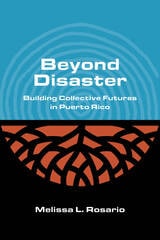
Beyond Disaster
Building Collective Futures in Puerto RicoMelissa L. Rosario
Northwestern University Press, 2025
An alternative view of Puerto Rico’s past, present, and future
How do we map the pathways to liberation where we have been taught to see only trauma, suffering, and lack? Melissa L. Rosario offers an alternative view of Puerto Rico, America’s oldest colony, removing readers from the framework of crisis to consider the deeper legacies of its current impasse. Beyond Disaster: Building Collective Futures in Puerto Rico is an intimate portrait, weaving insights from the author’s own life, research, and organizing work as a scholar in the diaspora who rematriated. Rosario bridges the genres of social history and memoir to unsettle the meaning of resistance and freedom, underscoring the deep wounds of colonialism while still uplifting the profound possibilities of embodied alternatives.
Beyond Disaster critiques the framework of debt and crisis by examining the psychological, emotional, and spiritual effects of colonialism. Rosario highlights key examples of organizing efforts to defend land and education against total enclosure, protecting life amid loss. This book offers a series of microhistories, vignettes, and prose poetry to foreground the daily practices necessary to anchor the ecological and political landscapes of our collective future.
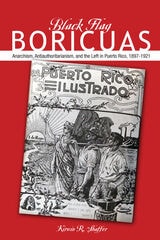
Black Flag Boricuas
Anarchism, Antiauthoritarianism, and th eLeft in Puerto Rico, 1897-1921Kirwin R. Shaffer
University of Illinois Press, 2013
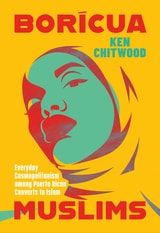
Borícua Muslims
Everyday Cosmopolitanism among Puerto Rican Converts to IslamKen Chitwood
University of Texas Press, 2025
The stories and struggles of Puerto Rican Muslims in modern day America.
Among Puerto Rican converts to Islam, marginalization is a fact of daily life. Their “authenticity” is questioned by other Muslims and by fellow Borícua on the island and in the United States. At the same time, they exist under the shadow of US colonization and as Muslims in the context of American empire. To be a Puerto Rican Muslim, then, is to negotiate identity at numerous intersections of diversity and difference.
Drawing on years of ethnographic research and more than a hundred interviews conducted in Puerto Rico, New York, Florida, Texas, New Jersey, and online, Ken Chitwood tells the story of Puerto Rican Muslims as they construct a shared sense of peoplehood through everyday practices. Borícua Muslims thus provides a study of cosmopolitanism not as a political ideal but as a mundane social reality—a reality that complicates scholarly and public conversations about race, ethnicity, and religion in the Americas. Expanding the geography of global Islam and recasting the relationship between religion and Puerto Rican culture, Borícua Muslims is an insightful reckoning with the manifold entanglements of identity amid late-modern globalization.
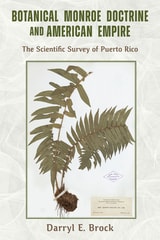
Botanical Monroe Doctrine and American Empire
The Scientific Survey of Puerto RicoDarryl E. Brock
University of Alabama Press, 2026
Explores how a US-led natural history survey of Puerto Rico served American Empire while yet catalyzing Boricua cultural nationalism
In Botanical Monroe Doctrine and American Empire, Darryl E. Brock examines the history, influence, and legacy of an ambitious effort to conduct a “physical and natural history survey of Porto [Puerto] Rico.” As founder of The New York Botanical Garden, Nathaniel Lord Britton advanced a botanical Monroe Doctrine that sought to counter British and European scientific influence in the Americas by establishing American authority over the naming and classification of species. Although initially aligned with imperial and “civilizing” aims, the Scientific Survey of Puerto Rico ultimately contributed to modernization, professionalization, and cultural preservation on the island. Its work in Taíno archaeology and jíbaro folklore helped lay the foundation for today’s Caguana Indigenous Ceremonial Park and reinforced currents of Boricua cultural nationalism. The survey also intersected with broader political and economic developments, influencing areas from bilingual education to New Deal administration in Puerto Rico.
Sponsored by the New York Academy of Sciences, the survey was conducted by The New York Botanical Garden in partnership with the American Museum of Natural History and the Yale Peabody Museum, with the final report issued in 1970. Puerto Rican scientists and intellectuals, including mycologist and future University of Puerto Rico chancellor Carlos Chardón, actively contributed to the project. Expanding to the Virgin Islands, the survey encompassed nearly two dozen expeditions, collected more than 10,000 plant specimens, and identified thirty-eight new species. Its nineteen published volumes remain among the most comprehensive multidisciplinary scientific studies of any tropical region. Brock’s groundbreaking work is essential reading for those interested in the history of science, Puerto Rico, and American empire.