Results by title
72 books match the query 'Railroads' and 3 start with b

Bonds of Enterprise
John Murray Forbes and Western Development in America's Railway AgeJohn Lauritz Larson
University of Iowa Press, 2001
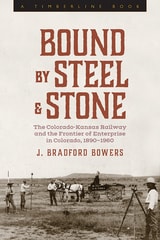
Bound by Steel and Stone
The Colorado-Kansas Railway and the Frontier of Enterprise in Colorado, 1890-1960J. Bradford Bowers
University Press of Colorado, 2022
Offering the Colorado-Kansas Railway as an example of how shortline railroads helped to integrate the rural landscape with the larger urban and economic world, Bowers reveals the constant adaptations driven by changing economic forces and conditions. He puts the railway in context of the wider environmental and political landscapes, the growing quarrying and mining business, the expansion of agriculture and irrigation, Progressive-era political reforms, and land development. In the new frontier of enterprise in the early twentieth-century American West, the railroad highlights the successes and failures of the men inspired to pursue these new opportunities as well as the story of one woman who held these fragile industries together well into the second half of the twentieth century.
Bound by Steel and Stone is an insightful addition to the history of industrialization and economic development in Colorado and the American West.
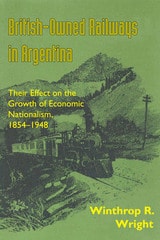
British-Owned Railways in Argentina
Their Effect on the Growth of Economic Nationalism, 1854-1948By Winthrop R. Wright
University of Texas Press, 1974
During the nineteenth century, British-owned railways grew under the protection of an Argentine ruling elite that considered railways both instruments and symbols of progress. Under this program of support for foreign enterprise, Argentina had by 1914 built the largest railway network in Latin America.
During the first decades of the twentieth century, the railways were successful in following a policy of calculated disregard for Argentine interests in general. However, following the end of World War I, the British economic empire began to decline and Argentine economic nationalism grew. A number of popularistic political movements incorporated economic nationalism into their platforms, and even among the ruling elite there were signs of increasing nationalistic sentiment.
Although most studies of economic nationalism have emphasized the importance of the middle-class Radical party in the rise of xenophobia, Winthrop R. Wright's study shows that antiforeign economic nationalism was not entirely a reaction to the conservative elite. Between 1932 and 1938 the nationalistic programs of General Agustin Justo's government—basically a conservative regime—led the British interests to decide to sell their holdings. The British govemment had arrived at a position of supporting the economic withdrawal of the large British-owned firms long before Juan D. Perón appeared on the political scene.
Perón combined traditional Argentine economic nationalism with his own scheme to gain power over all elements in Argentina. His solution to the railway problem, although more dramatically executed, did not differ greatly from that of the conservative Justo. Perón purchased the railways outright in 1947–1948, but his use of nationalism was in reality covering his own inability to outbargain Britain and the United States following the conclusion of World War II.