53 books match the query 'Reconstruction (U.S. history, 1865-1877)' and 3 start with b
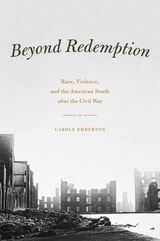
cover of Beyond Redemption: Race, Violence, and the American South after the Civil War

Beyond Redemption

Race, Violence, and the American South after the Civil War

Carole Emberton

University of Chicago Press, 2013
In the months after the end of the Civil War, there was one word on everyone’s lips: redemption. From the fiery language of Radical Republicans calling for a reconstruction of the former Confederacy to the petitions of those individuals who had worked the land as slaves to the white supremacists who would bring an end to Reconstruction in the late 1870s, this crucial concept informed the ways in which many people—both black and white, northerner and southerner—imagined the transformation of the American South.

Beyond Redemption explores how the violence of a protracted civil war shaped the meaning of freedom and citizenship in the new South. Here, Carole Emberton traces the competing meanings that redemption held for Americans as they tried to come to terms with the war and the changing social landscape. While some imagined redemption from the brutality of slavery and war, others—like the infamous Ku Klux Klan—sought political and racial redemption for their losses through violence. Beyond Redemption merges studies of race and American manhood with an analysis of post-Civil War American politics to offer unconventional and challenging insight into the violence of Reconstruction.

[more]
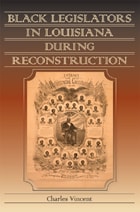
cover of Black Legislators in Louisiana during Reconstruction

Black Legislators in Louisiana during Reconstruction

Charles Vincent

Southern Illinois University Press, 2011

When originally published, Charles Vincent's scholarship shed new light on the achievements of black legislators in the state legislatures in post-Civil War Louisiana-a state where black people were a majority in the state population but a minority in the legislature. 

Now updated with a new preface, this volume endures as an important work that illustrates the strength of minorities in state government during Reconstruction. It focuses on the achievements of the black representatives and senators in the Louisiana legislature who, through tireless fighting, were able to push forward many progressive reforms, such as universal public education, and social programs for the less fortunate. 
 
[more]
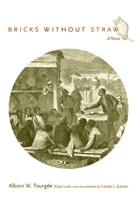
cover of Bricks Without Straw: A Novel

Bricks Without Straw

A Novel

Albion W. Tourgée

Duke University Press, 2009

A classic of American political fiction first published in 1880, a mere three years after Reconstruction officially ended, Bricks Without Straw offers an inside view of the struggle to create a just society in the post-slavery South. It is unique among the white-authored literary works of its time in presenting Reconstruction through the eyes of emancipated slaves. As a leading Radical Republican, the author, Albion W. Tourgée, played a key role in drafting a democratized Constitution for North Carolina after the Civil War, and he served as a state superior court judge during Reconstruction. Tourgée worked closely with African Americans and poor whites in the struggle to transform North Carolina’s racial and class politics. He saw the ravages of the Ku Klux Klan firsthand, worked to bring the perpetrators of Klan atrocities to justice, and fought against what he called the “counter-revolution” that destroyed Reconstruction.

Bricks Without Straw is Tourgée’s fictionalized account of how Reconstruction was sabotaged. It is a chilling picture of violence against African Americans condoned, civil rights abrogated, constitutional amendments subverted, and electoral fraud institutionalized. Its plot revolves around a group of North Carolina freedpeople who strive to build new lives for themselves by buying land, marketing their own crops, setting up a church and school, and voting for politicians sympathetic to their interests, until Klan terrorism and the ascendancy of a white supremacist government reduce them to neo-slavery. This edition of Bricks Without Straw is enhanced by Carolyn L. Karcher’s introduction, which sets the novel in historical context and provides an overview of Albion W. Tourgée’s career, a chronology of the significant events of both the Reconstruction era and Tourgée’s life, and explanatory notes identifying actual events fictionalized in the novel.

[more]