Results by title
201 books match the query 'Regional Studies' and 8 start with b
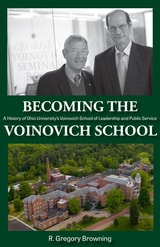
Becoming the Voinovich School
A History of Ohio University’s Voinovich School of Leadership and Public ServiceR. Gregory Browning, Ph.D.
Ohio University Press, 0
The evolution of a university-based public service model that integrates leadership, applied research, and regional engagement in Appalachian Ohio
Becoming the Voinovich School chronicles the evolution of Ohio University’s Voinovich School of Leadership and Public Service, a pioneering institution that blends academic rigor with hands-on public engagement. Founded on the vision of political scientist Mark Weinberg and inspired by the leadership philosophy of former US senator and Ohio governor George V. Voinovich, the school has become a national model for university-based public service.
From its modest beginnings in 1976—when Weinberg was hired to build a public administration program from scratch—the school has grown into a dynamic “do tank” serving the Appalachian Ohio region and beyond. Early initiatives like the Institute for Local Government Administration and Rural Development laid the groundwork for a new kind of academic center: one that connects faculty expertise with real-world problem-solving. Through applied research, GIS analysis, leadership training, and program evaluation, the school has become a trusted convener and catalyst for change.
The Voinovich School’s mission spans five key sectors: economic development, community development, education and child wellness, environmental restoration, and health and well-being. Its work is rooted in a commitment to empowering communities, especially those facing the economic and health challenges of postindustrial Appalachia. By pairing grant-funded projects with experiential education, the school has created opportunities for students to engage directly with pressing public issues while building leadership capacity across the region.
In 2007, the center was formally renamed the Voinovich School, reflecting its expanded scope and growing impact. Over the next decade, it launched new graduate programs, raised its national ranking, and became the educational partner for the Ohio Economic Development Institute. Today, the school continues to leverage state and federal funding, private-sector partnerships, and alumni networks to address complex challenges with innovative, community-driven solutions.
This book offers a compelling account of how one university unit transformed public service education—and how its legacy continues to shape leadership and policy in and beyond Ohio.
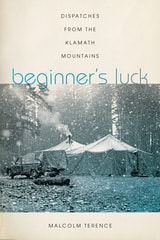
Beginner's Luck
Dispatches from the Klamath MountainsMalcolm Terence
Oregon State University Press, 2018
In the late 1960s, Malcolm Terence left his job as a reporter for the Los Angeles Times to look for adventure and may have found more than he bargained for. The era had triggered unprecedented social and political changes in America, tectonic shifts that challenged war and the social order that oppressed people along lines of class, gender, and race. One branch was a back-to-the-land movement, and Terence, who had just traveled for a year managing a rock band, strayed into Black Bear Ranch, a commune just starting in a remote corner of the Klamath Mountains near the California-Oregon border.
Black Bear Ranch still exists, but many of its early residents eventually returned to urban civilization. A few, Terence among them, stayed on in neighboring river towns. Some tried logging, others gold mining, and some tried growing marijuana, all with mixed success. The local mining and timber communities had a checkered opinion of their new hippie neighbors, as did the Native tribes, but it was the kind of place where people helped each other out, even if they didn’t always agree.
When wildfires grew large, Terence and other veterans of the commune joined the fire crews run by the US Forest Service. In between, the Black Bear expats built homesteads, planted gardens, delivered babies, and raised their children. They gradually overcame the skepticism of the locals and joined them in political battles against the use of herbicides in the forest and the Forest Service’s campaign to close all the mining claims. As in the best of organizing efforts, the organizers learned as much as they led.
Beginner’s Luck will appeal to anyone who experienced life on a commune in the 1960s–1970s or who wants to learn about this chapter in modern American history. Terence offers insight into environmental activism and the long history of conflict between resource exploitation and Native American rights without lecturing or pontificating. With wit, humor, and humility, his anecdotal essays chronicle a time and place where disparate people came together to form an unlikely community.

Betting on Macau
Casino Capitalism and China's Consumer RevolutionTim Simpson
University of Minnesota Press, 2023
A comprehensive look into how Macau’s recent decades of gambling-related growth produced one of the wealthiest territories on the planet
Betting on Macau delves into the radical transformation of what was formerly the last remaining European territory in Asia, returned to the People’s Republic of China in 1999 after nearly half a millennium of Portuguese rule. Examining the unprecedented scale of its development and its key role in China’s economic revolution, Tim Simpson follows Macau’s emergence from historical obscurity to become the most profitable casino gaming locale in the world.
Identified as a UNESCO World Heritage Site and renowned for its unique blend of Chinese and Portuguese colonial-era architecture, contemporary Macau has metamorphosed into a surreal, hypermodern urban landscape augmented by massive casino megaresorts, including two of the world’s largest buildings. Simpson situates Macau’s origins as a strategic trading port and its ensuing history alongside the emergence of the global capitalist system, charting the massive influx of foreign investment, construction, and tourism in the past two decades that helped generate the territory’s enormous wealth.
Presented through a cross section of postcolonial studies and social theory with extensive insight into the global gambling industry, Betting on Macau uncovers the various roots of the territory’s lucrative casino capitalism. In turn, its trenchant analysis provides a distinctive view into China’s broader project of urbanization, its post-Mao economic reforms, and the continued rise of its consumer culture.
Beyond Hill and Hollow
Original Readings in Appalachian Women’s StudiesElizabeth S. D. Engelhardt
Ohio University Press, 2004
Women’s studies unites with Appalachian studies in Beyond Hill and Hollow, the first book to focus exclusively on studies of Appalachia’s women. Featuring the work of historians, linguists, sociologists, performance artists, literary critics, theater scholars, and others, the collection portrays the diverse cultures of Appalachian women.
The chapters in Beyond Hill and Hollow examine the hidden lives of Appalachian prostitutes, urban Appalachian women in the 1800s, rural women in company towns, and an African American Appalachian poet from the 1900s. Contributors look at Appalachian opera houses, Jewish women in the coalfields, the writings of Wilma Dykeman and Sharyn McCrumb, and activists in out-migrant communities like Cincinnati. With an introduction by editor Elizabeth S. D. Engelhardt, Beyond Hill and Hollow firmly establishes the field of Appalachian Women’s Studies.
Appropriate both as a reference and as a classroom text, Beyond Hill and Hollow expands our understanding of Appalachian women’s lives. Readers, whether from the region or beyond, may recognize themselves or women they know in its pages.
Beyond White Picket Fences
Evolution of an American TownCatherine Simpson Bueker
Russell Sage Foundation, 2025
Drawing on interviews, archival data, and participant observations, Bueker examines how Italian, Jewish, and Chinese newcomers influenced and were influenced by the established Wellesley community. She examines the ways in which immigrant and ethnic groups assimilate, retain their cultural backgrounds, and respond to discrimination, sometimes simultaneously, and, in doing so, alter the mainstream. Some new residents responded to Wellesley by assimilating to it. They developed relationships with long-term resident neighbors, volunteered in their children’s schools, and ran for elected positions. In adapting themselves to their new community, however, they also influenced it by virtue of their distinct cultural backgrounds.
Other new residents worked to preserve their cultures by establishing ethnic-specific organizations, lobbying to have new holidays incorporated into the calendar, and hewing to their own ethnic culinary traditions. Their efforts also influenced the established community. When newcomers attempted to retain their culture by requesting ethnic-specific food items be stocked at the local grocery store, opening ethic restaurants, or renting space for a new organization, for example, they impacted the established community. New individuals and groups also responded to experiences of hostility and discrimination. Italian residents fought against attempts at school redistricting targeting them in the 1930s, Jewish residents pushed back against housing discrimination in the 1950s and 1960s, and Chinese residents responded to anti-Asian incidents in the wake of the COVID-19 pandemic in 2020. These groups had to engage with the larger community to rectify these injustices. Some of the changes in Wellesley have come about with little recognition or response, others have been met with resistance and anger. Whether the changes are subtle or obvious and whether new groups are embraced or resisted, the whole town is altered in an ongoing process as new groups continue to move to and settle in Wellesley.
Beyond White Picket Fences is a timely and compelling examination of the ways newcomers become part of and shape American communities.
Beyond the City and the Bridge
East Asian Immigration in a New Jersey SuburbMatsumoto, Noriko
Rutgers University Press, 2018
Winner of the Richard P. McCormick Prize from the New Jersey Historical Association
Honorable Mention, 2019 American Sociological Association Book Award - Asia/Asian American Section
In recent decades, the American suburbs have become an important site for immigrant settlement. Beyond the City and the Bridge presents a case study of Fort Lee, Bergen County, on the west side of the George Washington Bridge connecting Manhattan and New Jersey. Since the 1970s, successive waves of immigrants from East Asia have transformed this formerly white community into one of the most diverse suburbs in the greater New York region. Fort Lee today has one of the largest concentrations of East Asians of any suburb on the East Coast, with Chinese, Japanese, and Koreans forming distinct communities while influencing the structure and everyday life of the borough. Noriko Matsumoto explores the rise of this multiethnic suburb—the complex processes of assimilation and reproduction of ethnicities, the changing social relationships, and the conditions under which such transformations have occurred.
Black Huntington
An Appalachian StoryCicero M. Fain III
University of Illinois Press, 2019
How African Americans thrived in a West Virginia city
By 1930, Huntington had become West Virginia's largest city. Its booming economy and relatively tolerant racial climate attracted African Americans from across Appalachia and the South. Prosperity gave these migrants political clout and spurred the formation of communities that defined black Huntington--factors that empowered blacks to confront institutionalized and industrial racism on the one hand and the white embrace of Jim Crow on the other. Cicero M. Fain III illuminates the unique cultural identity and dynamic sense of accomplishment and purpose that transformed African American life in Huntington. Using interviews and untapped archival materials, Fain details the rise and consolidation of the black working class as it pursued, then fulfilled, its aspirations. He also reveals how African Americans developed a host of strategies--strong kin and social networks, institutional development, property ownership, and legal challenges--to defend their gains in the face of the white status quo. Eye-opening and eloquent, Black Huntington makes visible another facet of the African American experience in Appalachia.

Brazil at the Dawn of the Eighteenth Century
André João Antonil
Tagus Press, 2012