Results by title
598 books match the query 'Religious' and 21 start with b
Baja California Missions
In the Footsteps of the PadresDavid Burckhalter; Photographs by David Burckhalter and Mina Sedgwick; Foreword by Bernard L. Fontana
University of Arizona Press, 2013
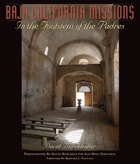
With gorgeous photographs of the architecture and religious art, and supported by a concise history that outlines the peninsula’s exploration and colonization by Roman Catholic priests, Baja California Missions excels as a book of photography and history. It promises adventure for readers at home, as well as for travelers ready to explore the churches in person.
The eight Spanish colonial stone churches of Baja California endure as the only intact originals of 34 missions built by the padres during the peninsula’s colonization. Due to structural renovations and restorations of the artwork undertaken over the last 30 years, the renowned mission churches have become sources of pride to the citizens of Baja California. Travelers are invited to visit at any time, especially during patron saint day celebrations.
As a guide, Baja California Missions is fully up to date, with directions for navigating Baja’s paved highways and desert and mountain roads. The mission sites are pinpointed on a topographic roadmap of the peninsula. A church floor plan is provided to accompany a walk-through tour for each church interior. The lovely eighteenth-century oil paintings and wooden statues that grace the church altars are also identified and described
Balthazar
A Black African King in Medieval and Renaissance ArtKristen Collins
J. Paul Getty Trust, The, 0
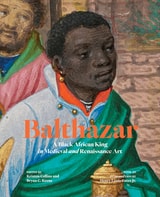
According to the Gospel of Matthew, magi from the East, following a star, traveled to Jerusalem bearing precious gifts for the infant Jesus. The magi were revered as wise men and later as kings. Over time, one of the three came to be known as Balthazar and to be depicted as a Black man.
Balthazar was familiar to medieval Europeans, appearing in paintings, manuscript illuminations, mosaics, carved ivories, and jewelry. But the origin story of this fascinating character uncovers intricate ties between Europe and Africa, including trade and diplomacy as well as colonization and enslavement.
In this book, experts in the fields of Ethiopian, West African, Nubian, and Western European art explore the representation of Balthazar as a Black African king. They examine exceptional art that portrays the European fantasy of the Black magus while offering clues about the very real Africans who may have inspired these images. Along the way, the authors chronicle the Black presence in premodern Europe, where free and enslaved Black people moved through public spaces and courtly circles. The volume’s lavish illustrations include selected works by contemporary artists who creatively challenge traditional depictions of Black history.
Be Not Conformed
Rene Girard at the Nexus of Athens, Jerusalem, and Silicon ValleyLuke Burgis
Catholic University of America Press, 2026

Beautiful Work
A Meditation on PainSharon Cameron
Duke University Press, 2000
In order to understand the nature of pain, Anna undertakes a meditation practice. We tend to think of pain as self-absorbing and exclusively our own ("my pain," "I am in pain"). In distinction, Sharon Cameron’s Anna comes to explore pain as common property, and as the basis for a radically reconceived selfhood. Resisting the limitations of memoir, Beautiful Work speaks from experience and simultaneously releases it from the closed shell of personal ownership. Outside of the not quite inevitable stories we tell about it, experience is less protected, less compromised, and more vivid than could be supposed.
Beautiful Work brings to bear the same interest in consciousness and intersubjectivity that characterizes Cameron’s other work.
Before Virtue
Jonathan J. Sanford
Catholic University of America Press, 2015
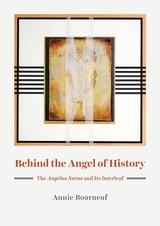
Behind the Angel of History
The "Angelus Novus" and Its InterleafAnnie Bourneuf
University of Chicago Press, 2022
This book begins with artist R. H. Quaytman uncovering something startling about a picture by Paul Klee. Pasted beneath Klee’s 1920 Angelus Novus—famous for its role in the writings of its first owner, Walter Benjamin—Quaytman found that Klee had interleaved a nineteenth-century engraving of Martin Luther, leaving just enough visible to provoke questions.
Behind the Angel of History reveals why this hidden face matters, delving into the intertwined artistic, political, and theological issues consuming Germany in the wake of the Great War. With the Angelus Novus, Klee responded to a growing call for a new religious art. For Benjamin, Klee’s Angelus became bound up with the prospect of meaningful dialogue among religions in Germany.
Reflecting on Klee’s, Benjamin’s, and Quaytman’s strategies of superimposing conflicting images, Annie Bourneuf reveals new dimensions of complexity in this iconic work and the writing it inspired.
Being Human
Philosophical Anthropology through PhenomenologyRobert E. Wood
Catholic University of America Press, 2022

Being is Better Than Not Being
The Metaphysics of Goodness and Beauty in AristotleChristopher V. Mirus
Catholic University of America Press, 2022
Beneath the Veil of the Strange Verses
Reading Scandalous TextsJeremiah L. Alberg
Michigan State University Press, 2013
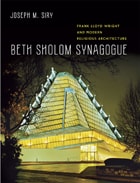
Beth Sholom Synagogue
Frank Lloyd Wright and Modern Religious ArchitectureJoseph M. Siry
University of Chicago Press, 2011
In a suburb just north of Philadelphia stands Beth Sholom Synagogue, Frank Lloyd Wright’s only synagogue and among his finest religious buildings. Designated a National Historic Landmark in 2007, Beth Sholom was one of Wright’s last completed projects, and for years it has been considered one of his greatest masterpieces.
Betrayal of the Spirit
My Life behind the Headlines of the Hare Krishna MovementNori J. Muster
University of Illinois Press, 1996
Combining behind-the-scenes coverage of an often besieged religious group with a personal account of one woman's struggle to find meaning in it, Betrayal of the Spirit takes readers to the center of life in the Hare Krishna movement.
Nori J. Muster joined the International Society of Krishna Consciousness (ISKCON)--the Hare Krishnas--in 1978, shortly after the death of the movement's spiritual master, and worked for ten years as a public relations secretary and editor of the organization's newspaper, the ISKCON World Review. In this candid and critical account, Muster follows the inner workings of the movement and the Hare Krishnas' progressive decline.
Combining personal reminiscences, published articles, and internal documents, Betrayal of the Spirit details the scandals that beset the Krishnas--drug dealing, weapons stockpiling, deceptive fundraising, child abuse, and murder within ISKCON–as well as the dynamics of schisms that forced some 95 percent of the group's original members to leave. In the midst of this institutional disarray, Muster continued her personal search for truth and religious meaning as an ISKCON member until, disillusioned at last with the movement's internal divisions, she quit her job and left the organization.
In a new preface to the paperback edition, Muster discusses the personal circumstances that led her to ISKCON and kept her there as the movement's image worsened. She also talks about "the darkest secret"–child abuse in the ISKCON parochial schools--that was covered up by the public relations office where she worked.
Betting on Freedom
My Life in the ChurchCarinal Angelo Scola
Catholic University of America Press, 2021
Beyond the Monastery Walls
The Ascetic Revolution in Russian Orthodox Thought, 1814–1914Patrick Lally Michelson
University of Wisconsin Press, 2017
Patrick Lally Michelson's intellectual history of asceticism in Russian Orthodox thought traces the development of these competing arguments from the early nineteenth century to the early months of World War I. He demonstrates that this discourse was an imaginative interpretation of lived Orthodoxy, primarily meant to satisfy the ideological needs of Russian thinkers and Orthodox intellectuals as they responded to the socioeconomic, political, and cultural challenges of modernity.
Birmingham's Rabbi
Morris Newfield and Alabama, 1895-1940Mark Cowett
University of Alabama Press, 1986
Taking a multidimensional approach, Cowett places Newfield's early life in the context of his Hungarian childhood and also relates Newfield’s career to those of fellow Hebrew Union College graduates and to national Reform Jewish history. The reader is made aware constantly of changing conditions in Birmingham, in Alabama, and in the south and how those changes affected Newfield’s congregants. Cowett illuminates Newfield’s efforts to help Jews maintain a sense of religious identity in a predominately Southern and Christian environment.
Based upon essential sources including interviews, newspapers, and manuscript collections in Alabama and at the American Jewish Archives in Cincinnati, Cowett shows Newfield’s struggle to support social welfare efforts in Alabama during the Progressive Era. He recognized the need for Jews to develop bonds with other American ethnic groups. Cowett portrays him as a mediator between not only Jew and Christian but also black and white, labor and capital, liberal and conservative—in short, within the full spectrum of political and social exchange in an industrial city of the New South.
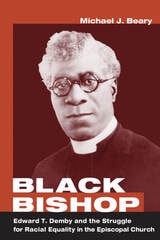
Black Bishop
Edward T. Demby and the Struggle for Racial Equality in the Episcopal ChurchMichael J. Beary
University of Illinois Press, 2001
America’s first Black bishop and his struggle to rebuild the African American presence inside the Episcopal Church
In 1918, the Right Reverend Edward T. Demby took up the reins as Suffragan (assistant) Bishop for Colored Work in Arkansas and the Province of the Southwest, an area encompassing Arkansas, Texas, Kansas, Oklahoma, Missouri, and New Mexico. Set within the context of a series of experiments in black leadership conducted by the Episcopal Diocese of Arkansas in the early decades of the twentieth century, Demby's tenure in a segregated ministry illuminates the larger American experience of segregation disguised as a social good.
Intent on demonstrating the industry and self-reliance of black Episcopalians to the church at large, Demby set about securing black priests for the diocese, baptizing and confirming communicants, and building schools and other institutions of community service. A gifted leader and a committed Episcopalian, Demby recognized that black service institutions, such as schools, hospitals, and orphanages, would be the means to draw African Americans back to the Episcopal Church, which they had abandoned in droves after emancipation as the church of their former masters.
For more than twenty years, hamstrung by white apathy, lack of funds, jurisdictional ambiguity, and the Great Depression, Demby doggedly tried to establish the credibility of a ministry that was as ill-conceived as it was well intended. Michael J. Beary skillfully narrates the shifting alliances within the Episcopal Church and shows how race was but one aspect of a more elemental struggle for power. He demonstrates how Demby's steadiness of purpose and non-confrontational manner gathered allies on both sides of the color line and how, ultimately, his judgment and the weight of his experience carried the church past its segregationist experiment.

Bloom
A Transgender MemoirShane A. McCammon
University of Utah Press, 2027
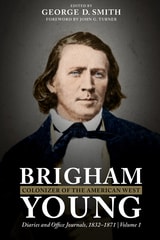
Brigham Young, Colonizer of the American West
Diaries and Office Journals, 1832–1871George D. Smith
Signature Books, 2019
Thus, by 1877, some 400 Mormon settlements spanned the western frontier from Salt Lake City to outposts in Idaho, Nevada, Arizona, Wyoming, and California. As prophet of the LDS Church and governor of the proposed State of Deseret, Young led several campaigns for Utah statehood while defending polygamy and local sovereignty. His skillful and authoritarian leadership led historian Bernard de Voto to classify him as an “American genius,” responsible for turning Joseph Smith’s visions “into the seed of life.”
Young’s diaries and journals reveal a man dedicated to his church, defensive of his spiritual and temporal claims to authority, and determined to create a modern Zion within the Utah desert. Editor George D. Smith’s careful organization and annotation of Young’s personal writings provide insights into the mind of Mormonism’s dynamic church leader and frontier statesman.
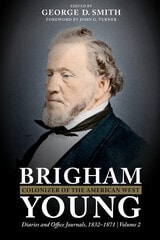
Brigham Young, Colonizer of the American West
Diaries and Office Journals, 1832–1871: Volume 2George D. Smith
Signature Books, 2021
Thus, by 1877, some 400 Mormon settlements spanned the western frontier from Salt Lake City to outposts in Idaho, Nevada, Arizona, Wyoming, and California. As prophet of the LDS Church and governor of the proposed State of Deseret, Young led several campaigns for Utah statehood while defending polygamy and local sovereignty. His skillful and authoritarian leadership led historian Bernard de Voto to classify him as an “American genius,” responsible for turning Joseph Smith’s visions “into the seed of life.”
Young’s diaries and journals reveal a man dedicated to his church, defensive of his spiritual and temporal claims to authority, and determined to create a modern Zion within the Utah desert. Editor George D. Smith’s careful organization and annotation of Young’s personal writings provide insights into the mind of Mormonism’s dynamic church leader and frontier statesman.

Brooklyn Odyssey
My Journey out of HasidismZalman Newfield
Temple University Press, 2026
Growing up in Crown Heights, Brooklyn as a member of the Chabad-Lubavitch Hasidic Orthodox Jewish community, Zalman Newfield was raised in an atmosphere of strict gender segregation, rigorous religious education, and nearly all-consuming ritual practices. Trained to be a Lubavitch emissary, he traveled around the world doing Jewish outreach to help usher in the messianic redemption. However, after exposure to the wider world, he abandoned the faith of his youth.
Brooklyn Odyssey is Newfield’s poignant and hopeful memoir about exiting Orthodoxy. He recounts asserting his individuality and taking the radical step of shaving his beard. Reflective about his upbringing, Newfield is open to and curious about a world beyond Brooklyn while also maintaining his profound bond with his family and Jewish tradition. He writes candidly about his emotional, intellectual, and social experiences in and out of the Lubavitch community.
From pivotal moments of devastation, including the illness and death of his younger brother and of his revered spiritual leader Rabbi Menachem Mendel Schneerson, to moments of joyful resolve, including the decision to pursue a doctorate and marry a non-Orthodox Jew, Newfield takes readers on his moving and impactful journey.
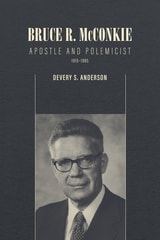
Bruce R. McConkie
Apostle and Polemicist, 1915–1985Anderson, Devery S.
Signature Books, 2024
Although he served as an apostle in the Church of Jesus Christ of Latter-day Saints for only twelve and a half years, Bruce R. McConkie’s twenty-six years’ service in the First Council of Seventy had already made him a household name within the church. Called to full-time church service at age thirty-one, McConkie quickly gained a reputation as a theologian and doctrinal teacher. He became a prolific writer, and his controversial book, Mormon Doctrine, remained a bestseller for decades. His writing style, dogmatic approach, and quickness to reprimand others he believed in error made him many enemies, while others endeared themselves to him because of those very traits.
McConkie the man was far more complex than the serious and focused general authority most church members saw and heard at the pulpit. Those who knew him best experienced his profound sense of humor. His passion for jogging, rock hounding, and jewelry making occupied much of his free time. Those who witnessed his final address delivered days before his death felt compassion toward him, no matter how they had always viewed him as a writer, speaker, or leader. Truly, to understand Bruce R. McConkie one must look closely at the entire picture.
Building a Global Zion
The Life and Vision of David O. McKayBrian Q. Cannon
Signature Books, 2025
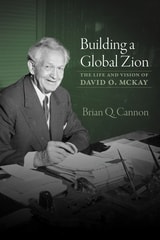
Called as an apostle in 1906, David O. McKay devoted the remaining sixty-four years of his life to serving in the Church of Jesus Christ of Latter-day Saints, including nineteen as church president. That lengthy tenure, combined with his warmth, extensive personal ministry, broadmindedness, deep spirituality, and unprecedented global travel made him one of the church’s most beloved and influential leaders of all time. When he died in 1970, roughly 60 percent of the church’s membership had known no other church president. Memories of McKay’s teachings and ministry remain a taproot for the spiritual convictions and values of many Latter-day Saints.
Brian Q. Cannon’s biography offers a fresh perspective on important features of McKay’s life, showing how his mission to Scotland, round-the-world tour as an apostle, and service as president of the European Mission shaped his global vision and priorities. Building a Global Zion illuminates previously underappreciated facets of McKay’s reach, including his crusades against alcohol consumption and political corruption, his long-term administration of missionary work, his spiritual impressions, his personnel decisions, and his mediation of interpersonal impasses in administrative settings. Cannon carefully reconstructs facets of McKay’s vast ministry to individuals, highlights distinctive themes of his teachings, and explores challenges that confronted McKay’s associates as his health and acuity waned.